There are 1483 results
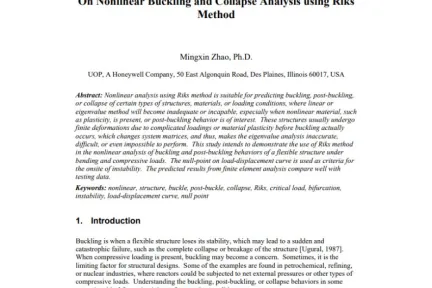
On Nonlinear Buckling and Collapse Analysis using Riks Method

Nonlinear analysis using Riks method is suitable for predicting buckling, post-buckling, or collapse of certain types of structures, materials, or loading conditions, where linear or eigenvalue method will become inadequate or incapable, especially when nonlinear material, such as plasticity, is present, or post-buckling behavior is of interest. These structures usually undergo finite deformations due to complicated loadings or material plasticity before buckling actually occurs, which changes system matrices, and thus, makes the eigenvalue analysis inaccurate, difficult, or even impossible to perform. This study intends to demonstrate the use of Riks method in the nonlinear analysis of buckling and post-buckling behaviors of a flexible structure under bending and compressive loads.

Customer Papers
On Nonlinear Buckling and Collapse Analysis using Riks Method
Fatigue equivalent loads for visualization of multimodal dynamic simulations

Transient dynamic simulations gain importance in the automotive industry and modern fatigue postprocessors are apt to evaluate the fatigue damage. However, additional insight into a structure’s behaviour may be obtained from observing the displacements. Displacement patterns are important for design engineers in order to improve the structure. With proportional static loads it is trivial to display and understand the displacements, but the displacements in dynamic simulations are often very complicated. This paper describes a novel method for visualising the transient displacements of mode-based analyses. Based on the modal displacements a new simple, yet fatigue equivalent, modal displacement is computed and visualized instead.

Customer Papers

Fatigue equivalent loads for visualization of multimodal dynamic simulations
Development of Advanced HIII Abaqus dummies

Hybrid III dummies are among the most frequently used dummies in both industry and academia for vehicle crash safety. Abaqus is one of most widely applied finite element codes in the world. To meet the needs of crash safety analysis and to exploit the potential of the Abaqus/Explicit code, a family of HIII dummies, including HII 50th male, 5th female and 95th male dummies, were developed at FTSS in collaboration with Simulia and BMW. This paper describes in detail the development of the HIII dummies with specific reference to the HIII 50th dummy.

Customer Papers

Development of Advanced HIII Abaqus dummies
Modelling and Analysis of Welding Processes in Abaqus using the Virtual Fabrication Technology Analysis Software developed by Battelle and Caterpillar Inc

The ability to accurately model welding processes in order to predict residual stresses and distortions is becoming increasingly important in the engineering industry. Abaqus can be used to model the welding process but this has been found to be considerably time consuming and requires a large number of assumptions to be made. Virtual Fabrication Technology is an analysis software suite that is designed to allow Abaqus to accurately model complex welding procedures. It was developed by the Battelle Memorial Institute in conjunction with Caterpillar Incorporated in the USA. The software is centred on a Graphical User Interface that is used to assign welding paths, parameters and material properties to FE models that have been imported from Abaqus/CAE.

Customer Papers

Modelling and Analysis of Welding Processes in Abaqus using the Virtual Fabrication Technology Analysis Software developed by Battelle and Caterpillar Inc
Representation of Coriolis forces and simulation procedures for moving fluid-conveying pipes

For inclusion of inertia effects of moving fluid columns or strings into structural mechanics simulations, a combined finite-element modelling scheme is proposed in ABAQUS. The concept has been realized in the form of user subroutines (UEL) of beam type. These can be coupled to existing standard (e.g., Euler-Bernoulli or Timoshenko) elements . The proposed Coriolis elements can be applied for, e.g., prediction of loads from high-speed flows and phase shifts of oscillating fluid-conveying pipe systems with arbitrary complex designs. The modelling scheme also allows a flexible coupling to shell or solid finite-element models.

Customer Papers

Representation of Coriolis forces and simulation procedures for moving fluid-conveying pipes
Efficient Shape Optimisation of an Aircraft Landing Gear Door Locking Mechanism by Coupling Abaqus to GENESIS

The objective of this work was to minimize the mass of a mechanism for locking aircraft landing gear doors whilst ensuring stresses did not exceed the material allowable stress. A typical metallic locking mechanism comprises a frame attached to the aircraft structure and supporting a number of linkages through pivot pins. These linkages transfer translational motion of a hydraulic actuator into rotation of a hook, which engages with the door. The structure was modelled with Abaqus/Standard as a non-linear static analysis involving contact, but with no material or geometric non-linearity.

Customer Papers

Efficient Shape Optimisation of an Aircraft Landing Gear Door Locking Mechanism by Coupling Abaqus to GENESIS
Skid against Curb simulation using AbaqusExplicit

Skid a full vehicle against a curb in lateral and longitudinal direction are two out of several tests to proof the strength of a suspension. Knowing the internal forces acting on suspension components during such an event is extremely important for being able to dimension safety critical parts correctly. Measuring these loads is an elaborate task, because the use of wheel force transducers is not possible due the risk of damaging them. It is necessary to apply strain gauges and force cells instead. Furthermore an attempt will be made to transfer the full vehicle impact tests / simulations to suspension level testing. Both a suspension impact rig as well as a simple static suspension strength rig will be set up in the real and the virtual world.

Customer Papers

Skid against Curb simulation using AbaqusExplicit
Using Abaqus User Subroutines to Develop a New Finite Element Modeling Tool for Heat Treatment Simulation

Heat treatment processes, particularly quenching, are essential to improve mechanical properties in the production of steel castings, but they also generate residual strains and stresses and volumetric expansion due to phase transformations and microstructure changes that occur during heat treatment of a steel body. These coupled thermo-mechanical-microestructural problem involves some complex metallurgical relationships that are described by different mathematical models. The purpose of the present work is to develop a computational tool, using Abaqus and FORTRAN subroutines, for analyzing the complete problem of heat treatment distortion and thermal stresses that includes prediction of the phase transformations, microstructure and material properties.

Customer Papers

Using Abaqus User Subroutines to Develop a New Finite Element Modeling Tool for Heat Treatment Simulation
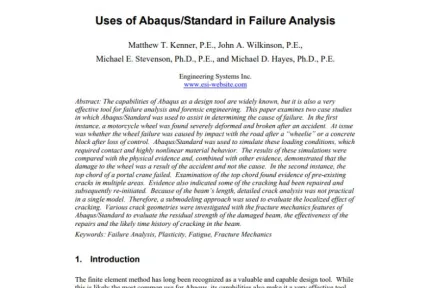
Uses of AbaqusStandard in Failure Analysis

The capabilities of Abaqus as a design tool are widely known, but it is also a very effective tool for failure analysis and forensic engineering. This paper examines two case studies in which Abaqus/Standard was used to assist in determining the cause of failure. In the first instance, a motorcycle wheel was found severely deformed and broken after an accident. At issue was whether the wheel failure was caused by impact with the road after a “wheelie” or a concrete block after loss of control. Abaqus/Standard was used to simulate these loading conditions, which required contact and highly nonlinear material behavior.

Customer Papers

Uses of AbaqusStandard in Failure Analysis
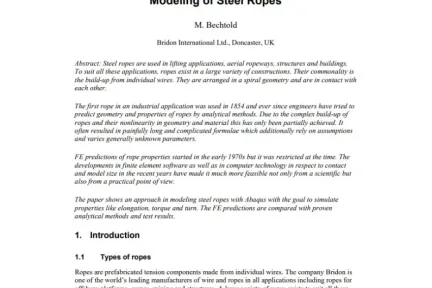
Modeling of Steel Ropes

Steel ropes are used in lifting applications, aerial ropeways, structures and buildings. To suit all these applications, ropes exist in a large variety of constructions. Their commonality is the build-up from individual wires. They are arranged in a spiral geometry and are in contact with each other.The paper shows an approach in modeling steel ropes with Abaqus with the goal to simulate properties like elongation, torque and turn. The FE predictions are compared with proven analytical methods and test results.

Customer Papers

Modeling of Steel Ropes
ELECTROSTATIC DISCHARGE CONTACT

Electrostatic Discharge (ESD) is a phenomenon where static electricity discharge happens between two electrically charged objects when they are in close proximity, such as the human finger approaching an electronic device. The high current pulse generated by the discharge process can flow into the electronic device, causing damage to internal PCBs and IC devices. With the trend in the electronics industry to increase operating speeds and decrease operating voltages of electronic components, devices are even more susceptible to ESD and designing-in protection to avoid damage, upset or failure is essential.

White Papers

ELECTROSTATIC DISCHARGE CONTACT
There are 245 results

Customer stories

There are 130 results

From the communities

There are 6 results

SIMULIA Self Learning

We provide hundreds of self-learning modules so you can continue to learn at your convenience

Blogs

Read the SIMULIA blog on the latest news and innovations from our experts.

There are 694 results

Learn What SIMULIA Can Do for You

Speak with a SIMULIA expert to learn how our solutions enable seamless collaboration and sustainable innovation at organizations of every size.

Get Started

Courses and classes are available for students, academia, professionals and companies. Find the right SIMULIA training for you. 

Get Help

Find information on software & hardware certification, software downloads, user documentation, support contact and services offering