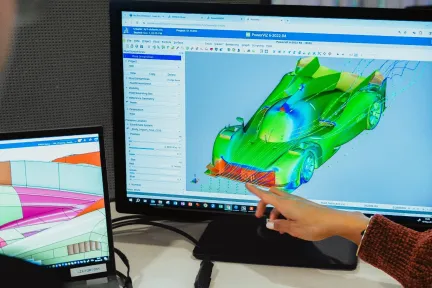
The current paper describes a computational work ow for the prediction of the acoustic impact of vertical take-o and landing vehicles hovering over an crowded, urban area. The aeroacoustic sources are predicted by using the high-fidelity CFD solver SIMULIA PowerFLOW 6-2019 based on a Lattice-Boltzmann/Very-Large-Eddy-Simulation method. The acoustic propagation in quiescent air is extracted directly from the CFD simulation performed in a domain encompassing both the vehicle and the nearby urban city block. The effects of sound scattering due to the presence of several buildings is analyzed by comparing the noise levels on the surface of the buildings with levels extracted on the same surface from another solution performed without buildings. The potentiality of this technology in the optimization of a ight corridor is highlighted.
Tech Notes