There are 1489 results
RESERVOIR GEOMECHANICS

Energy consumption in the world is increasing. The growth in consumption is expected to be strongly driven by China, India and other non-OECD countries. Most of this consumption will be related to oil and gas, mainly for transportation and electricity. Oil and gas also are primary raw materials for a wide range of products including plastics and chemicals, and their usage is also increasing fast. This increase in the demand for oil and gas needs to be satisfied reliably and sustainably. How can we ensure that this happens?

White Papers
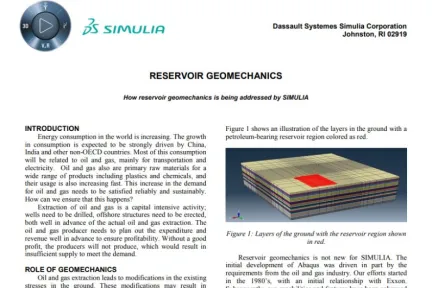
RESERVOIR GEOMECHANICS
Mechanics of hydraulic fracturing in ultra-low permeability formations: role of cavitation and sorption

Hydraulic fracturing (HF) comprises nucleation and growth of fractures in rock formations via flow-induced pressurization. HF is routinely used as a means of stimulating low permeability rock formations to enhance the recovery of oil and gas. The physical processes in the fracture process zone (FPZ) during HF are usually very complex because of the coupling between fracturing-fluid flow, rock deformation and diffusion of host fluid. Identifying all the critical pieces of physics is the key to developing a reliable full-physics modeling and simulation capability. Such a capability will not only enhance our understanding of HF but will also aid greatly towards the development of an effective stimulation strategy.

Customer Papers

Mechanics of hydraulic fracturing in ultra-low permeability formations: role of cavitation and sorption
Coupling Reservoir Simulation and Geomechanical Modeling to Improve the Analysis of Hydrocarbon Reservoir Behavior

In oil and gas field development, reservoir simulation is applied to accurately predict and analyze fluid flow during production. The results of reservoir simulation can be used as input for 4D geomechanical modelling to obtain the earth’s mechanical response such as reservoir compaction. However, in such a one-way coupling scheme, the geomechanical response of a system has no influence on the reservoir simulation, whereas in reality mechanical and flow behaviors influence each other.

Customer Papers

Coupling Reservoir Simulation and Geomechanical Modeling to Improve the Analysis of Hydrocarbon Reservoir Behavior
Integration for installation Upper Body of the European Semi-bonnet Truck

The semi-bonnet Truck consists of Chassis Cab composed of Cabin (CAB) and chassis frame and Upper Body (UB) such as Deck etc. The motor company has to offer manual about connection part of Chassis cab and Upper body to body builder company for manufacturing specially equipped vehicle of European Semi-bonnet truck. This is called BBM (Body Builder Manual). In this study, the simulations are carried out under several loading conditions (Normal loads, Abuse loads, Special loads) in various specially equipped vehicles (Tail-Lift Box, Sidewards of Tipper, Backwards of Tipper vehicle etc.) for ensuring robustness of connection part of Chassis cab and UB. It was able to secure stiffness and strength of connection part of Chassis cab and UB through this process, and optimize the position and number of the chassis bracket.

Customer Papers

Integration for installation Upper Body of the European Semi-bonnet Truck
Recent Advances in Composites Forming Simulation with User-Defined Material Models in Abaqus

Thermoforming and automated fabric placement processes show promise for reducing the time and cost for the manufacture of textile-reinforced composites. Simulating these processes can give insight into the manufacturability of the composite structure for each option and guide the design of the manufacturing process. Commonly used fishnet algorithms offer a computationally efficient method for modeling the draping of a fabric on a surface but do not consider the mechanical behavior of the material. A finite element solution for draping has the advantage of including the mechanical behavior of the textile, thereby allowing for investigating the relationship among changes in processing conditions and the resulting quality of the part. In the current research, a finite element based methodology for simulating the behavior of textile reinforced composites during the manufacturing process is presented.

Customer Papers

Recent Advances in Composites Forming Simulation with User-Defined Material Models in Abaqus
Optimization of Heavy-Duty Cylinder Head Gasket Manufacturing Press Using Isight

In this paper, Isight and Abaqus are used to simulate and improve the multiple-stage manufacturing process of heavy-duty cylinder head gaskets. An iterative procedure using Abaqus with custom scripting is first used to identify the required power input to achieve steady-state press operation. An Isight process flow is then developed to simulate the manufacturing process of coils of material being fed into continuous process equipment and automatically bonded in a heated platen press simulated by Abaqus. Isight parameter studies are then applied to examine the heater power required to maintain a consistent temperature on the platens to minimize both heat loss and press stabilization time. The combination of Abaqus and Isight is used to improve both the heavy-duty gasket manufacturing process performance and the resulting product quality.

Customer Papers

Optimization of Heavy-Duty Cylinder Head Gasket Manufacturing Press Using Isight
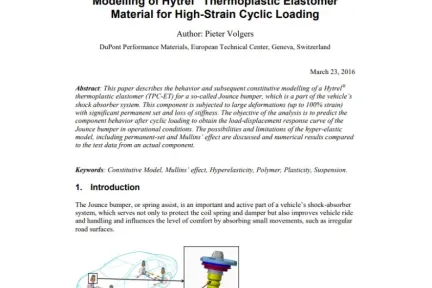
Modelling of Hytrel Thermoplastic Elastomer Material for High-Strain Cyclic Loading

This paper describes the behavior and subsequent constitutive modelling of a Hytrel thermoplastic elastomer (TPC-ET) for a so-called Jounce bumper, which is a part of the vehicle’s shock absorber system. This component is subjected to large deformations (up to 100% strain) with significant permanent set and loss of stiffness. The objective of the analysis is to predict the component behavior after cyclic loading to obtain the load-displacement response curve of the Jounce bumper in operational conditions. The possibilities and limitations of the hyper-elastic model, including permanent-set and Mullins’ effect are discussed and numerical results compared to the test data from an actual component.

Customer Papers

Modelling of Hytrel Thermoplastic Elastomer Material for High-Strain Cyclic Loading
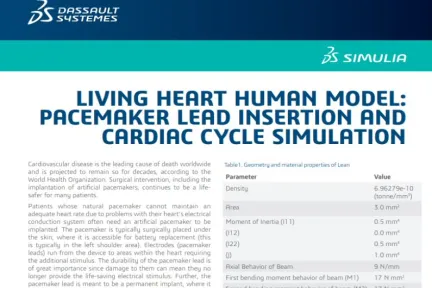
LIVING HEART HUMAN MODEL: PACEMAKER LEAD INSERTION AND CARDIAC CYCLE SIMULATION

The SIMULIA Living Heart Human Model provides a unique testing environment where a pacemaker lead can be virtually inserted and mechanically deformed during the cardiac cycle. Once the mechanical deformation results are obtained, the long-term durability of the implant can be assessed. The virtual nature of the test provides a physiologically accurate methodology to test new and existing devices without exposing patients to un-necessary risk.

Tech Notes

LIVING HEART HUMAN MODEL: PACEMAKER LEAD INSERTION AND CARDIAC CYCLE SIMULATION
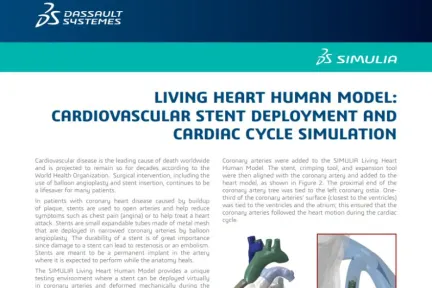
LIVING HEART HUMAN MODEL: CARDIOVASCULAR STENT DEPLOYMENT AND CARDIAC CYCLE SIMULATION

The SIMULIA Living Heart Human Model provides a unique testing environment where a stent can be deployed virtually in coronary arteries and deformed mechanically during the cardiac cycle. Once the mechanical deformation results are obtained, the long-term durability of the stent can be assessed. The virtual nature of the test provides a physiologically accurate methodology to test new and existing devices without exposing patients to unnecessary risk.

Tech Notes

LIVING HEART HUMAN MODEL: CARDIOVASCULAR STENT DEPLOYMENT AND CARDIAC CYCLE SIMULATION
Modeling Natural Fracture Activation Using a Poro-elastic Fracture Intersection Model

Using this model, natural fracture opening and shear slippage are investigated depending on horizontal stress contrast, adjoining fissure conductivity, and hydraulic-natural fracture intersection angle. Modeling results demonstrate the complexities of hydraulic fracture growth through the intersection with natural fracture such as selective branching and throttling at the intersection. Our fracturing simulation results agree with the analytical criteria for fracture crossing or arrest at the intersection.

Customer Papers

Modeling Natural Fracture Activation Using a Poro-elastic Fracture Intersection Model
FEA Prediction of Off-Road Tire Temperature Distribution

Excessive heat generation and retention in ultra-large dump truck tires is among the most common causes of tire failures in the surface mining industry. Accurate prediction of an operating tire temperature profile involves the use of advanced numerical models and solution schemes to mimic the complete elastomeric materials response to operating conditions. The internally generated heat in a tire is a function of its viscoelastic energy dissipation during rolling. Previous research studies have inaccurately predicted off-the-road (OTR) tire heat generation rates and temperatures by the use of linear viscoelasticity to approximate the rather nonlinear viscoelastic rubber material. This paper presents an accurate approach to predicting OTR tire temperature distributions taking into account the true mechanical response of the filled rubber compounds used in tires.

Customer Papers

FEA Prediction of Off-Road Tire Temperature Distribution
There are 245 results

Customer stories

There are 129 results

From the communities

There are 6 results

SIMULIA Self Learning

We provide hundreds of self-learning modules so you can continue to learn at your convenience

Blogs

Read the SIMULIA blog on the latest news and innovations from our experts.

There are 694 results
SIMULIA

SIMULIA provides realistic multiphysics simulation, design exploration, and optimization capabilities for designers, engineers and researchers.

Article

SIMULIA

Learn What SIMULIA Can Do for You

Speak with a SIMULIA expert to learn how our solutions enable seamless collaboration and sustainable innovation at organizations of every size.

Get Started

Courses and classes are available for students, academia, professionals and companies. Find the right SIMULIA training for you. 

Get Help

Find information on software & hardware certification, software downloads, user documentation, support contact and services offering