There are 1489 results
Implementation of an elasto-viscoplastic constitutive law in Abaqus/Standard for an improved characterization of rock materials

Subsidence modeling is an important activity in the oil and gas industry, for the environmental and operational implications associated to this phenomenon. Abaqus/Standard has been used for many years in Eni as the main numerical simulator for studying the geomechanical behavior of reservoirs. The results of a large campaign of acquisition of subsidence monitoring data in conjunction with the advanced analysis of laboratory experiments have shown that, in some cases, an improved mechanical characterization can be tailored to better capture the complex behavior of the reservoir rock under the effect of underground fluid withdrawal.

Customer Papers
Implementation of an elasto-viscoplastic constitutive law in Abaqus/Standard for an improved characterization of rock materials
Progressive Damage and Failure analysis of Automotive Wheels Using an Explicit Finite Element Method

Material degradation and dynamic loadings are the main reasons for the damage in metals. Material degradation was caused by crack initiation and fatigue or dynamic loadings are the source for crack growth. The precise and realistic modeling of inelastic behavior of metals is crucial for solving several problems in engineering fields. To predict the initiation and growth of damage, there are several failure models & theories available presently. In this paper, progressive damage and failure material model using explicit finite element techniques are applied to predict the failure of aluminum alloy.

Customer Papers

Progressive Damage and Failure analysis of Automotive Wheels Using an Explicit Finite Element Method
Coupled Eulerian-Lagrangian contact modeling for airbag deployment simulation

The coupled Eulerian-Lagrangian (CEL) method in Abaqus/Explicit is essential in component design of head protection systems at BMW Group as it allows an accurate modeling of the gas behavior. However, due to the nature of the algorithm, the modeling of the contact between inflator gas and airbag membrane is a challenging task. Using conventional modeling techniques, two airbag membrane sections are not able to separate again, as soon as they come into contact, as the membrane elements are embedded into Eulerian cells entirely filled with inflator gas. The proposed modeling approach overcomes this severe contact issue and allows separation of the membranes after having been in contact. The method has successfully been applied for airbag deployment simulations within the development process at BMW Group.

Customer Papers

Coupled Eulerian-Lagrangian contact modeling for airbag deployment simulation
Prediction of Aluminum Wheel Distortion under Pothole Impact

In the vehicle design, the interaction between road and vehicle is the main criteria in order to meet the durability, NVH (Noise Vibration and Harshness) & handling performance. Potholes in the road can cause damage to the wheel, suspension and chassis components. Pothole size and vehicle speed were the main factors for the damage. The larger pothole can cause severe damage or alignment issues. Based on the severity of the impact, damage will happen to the wheel rim and there will be a reduction in the air pressure inside the tire. In long-term, it will damage the suspension or steering components and it can also lead to premature tire wear and poor handling of the vehicle.

Customer Papers

Prediction of Aluminum Wheel Distortion under Pothole Impact
Prediction of Nonlinear Viscoelastic Recovery of Thermoplastic Polymers using Abaqus Parallel Rheological Framework Model

Thermoplastic polymers show significant nonlinear viscoelastic behavior due to which, after removing the applied load, these materials have some viscoelastic recovery over time before permanent deformation or set occurs. In this work, Abaqus PRF model is used to predict this time dependent viscoelastic recovery. Unlike linear viscoelastic model in Abaqus, PRF model can predict the typical nonlinear viscoelastic behavior of thermoplastic materials. Two types of testing, stress relaxation and cyclic loading at three different strain levels, are used to calibrate the coefficients of PRF model. SIMULIA’s optimization tool Isight is used to optimize these coefficients. Using the optimized coefficients, the PRF model is able to predict the time dependent nonlinear viscoelastic recovery of thermoplastic polymers.

Customer Papers

Prediction of Nonlinear Viscoelastic Recovery of Thermoplastic Polymers using Abaqus Parallel Rheological Framework Model
Baseball Bat Swing Analysis Using Finite Element Methods

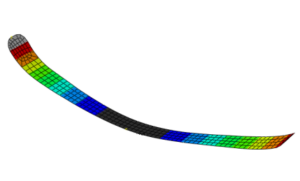
This paper builds on previous undergraduate research done on the analysis of a baseball bunt. In that situation the bat was held stationary, while the ball was launched at a given velocity. In this research, the bat is allowed to swing with the swinging motion controlled by the user. The end result is a determination of the optimal position to hit a ball during a bat swing on an approaching ball as well as the optimal swing pattern. The ball’s exit velocity and direction is obtained after the impact with the bat. The results will not only show the direction the ball will travel, but how far it will travel as well.

Customer Papers
Baseball Bat Swing Analysis Using Finite Element Methods
Evaluation of Effects of Trapped Fluid on Downhole Tool Deformation

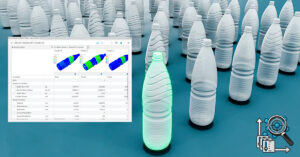
During finite element analysis (FEA) of downhole tools, the fluid load acting on the tool chassis and completion system, such as hydrostatic pressure, reservoir pressure, or applied wellbore pressure, is simply represented by uniform static pressure. This approximation of fluid load has been shown to be effective and accurate enough for many applications and is widely accepted. However, this fluid load representation can be problematic in terms of trapped fluid because the pressure from trapped fluid, which is typically confined between seals in a closed or confined volume, changes with deformation or deflection caused by applied pressure or by axial tensile or compressive loads on surrounding structures.

Customer Papers
Evaluation of Effects of Trapped Fluid on Downhole Tool Deformation
Using an Intermediate Validation Step to Increase CAE Confidence

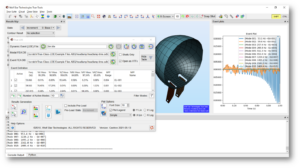
Simulations contain assumptions and uncertainties that a designer must evaluate to obtain a measure of accuracy. The assumptions of the product design can be differentiated from the ones for the solver and material model through the use of a mid-stage validation. An open loop validation uses a controlled test on a standardized part to compare results from a simulation to the physical experiment. From the validation, confidence in the material model and solver is gained. In this study, the material properties of a polypropylene are tested to characterize for an *ELASTIC *PLASTIC model in ABAQUS. A validation of a quasi-static three-point bending experiment of a parallel ribbed plate is then performed and simulated. A comparison of the strain fields resulting from the complex stress state on the face of the ribs obtained by digital image correlation (DIC) vs. simulation is used to quantify the simulation's fidelity.

Customer Papers
Using an Intermediate Validation Step to Increase CAE Confidence
Simulation of caulking process using Abaqus Explicit

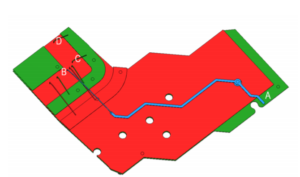
This paper showcases the capabilities of Abaqus explicit solver to simulate and solve problems involving huge plastic deformation due to caulking process. Caulking is a mechanical joining process achieved by plastically deforming a material in order to hold another material. This method is in research phase and being examined by engineers at Daimler and University of Erlangen-Nuremberg (Germany). This technique is mainly used in Permanent Magnet motors to hold the magnets in the rotor stacks. The objective of the simulation is to find optimum tool geometry, depth of tool penetration and location of penetration for caulking process. The process involves huge plastic deformation and is successfully simulated using Abaqus Explicit. This illustrates the effectiveness of numerical simulations, helping the designers in reducing the need for actual test bench with numerous high cost fabricated hardware setup and thereby saving huge R &D cost and time.

Customer Papers

Simulation of caulking process using Abaqus Explicit
A Simplified 3D Numerical Scheme for Accurate Calculation of Critical Value of Pressure Drawdown of Weak Sand Formation

The critical value of pressure drawdown (CVPDD) is a key parameter for controlling the production rate for most of the wells in weak sand formations and depends on the form of completion used, particularly in cases of high-pressure/high-temperature (HP/HT). This paper presents a simplified three-dimensional (3D) calculation of CVPDD on the basis of maximum plastic strain for a given well in offshore Gulf of Mexico. A fully-coupled, poro-elastoplastic model was adopted to simulate the porous flow that occurred simultaneously with matrix inelastic deformation. A submodeling technique was adopted to address the discrepancy between the scale of the oil field and that of the wellbore section.

Customer Papers

A Simplified 3D Numerical Scheme for Accurate Calculation of Critical Value of Pressure Drawdown of Weak Sand Formation
There are 245 results

Customer stories

There are 129 results

From the communities

There are 6 results

SIMULIA Self Learning

We provide hundreds of self-learning modules so you can continue to learn at your convenience

Blogs

Read the SIMULIA blog on the latest news and innovations from our experts.

There are 694 results

Learn What SIMULIA Can Do for You

Speak with a SIMULIA expert to learn how our solutions enable seamless collaboration and sustainable innovation at organizations of every size.

Get Started

Courses and classes are available for students, academia, professionals and companies. Find the right SIMULIA training for you. 

Get Help

Find information on software & hardware certification, software downloads, user documentation, support contact and services offering