There are 1489 results
Model Order Reduction Methods for Explicit FEM

Abaqus/Explicit is a well-established and widely used FEM solver for crash and pedestrian safety simulations. However, due to the large number of degrees of freedom, simulation time is still a limiting factor especially in context of structural optimization. In typical crash simulation, a large portion of the model undergoes only elastic deformation. Hence, model order reduction (MOR) methods can bring a significant decrease in the computational time. While Abaqus/Standard already offers several reduction methods, MOR is currently not applicable for Abaqus/Explicit. The purpose of this work is to enable MOR for explicit finite element models by use of superelements. Reduced mass and stiffness matrices are generated by Abaqus/Standard and transferred to the explicit solver through a VUEL subroutine.

Customer Papers
Model Order Reduction Methods for Explicit FEM
Thermal - Fluid Co-Simulation of DNA Sequencing Thermocycler

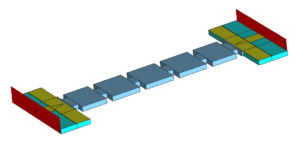
Sequencing and amplification of DNA involves a precisely controlled thermal incubation cycle. Upscaling of traditional thermocyclers can be problematic due to nonuniformities induced across large incubation plates. Multiple chip profiles are studied to compare edge effects and promote uniform thermal histories across the incubation plate. Thermal performance is evaluated via steady-state heating within Abaqus/Standard. Transient cooling is modeled via Abaqus co-simulation by coupling thermal and fluid models.

Customer Papers

Thermal - Fluid Co-Simulation of DNA Sequencing Thermocycler
Multi-Scale Modelling of Textile Reinforced Tissue Engineered Heart Valves

Transcatheter aortic valve implantation of fibrin-based tissue engineered heart valves with a tubular leaflet construct have been developed as an alternative to invasive traditional surgical heart valve implantation, but currently need reinforcement to withstand pressures found in the aortic position. To increase valve strength, a PET textile reinforcement has been introduced to the fibrin scaffold. However, care must be taken when using a textile reinforcement. Increasing reinforcement may increase the strength, but also increases stiffness which can interfere with the functionality of the valve, prohibiting full valve closure. In order to predict the behavior of the valve, improve design, and eventually optimize valve performance by tailoring the textile reinforcement, a 4-tiered hierarchical multi-scale modelling framework has been created.

Customer Papers

Multi-Scale Modelling of Textile Reinforced Tissue Engineered Heart Valves
Predicting and Designing Integrated Safety Syringe for Shelf Life Using Advanced Nonlinear Constitutive Models in ABAQUS

The Medical device industry is a highly regulated industry with patient safety being paramount. Ensuring the highest quality and patient safety demands that the device performs as desired from the time it is manufactured, through the shelf life of the product, and during use. Plastics used in medical devices can undergo degradation in mechanical properties over time during the product shelf life depending on the design of the device. It is therefore important to take this aspect of plastic behavior into account during material selection and device design. Plastics under constant load for long periods of time exhibit creep deformations. Testing devices for creep can be a lengthy process often leading to delay in design iterations to yield the optimum design and subsequently time to market.

Customer Papers

Predicting and Designing Integrated Safety Syringe for Shelf Life Using Advanced Nonlinear Constitutive Models in ABAQUS
Simulating blood flow in Living Heart Model

Being able to visualize blood flow in leaving heart helps to understand heart diseases and define strategy for surgical intervention. The ideal simulation should be performed on a specific patient heart model (individual geometry) to correctly asses the specific cardiac problem and predict possible treatment. In this paper two approaches is presented for simulating blood flow using numerical CFD approach: simulation based on the SIMULIA Living Heart FE Model and simulation based on dynamic 3D heart model obtained from a 3D MRI/MRT scanner. The CFD simulation is performed in both cases using FlowVision CFD code. Both approaches provide a better understanding of the blood flow during a cardiac cycle.

Customer Papers
Simulating blood flow in Living Heart Model
A FINITE ELEMENT MODEL OF THE INTERVERTEBRAL DISC

The aim of this study was to develop an FE model of the IVD that replicated the in vivo failure modes experienced clinically. The model created in this study utilized four distinct materials - the cartilaginous end plate (CEP), Nucleus Pulposus (NP), and two distinct layers of the Annulus Fibrosis (AF) - to represent the constituents of the IVD. The geometry of the model was based on average dimensions provided by computerized axial tomography. Material properties were assigned to each component based on published values from the literature. The model was validated by comparison to force/displacement data from mechanical testing.

Customer Papers

A FINITE ELEMENT MODEL OF THE INTERVERTEBRAL DISC
Stiffness Mapping in Biological Materials based on MRI Imaging and Topology Optimization

Magnetic resonance imaging (MRI) is a preeminent technology to visualize the internal tissue structure, in addition to other physical phenomena like flow and diffusion. One specialized MRI technique, termed displacements under applied loading by MRI (dualMRI), was developed to measure displacements and strain in musculoskeletal tissues, hydrogels, and engineered constructs. However, deformation information does not directly describe spatial distributions of tissue stiffness, which is critical to the understanding of disease progression. In this study, the inverse simulation was validated on displacements results derived from forward simulations where materials properties and boundary conditions were known.

Customer Papers
Stiffness Mapping in Biological Materials based on MRI Imaging and Topology Optimization
Topology Optimization of a Lacrosse Head

Like many industries the balance between cost, stiffness, strength and weight is critical in sports equipment. This study goes through the methodology to perform topology optimization with Catia (CAD), Abaqus (FEA), Tosca (Topology Optimization) and Simpoe (Injection Molding). Topology optimization evolves the geometry to remove unneeded material effectively minimizing weight and maximizing performance. This is carried out by automatically scaling individual element’s density and stiffness based on the stress state of the previous simulation. This is an iterative process where material flows to regions to satisfy constraints and minimize the objective function.

Customer Papers

Topology Optimization of a Lacrosse Head
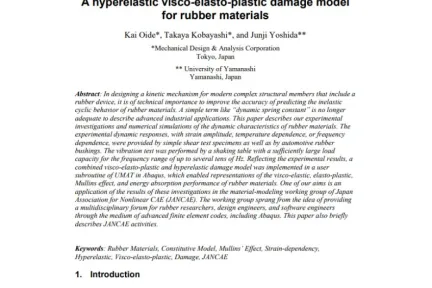
A hyperelastic visco-elasto-plastic damage model for rubber materials

In designing a kinetic mechanism for modern complex structural members that include a rubber device, it is of technical importance to improve the accuracy of predicting the inelastic cyclic behavior of rubber materials. A simple term like “dynamic spring constant” is no longer adequate to describe advanced industrial applications. This paper describes our experimental investigations and numerical simulations of the dynamic characteristics of rubber materials. The experimental dynamic responses, with strain amplitude, temperature dependence, or frequency dependence, were provided by simple shear test specimens as well as by automotive rubber bushings

Customer Papers

A hyperelastic visco-elasto-plastic damage model for rubber materials
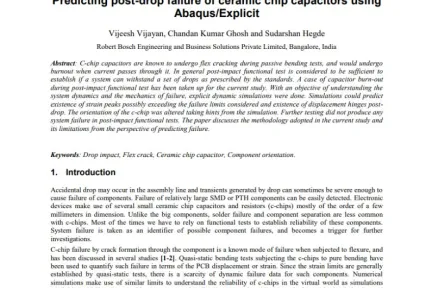
Predicting post-drop failure of ceramic chip capacitors using Abaqus/Explicit

C-chip capacitors are known to undergo flex cracking during passive bending tests, and would undergo burnout when current passes through it. In general post-impact functional test is considered to be sufficient to establish if a system can withstand a set of drops as prescribed by the standards. A case of capacitor burn-out during post-impact functional test has been taken up for the current study. With an objective of understanding the system dynamics and the mechanics of failure, explicit dynamic simulations were done. Simulations could predict existence of strain peaks possibly exceeding the failure limits considered and existence of displacement hinges postdrop. The orientation of the c-chip was altered taking hints from the simulation. Further testing did not produce any system failure in post-impact functional tests. The paper discusses the methodology adopted in the current study and its limitations from the perspective of predicting failure.

Customer Papers

Predicting post-drop failure of ceramic chip capacitors using Abaqus/Explicit
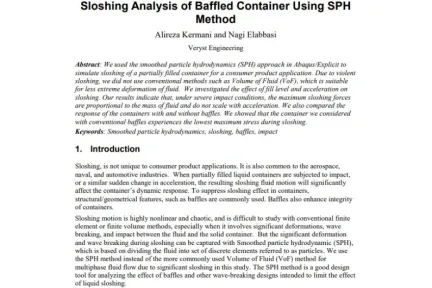
Sloshing Analysis of Baffled Container Using SPH Method

We used the smoothed particle hydrodynamics (SPH) approach in Abaqus/Explicit to simulate sloshing of a partially filled container for a consumer product application. Due to violent sloshing, we did not use conventional methods such as Volume of Fluid (VoF), which is suitable for less extreme deformation of fluid. We investigated the effect of fill level and acceleration on sloshing. Our results indicate that, under severe impact conditions, the maximum sloshing forces are proportional to the mass of fluid and do not scale with acceleration. We also compared the response of the containers with and without baffles. We showed that the container we considered with conventional baffles experiences the lowest maximum stress during sloshing.

Customer Papers

Sloshing Analysis of Baffled Container Using SPH Method
There are 245 results

Customer stories

There are 129 results

From the communities

There are 6 results

SIMULIA Self Learning

We provide hundreds of self-learning modules so you can continue to learn at your convenience

Blogs

Read the SIMULIA blog on the latest news and innovations from our experts.

There are 694 results
What’s New in Isight 2022

In today’s computer-aided product development and manufacturing environment, designers and engineers are...

Article

What’s New in Isight 2022

Learn What SIMULIA Can Do for You

Speak with a SIMULIA expert to learn how our solutions enable seamless collaboration and sustainable innovation at organizations of every size.

Get Started

Courses and classes are available for students, academia, professionals and companies. Find the right SIMULIA training for you. 

Get Help

Find information on software & hardware certification, software downloads, user documentation, support contact and services offering