There are 1489 results
Simulation of a Multi-pass Groove Weld and Clad Plate Using Abaqus 2D Weld GUI and Comparison with Measurements

The computer simulation of multiple layering of welds is necessary to determine the distortion and residual stresses from the welding process. The welding simulation requires thermal and structural solutions, which are usually carried out in two simulations. Once solved, the thermal transient model temperature results are read into the structural model to solve for component stresses.

Customer Papers
Simulation of a Multi-pass Groove Weld and Clad Plate Using Abaqus 2D Weld GUI and Comparison with Measurements
Automated framework to estimate probability of mechanical failure in handheld electronic devices

An automated framework for numerical simulation is developed to estimate the probability of brittle failure for a cell-phone display subjected to accelerated life cycle testing (ALT). SIMULIA Isight and the Abaqus-Python interface are used to predict the field-failure rate (FFR). The framework’s adaptable definition of inputs and output parameters can be extended to other common failures in handheld devices such as the denting and cracking of the housing walls, the cracking and delamination of the solder-joints in surface mounted devices, and the shock based criteria for packaged components.

Customer Papers

Automated framework to estimate probability of mechanical failure in handheld electronic devices
Analysis Tools for Accelerated Development of Composite Materials

Composite materials continue to rapidly improve in terms of structural performance. These materials offer the promise of significant weight reduction in many products—particularly aerospace structures, where weight minimization is critical to both cost and overall performance. Despite this potential, however, several challenges prevent composite materials from being used as widely and pervasively as traditional materials. Preliminary design concept evaluation of a structure with a novel material is difficult without a lengthy, expensive test program to provide the requisite material properties, but manufacturers are justifiably reluctant to invest this time and money without confidence that the material under consideration merits such expense.

Customer Papers

Analysis Tools for Accelerated Development of Composite Materials
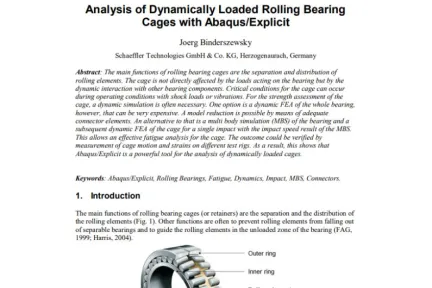
Analysis of Dynamically Loaded Rolling Bearing Cages with Abaqus/Explicit

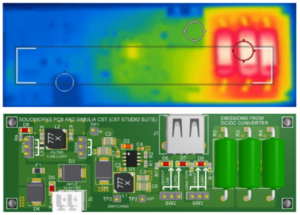
The main functions of rolling bearing cages are the separation and distribution of rolling elements. The cage is not directly affected by the loads acting on the bearing but by the dynamic interaction with other bearing components. Critical conditions for the cage can occur during operating conditions with shock loads or vibrations. For the strength assessment of the cage, a dynamic simulation is often necessary. One option is a dynamic FEA of the whole bearing, however, that can be very expensive. A model reduction is possible by means of adequate connector elements. An alternative to that is a multi body simulation (MBS) of the bearing and a subsequent dynamic FEA of the cage for a single impact with the impact speed result of the MBS. This allows an effective fatigue analysis for the cage. The outcome could be verified by measurement of cage motion and strains on different test rigs. As a result, this shows that Abaqus/Explicit is a powerful tool for the analysis of dynamically loaded cages.

Customer Papers
Analysis of Dynamically Loaded Rolling Bearing Cages with Abaqus/Explicit
Applicability of Modal Dynamic Method in Seismic and Aircraft Crash Analyses of NPP Structures.

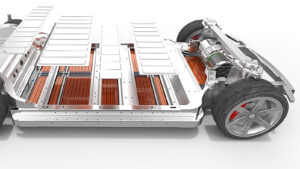
This work is considered to overview the applicability of modal dynamic method in seismic and aircraft crash analysis of NPP structures. Soil-structure interaction is taken into account; problem of 20%-limiting of modal composite damping is researched; results of different methods (Direct integration method, modal method, and upgraded modal method, when projected damping matrix is fully populated) are compared on test model and on real structure model. Simple test was solved theoretically and in ABAQUS, global damping matrices, acquired by modal and direct integration methods are compared. It is worth noting that both methods are approved for use in dynamic analysis of NPP structures by ASCE 4-98, but in most cases direct integration method gives more conservative results.

Customer Papers
Applicability of Modal Dynamic Method in Seismic and Aircraft Crash Analyses of NPP Structures.
Approximating MIG Welds with Abaqus Spot Weld Functionality

Representing MIG welds in FEA models is often a very laborious task in preparing the FEA Models. Traditional techniques range from TIEs to shells to solid elements. Using TIEs can be subject to mesh density and parameter choices for the TIE. Shell and solid representation can require significant geometric preprocessing. Presented here is a technique that uses Abaqus spot welds to approximate MIG welds. It will be shown that this representation of welds has high accuracy with minimal pre-processing required and insensitivity to mesh density. An Abaqus/CAE plug-in has been developed to automate this process. Examples comparing stiffness, stress and strain will be shown.

Customer Papers

Approximating MIG Welds with Abaqus Spot Weld Functionality
High-velocity impact damage modeling of laminated composites using Abaqus/Explicit and multiscale methods

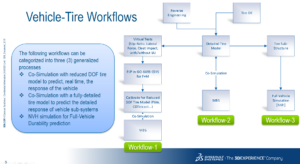
The present work describes a multiscale methodology which has been developed for modeling of impact damage in the laminated composite structures. The methodology employs the High Fidelity Generalized Method of Cells (HFGMC) micromechanical model for the prediction of the local stress and strain fields, within the representative unit cell of the unidirectional composite material. The Mixed Mode Continuum Damage Mechanics (MMCDM) theory has been utilized to model damage within the composite unit cell at the micromechanical level. The MMCDM theory enables modeling of the microdamage nonlinearities at in-plane shear and transverse compressive loadings of the composite plies. Employment of the multiscale approach enables the application of the MMCDM damage model in structural analyzes.

Customer Papers
High-velocity impact damage modeling of laminated composites using Abaqus/Explicit and multiscale methods
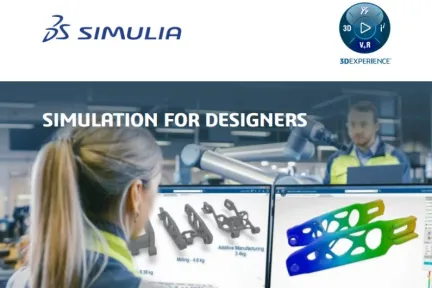
SIMULATION FOR DESIGNERS

Simulation for Designers provides connected, powerful and collaborative simulation solutions on 3DEXPERIENCE platform, available on-premise and on-cloud. Performing simulation during the design phase empowers you to accelerate innovation by solving engineering challenges for your CATIA designs with full data associativity.

Flyers

SIMULATION FOR DESIGNERS
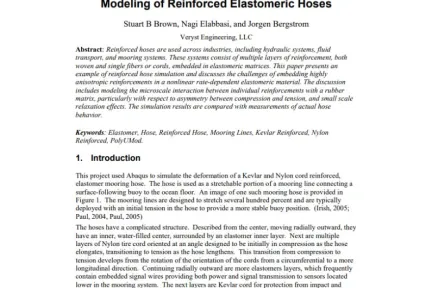
Modeling of Reinforced Elastomeric Hoses

Reinforced hoses are used across industries, including hydraulic systems, fluid transport, and mooring systems. These systems consist of multiple layers of reinforcement, both woven and single fibers or cords, embedded in elastomeric matrices. This paper presents an example of reinforced hose simulation and discusses the challenges of embedding highly anisotropic reinforcements in a nonlinear rate-dependent elastomeric material. The discussion includes modeling the microscale interaction between individual reinforcements with a rubber matrix, particularly with respect to asymmetry between compression and tension, and small scale relaxation effects. The simulation results are compared with measurements of actual hose behavior.

Customer Papers

Modeling of Reinforced Elastomeric Hoses
ELECTROSTATIC DISCHARGE AIR

Electrostatic Discharge (ESD) is a phenomenon where static electricity discharge happens between two electrically charged objects when they come into contact with each other, such as the human body and an electronic device. This high voltage ESD pulse generated from the human body can enter the electronic device if touched, causing damage to IC circuits inside it. With increasing operating speed and decreasing operating voltage of electronic components the problem of ESD is a severe source of interference which can produce damage, upset or failure in electronic systems.

White Papers

ELECTROSTATIC DISCHARGE AIR
There are 245 results

Customer stories

There are 129 results

From the communities

There are 6 results

SIMULIA Self Learning

We provide hundreds of self-learning modules so you can continue to learn at your convenience

Blogs

Read the SIMULIA blog on the latest news and innovations from our experts.

There are 694 results

Learn What SIMULIA Can Do for You

Speak with a SIMULIA expert to learn how our solutions enable seamless collaboration and sustainable innovation at organizations of every size.

Get Started

Courses and classes are available for students, academia, professionals and companies. Find the right SIMULIA training for you. 

Get Help

Find information on software & hardware certification, software downloads, user documentation, support contact and services offering