There are 1489 results
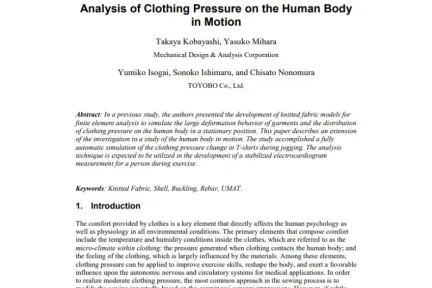
Analysis of Clothing Pressure on the Human Body in Motion

In a previous study, the authors presented the development of knitted fabric models for finite element analysis to simulate the large deformation behavior of garments and the distribution of clothing pressure on the human body in a stationary position. This paper describes an extension of the investigation to a study of the human body in motion. The study accomplished a fully automatic simulation of the clothing pressure change in T-shirts during jogging. The analysis technique is expected to be utilized in the development of a stabilized electrocardiogram measurement for a person during exercise.

Customer Papers
Analysis of Clothing Pressure on the Human Body in Motion
Automated Translation of Non-Symmetric BGA Design into Copper-Featured Three-Dimensional Abaqus Models

Package technology is constantly improving in order to keep up with the advances in silicon technology. Multi layered packages exhibit several failure modes that can be predicted using modern software tools. This paper provides a methodology for creating a high-fidelity model of the interposer with all the conductor geometries in Abaqus/CAE. The two failure modes that are explored with this model are package warpage prediction due to actual copper imbalance and filled microvia delamination. Each layer can meshed based on the actual geometry in the layout design. Package warpage is caused by copper imbalance between the two sides of the interposer.

Customer Papers

Automated Translation of Non-Symmetric BGA Design into Copper-Featured Three-Dimensional Abaqus Models
A model for Self-Pierce Rivet Process of a Boron Steel

Self piercing riveting (SPR) is a cold joining technique used in the automotive industry replacing the resistance spot welding. SPR creates a strong mechanical attachment between two or more similar or dissimilar sheets using a semi tubular rivet forge with a die. The number of sheet material combinations is increasing as vehicle design becomes more complex. Improving the mechanical properties of the rivet will enable greater versatility of standard rivet and die combinations. A 3D model of a prototype rivet during forging was developed, different die velocities and material hardness were analyzed aiming to validate the performance of a Boron steel (10B37), focus was set on the rivet, different mesh densities were assessed, the material behavior was input via tensile testing data obtained with wire samples according to ASTM E8 standard, while the die was assumed in all cases analytical rigid, also the influence of friction was studied.

Customer Papers

A model for Self-Pierce Rivet Process of a Boron Steel
Crack Analysis in Molybdenum Glass Melting Electrode

Molybdenum’s high melting point, high electrical conductivity, resistance to sagging at glass bath temperatures, and resistance to attack by most glasses make it an ideal material for glass melting electrodes. However, dissolution of molybdenum electrodes still occurs during glass melting and processing. A single piece molybdenum electrode was found to have cracked at the end of its service life. Post-mortem analyses also showed melting of the molybdenum material in the crack region. Finite element simulations using Abaqus were used to evaluate the crack formation. This study involved coupled thermal-mechanical modeling to predict the crack size and location. The FEA model was qualitatively successful in predicting the crack morphology based on very limited operational knowledge. The simulation results were compared with experimental results to evaluate necessary design changes for improving electrode life.

Customer Papers

Crack Analysis in Molybdenum Glass Melting Electrode
Ductile Tearing Instability Assessment of a Cracked Reactor Pressure Vessel Nozzle for Larger Critical Crack Size Compared to the FAD Method

The critical flaw size is computed for a cracked nozzle in a reactor pressure vessel using a ductile tearing instability assessment and is compared to the Failure Assessment Diagram method. A material resistance J-R curve and elastic-plastic finite element analyses are used to evaluate the crack stability. The expectation is that the critical crack size will be larger from the tearing instability assessment compared to the FAD assessment, since the rising J-R curve gives higher toughness as stable tearing occurs. A reactor pressure vessel nozzle geometry with a postulated surface crack is used as an example to examine the analysis details and common difficulties encountered when creating the crack model, obtaining the necessary elastic-plastic FEA convergence to compute the J-integral values, and determining the tearing stability point.

Customer Papers

Ductile Tearing Instability Assessment of a Cracked Reactor Pressure Vessel Nozzle for Larger Critical Crack Size Compared to the FAD Method
Evaluation of Brain Stresses during Car Crashes using the SAE Baja Racecar Test Vehicle

This report describes the result of a research project focused on driver’s brain damage evaluation during front impact of the Baja SAE race car to a wall. Two kinds of situation were considered in this analysis: a driver with and without a seat belt. The goal of this project is to check the amount of stress absorbed by the brain during impact and evaluate the role of the seat belt during impact. The analysis consists of a dynamic simulation of an impact of a car frame on a wall by using Finite Element Analysis (FEA) method. Models were meshed by using HyperMesh (a FEA pre-processing software). After finishing modeling, results were calculated and analyzed by using the Abaqus/Explicit (a computer aided engineering program) explicit solver. Results focus on the stresses, also will include energy, velocity, acceleration and displacements experienced by the following elements of model: brain, neck, dummy body and car frame. The results obtained from the analysis were displayed through charts.

Customer Papers
Evaluation of Brain Stresses during Car Crashes using the SAE Baja Racecar Test Vehicle
Distortion Prediction of Ti6Al4V Parts in Selective Laser Melting: An Industrial Case Study

Rapid heating and cooling in the Selective Laser Melting (SLM) additive manufacturing process generates large amounts of tensile residual stresses in the component. These stresses lead to part distortions and poor product performance. In most cases, distortions become more significant after cutting the part from the build tray and removing support structures. In this study, a complex topology optimized Gimbal Mount was considered for physical printing and finite element analysis of the print process. Th component was printed using Ti6Al4V material on an SLM machine and measurement points were taken on its outer profile. This data was compared with original geometry and simulation results. A good agreement was found between simulation and experimental results which was helpful in part development and establishing the technology.

Customer Papers

Distortion Prediction of Ti6Al4V Parts in Selective Laser Melting: An Industrial Case Study
Three-dimensional numerical foot model for running shoe designing

In the production process of running shoes, multiple requirement functions such as stability, cushioning, and comfort must be designed. Especially a lot of researchers have pointed out the importance of stability which means the management of excessive foot joint motions, because the long term running with poor stability shoes causes various lower extremity injuries. In this study, running shoe stability prediction method is proposed by using Abaqus. The numerical foot model constructed by stacking computed tomography images has 24 bones, cartilage, soft tissue, plantar fascia, and 3 ligaments. As loading conditions, the forces and torques at the ankle joint which can be obtained by the inverse dynamics of the 3-dimensional ground reaction forces during the contact phase in running were used.

Customer Papers

Three-dimensional numerical foot model for running shoe designing
Evaluation of Baseball Bats on Impact with a Baseball during a Bunt Hit

This report describes the stresses on a baseball bat during a bunt and analyzes the differences of the ball exit velocity (BEV) when hit at different points on the bat. During a bunt hit, the bat stays stationary on approach of the ball. The bat was made of a white ash wood with 33in of length and the ball used was the model ROLB2 from Rawlings. Eight different spots were analyzed, all of then between 5 to 7 inches from the top of the bat. The pitcher ball velocity was assumed at 90 miles per hour. Abaqus/Explicit was use to run the simulation over time. Results showed that 7 inches from the tip of the barrel is the sweet spot i.e. the best spot to hit the ball, where the highest BEV was reached and the bat had the lowest stresses.

Customer Papers

Evaluation of Baseball Bats on Impact with a Baseball during a Bunt Hit
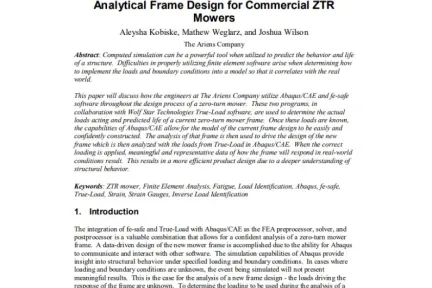
Analytical Frame Design for Commercial ZTR Mowers

Computed simulation can be a powerful tool when utilized to predict the behavior and life of a structure. Difficulties in properly utilizing finite element software arise when determining how to implement the loads and boundary conditions into a model so that it correlates with the real world.

Customer Papers

Analytical Frame Design for Commercial ZTR Mowers
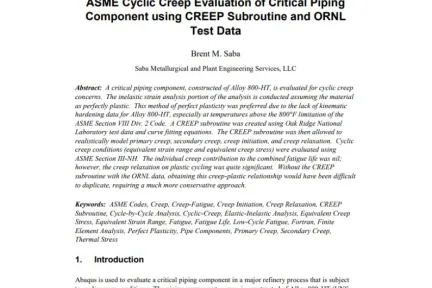
ASME Cyclic Creep Evaluation of Critical Piping Component using CREEP Subroutine and ORNL Test Data

A critical piping component, constructed of Alloy 800-HT, is evaluated for cyclic creep concerns. The inelastic strain analysis portion of the analysis is conducted assuming the material as perfectly plastic. This method of perfect plasticity was preferred due to the lack of kinematic hardening data for Alloy 800-HT, especially at temperatures above the 800°F limitation of the ASME Section VIII Div. 2 Code. A CREEP subroutine was created using Oak Ridge National Laboratory test data and curve fitting equations.

Customer Papers

ASME Cyclic Creep Evaluation of Critical Piping Component using CREEP Subroutine and ORNL Test Data
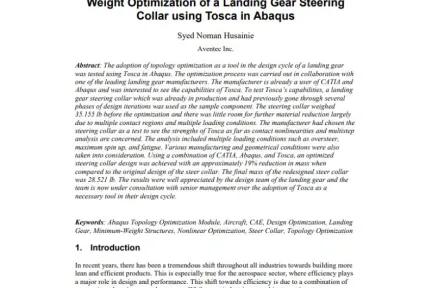
Weight Optimization of a Landing Gear Steering Collar using Tosca in Abaqus

The adoption of topology optimization as a tool in the design cycle of a landing gear was tested using Tosca in Abaqus. The optimization process was carried out in collaboration with one of the leading landing gear manufacturers. The manufacturer is already a user of CATIA and Abaqus and was interested to see the capabilities of Tosca. To test Tosca’s capabilities, a landing gear steering collar which was already in production and had previously gone through several phases of design iterations was used as the sample component. The steering collar weighed 35.155 lb before the optimization and there was little room for further material reduction largely due to multiple contact regions and multiple loading conditions.

Customer Papers

Weight Optimization of a Landing Gear Steering Collar using Tosca in Abaqus
There are 245 results

Customer stories

There are 129 results

From the communities

There are 6 results

SIMULIA Self Learning

We provide hundreds of self-learning modules so you can continue to learn at your convenience

Blogs

Read the SIMULIA blog on the latest news and innovations from our experts.

There are 694 results

Learn What SIMULIA Can Do for You

Speak with a SIMULIA expert to learn how our solutions enable seamless collaboration and sustainable innovation at organizations of every size.

Get Started

Courses and classes are available for students, academia, professionals and companies. Find the right SIMULIA training for you. 

Get Help

Find information on software & hardware certification, software downloads, user documentation, support contact and services offering