There are 1489 results
Strip Flatness Prediction in a 4 High Tandem Mill Using a Dynamic Model.

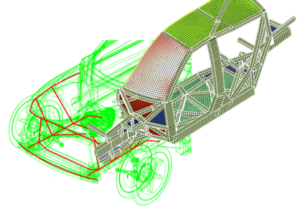
Some defects on the strip flatness could appear during the cold rolling, such as waves at center of edges. There are factors that influence the strip shape during the process including variables such as rolling speed, strip width, materials properties, forces at the entrances and exit of the rolling mill, elastic deflection, work rolls crown. In this work how the strip, the crown and the rolls behave during a cold rolling process in a 4 high tandem mill composed by four stands, and how their behavior create the strip shape are being studied. For developing the model a study of the mesh density, element type in the selected mesh, boundary conditions, type of part (deformable, analytical rigid), were taken into account.

Customer Papers
Strip Flatness Prediction in a 4 High Tandem Mill Using a Dynamic Model.
Optimised design of foundations for wind towers

Environmental, political, and other considerations are leading to the installation of growing numbers of wind turbines for electricity generation. The present paper concentrates on onshore installations, in which the turbine is placed at the end of a tower founded on the ground. A serious problem with the foundation or its connection with the tower entails a global failure. A worrying percentage of the towers built before 2010 is ill designed, often with obvious manifestations of the design problem. On the other hand the new designs attempt to optimise material quantities and costs while providing an adequate behaviour under the demands imposed.

Customer Papers

Optimised design of foundations for wind towers
Evaluation of Tennis Racket Swing during Impact with a Tennis Ball

This report analyzes the differences in the ball exit velocity (BEV) when a ball arriving at a given velocity is hit at different points on the string bed of a racket and describes the reaction force on the handle of the racket, though the use of Dynamic Finite Element Simulations. The objective is to prove that the Finite Element Method can be used to determine optimal hitting points for rackets during a tennis match. Optimal hitting points are considered to be the ones producing the fastest BEV and lowest reaction force on the user’s hand. Eleven different spots were analyzed. The incoming ball velocity was assumed to be 40m/s and the racket rotational swing speed was assumed to be 0.05 rad/ms. The results show that it is feasible to simulate the impact of a ball with a racket and determine stresses on the racket as well as the BEV and reaction force on the user’s hand using Dynamic Finite Elements and Abaqus/Explicit.

Customer Papers

Evaluation of Tennis Racket Swing during Impact with a Tennis Ball
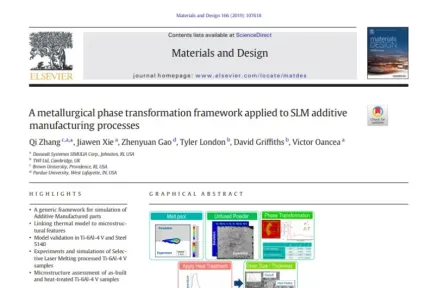
A metallurgical phase transformation framework applied to SLM additive manufacturing processes

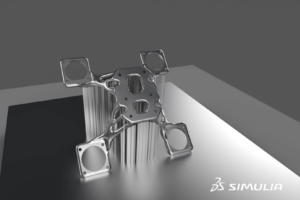
While significant progress has been made in the last few years, the reliability of Additively Manufactured (AM) parts is often less than desirable as they suffer from manufacturing defects and hence subpar strength and fatigue life. To address this challenge, numerical methods are sought to provide insight into the process and help accelerate progress in raising the quality of AM parts. In metal AM applications, assessing the amount of unfused powder, melt pool volumes, and metallurgical phase transformations is often of interest. In this work, we introduce a generic framework for assessing metallurgical phase transformations, building on a previously-developed general simulation framework for predicting temperature evolution, distortions, and residual stresses.

Customer Papers

A metallurgical phase transformation framework applied to SLM additive manufacturing processes
Dassault Systèmes SIMULIA Analyst Event 2018: New Highlights in Simulating Product, Nature and Life

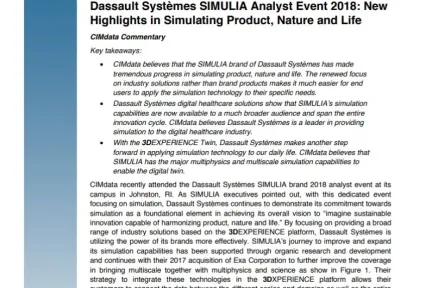
CIMdata recently attended the Dassault Systèmes SIMULIA brand 2018 analyst event at its campus in Johnston, RI. As SIMULIA executives pointed out, with this dedicated event focusing on simulation, Dassault Systèmes continues to demonstrate its commitment towards simulation as a foundational element in achieving its overall vision to “imagine sustainable innovation capable of harmonizing product, nature and life.” By focusing on providing a broad range of industry solutions based on the 3DEXPERIENCE platform, Dassault Systèmes is utilizing the power of its brands more effectively. SIMULIA’s journey to improve and expand its simulation capabilities has been supported through organic research and development and continues with their 2017 acquisition of Exa Corporation to further improve the coverage in bringing multiscale together with multiphysics and science as show in Figure 1.

White Papers

Dassault Systèmes SIMULIA Analyst Event 2018: New Highlights in Simulating Product, Nature and Life
There are 245 results

Customer stories

There are 129 results

From the communities

There are 6 results

SIMULIA Self Learning

We provide hundreds of self-learning modules so you can continue to learn at your convenience

Blogs

Read the SIMULIA blog on the latest news and innovations from our experts.

There are 694 results

Learn What SIMULIA Can Do for You

Speak with a SIMULIA expert to learn how our solutions enable seamless collaboration and sustainable innovation at organizations of every size.

Get Started

Courses and classes are available for students, academia, professionals and companies. Find the right SIMULIA training for you. 

Get Help

Find information on software & hardware certification, software downloads, user documentation, support contact and services offering