There are 1489 results
Virtual Modeling’s Role in Improving Impact Performance of Plastic Containers

The packaging industry is on the brink of process change—including manufacturing, materials and their applications. New concepts are being born via computer screens and virtually nurtured to create commercially-viable packages. This is taking place before ever touching the mold, creating an actual package or conducting a physical test. It’s important to understand various aspects of processing, material properties, package design, product characteristics, as well as specifications and performance parameters that need to be met.

Customer Papers
Virtual Modeling’s Role in Improving Impact Performance of Plastic Containers
Improving rubber tread designs against heat buildup under cyclic loading using strain energy

Heat generation in rubber is a complex phenomenon that occurs when a rubber component is being cyclically loaded. The development of this heat build-up comes from the viscoelastic nature of rubber compounds that occurs during the loading and unloading processes, and it is a difficult mechanism to quantify numerically. A lot of research on this particular and characteristic behavior of rubber has been done essentially since the invention of rubber. Over the course of the last decade or so, there have been numerous breakthroughs in the area of heat generation, and finite element codes are beginning to provide solutions to study this behavior. However, it is still a very complex parameter to measure and validate for practical purposes. As a result, an alternate way to devise a method to improve the designs of treads in our tracks against the development of heat build-up is to study the strain energy. The purpose of this research is to understand how we can use the strain energy generated under one full load cycle and utilize this to design a new and better generation of treads that can meet the constant increasing demands for performance in the world of rubber tracks.

Customer Papers

Improving rubber tread designs against heat buildup under cyclic loading using strain energy
A non linear model for studying the interface’s behavior bloc/mortar in a heritage building in Morocco and numerical modeling by Abaqus

This research work follows our first work presented in Simulia 2015 [1] about the modeling the mortarblock assembly for analyzing the potential occurrence of mechanical problems at interfaces as the consequence of an eventual incompatibility. The study considers a heritage building located in Morocco. In this recent study the authors test the effect of non linear behavior of materials and interface. An elastoplastic model including contact with friction and thermal conductivity is used. One concrete numerical example using Abaqus code will be treated and showed on this paper.

Customer Papers

A non linear model for studying the interface’s behavior bloc/mortar in a heritage building in Morocco and numerical modeling by Abaqus
Strength Analysis of Thermoplastic Containers Using Numerical Simulation

This study presents a numerical simulation strategy developed for strength analysis of thermoplastic containers. The method is based on the finite element analysis of both, the blowmolding process and the in-service loadings. The blow-molding analysis is performed to get the molded shape thickness distribution. The parison thickness and the coefficient of friction between the parison and the mold cavity are treated as parameters. They are varied until a good estimate of the thickness distribution is achieved. The thickness distribution obtained from the blowmolding analysis is then used in the subsequent loading analyses on the finished product.

Customer Papers
Strength Analysis of Thermoplastic Containers Using Numerical Simulation
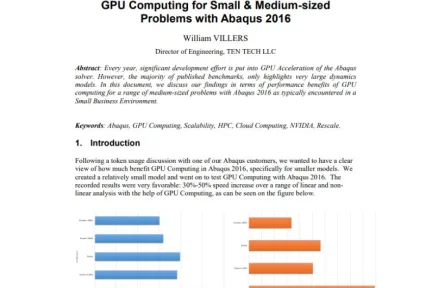
GPU Computing for Small & Medium-sized Problems with Abaqus 2016

Every year, significant development effort is put into GPU Acceleration of the Abaqus solver. However, the majority of published benchmarks, only highlights very large dynamics models. In this document, we discuss our findings in terms of performance benefits of GPU computing for a range of medium-sized problems with Abaqus 2016 as typically encountered in a Small Business Environment.

Customer Papers
GPU Computing for Small & Medium-sized Problems with Abaqus 2016
Application of FMI in Metal Casting press-Forming Process

Accurate simulation of metal casting press-forming process needs to consider mutual coupling effects in a number of different fields of physics subsystem. Hydraulic systems, control systems and mechanical systems are the most important subsystems among them. It is difficult to create various subsystems in detail in a single modeling tools, so co-simulation technology is used to take advantage of different tools to achieve the entire physical process of system-level simulation. The paper researched the co-simulation in the Abaqus software and the Matlab software based on FMI standard, considered fully the coupling effect between different system, simulated the metal casting press-forming process. The simulation results showed that co-simulation based on FMI standard can be well suited for multi-disciplinary co-simulation in complex mechanical model, and played a well-guiding role in the engineering design. The co-simulation would take more computation time than traditional simulation, but it can be achieved to research the integrated features of system and to reduce greatly experiments costs and prototype trial risks by using this technology.

Customer Papers

Application of FMI in Metal Casting press-Forming Process
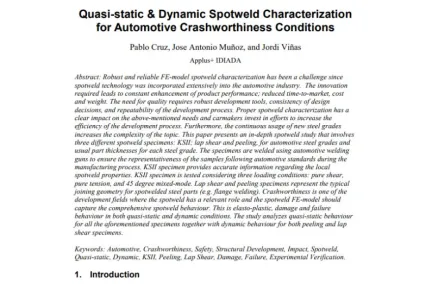
Quasi-static & Dynamic Spotweld Characterization for Automotive Crashworthiness Conditions

This paper presents an in-depth spotweld study that involves three different spotweld specimens: KSII; lap shear and peeling, for automotive steel grades and usual part thicknesses for each steel grade. The specimens are welded using automotive welding guns to ensure the representativeness of the samples following automotive standards during the manufacturing process. KSII specimen provides accurate information regarding the local spotweld properties. KSII specimen is tested considering three loading conditions: pure shear, pure tension, and 45 degree mixed-mode. Lap shear and peeling specimens represent the typical joining geometry for spotwelded steel parts (e.g. flange welding).

Customer Papers

Quasi-static & Dynamic Spotweld Characterization for Automotive Crashworthiness Conditions
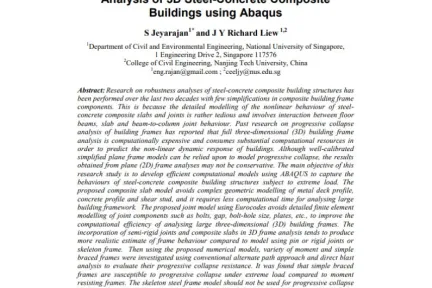
Analysis of 3D Steel-Concrete Composite Buildings using Abaqus

Research on robustness analyses of steel-concrete composite building structures has been performed over the last two decades with few simplifications in composite building frame components. This is because the detailed modelling of the nonlinear behaviour of steelconcrete composite slabs and joints is rather tedious and involves interaction between floor beams, slab and beam-to-column joint behaviour. Past research on progressive collapse analysis of building frames has reported that full three-dimensional (3D) building frame analysis is computationally expensive and consumes substantial computational resources in order to predict the non-linear dynamic response of buildings.

Customer Papers

Analysis of 3D Steel-Concrete Composite Buildings using Abaqus
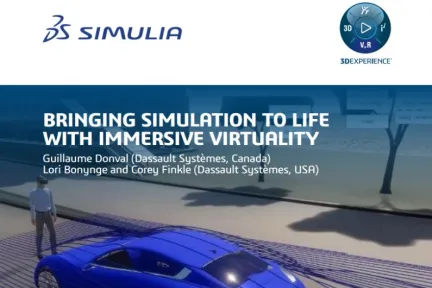
BRINGING SIMULATION TO LIFE WITH IMMERSIVE VIRTUALITY

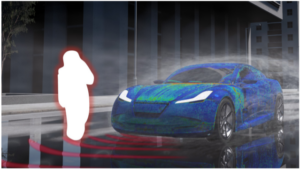
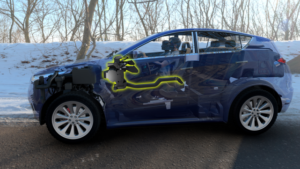
Immersive Virtuality allows us to observe things that simply cannot be seen in the real world, such as the cooling patterns of an additive manufacturing process, the under-the-hood deformation that occurs during a vehicle crash test, air flow around a jet engine, or even the blood flow through a beating human heart. By facsimileing these processes in an observable and measurable way, we can gain valuable insights for improvement, and share these findings in engaging and memorable ways. As a result, innovators can expect improved decision making, and findings, at each stage of the development process.

White Papers

BRINGING SIMULATION TO LIFE WITH IMMERSIVE VIRTUALITY
Modeling of Wave Propagation through Soft Electrically Tunable Metamaterials

In this paper, we present our numerical simulation capability, developed within the Abaqus/Standard environment, for modeling steady-state wave propagation through soft dielectric elastomer composites. Specifically, we will discuss (a) a nonlinear user-element subroutine (UEL) to simulate the coupled electric-displacement response of these soft materials, (b) a user MPC subroutine to enforce complex-valued Bloch-Floquet constraints, as well as to impose appropriate updated Lagrangian boundary conditions on the representative volume element (RVE), and (c) a method within the UEL to lower the dispersion error in the solution by modifying the mass matrix.

Customer Papers

Modeling of Wave Propagation through Soft Electrically Tunable Metamaterials
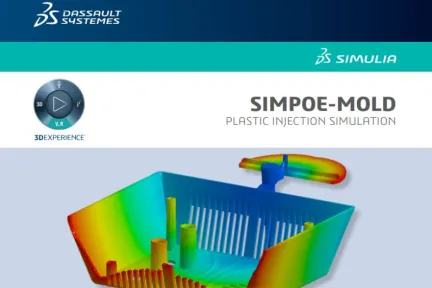
SIMPOE-MOLD PLASTIC INJECTION SIMULATION

For companies that design plastic parts or injection molds or manufacture plastic parts, SimpoeMold helps users predict and avoid manufacturing defects during the earliest stages of part and mold design, eliminating costly mold rework, improving part quality, decreasing time to market and optimizing production cycle times. The Simpoe-Mold plastic injection simulation solution is targeted towards all players involved in the plastic industry, whether they are product designers, mold designers, mold makers or plastic part manufacturers. Simpoe-Mold allows simulation with shell and solid mesh, with or without inserts, and it can handle complex shapes. Simpoe-Mold also allows simulation of more advanced processes, such as gas-assisted injection, co-injection molding, bi-refringance, overmolding, multishot or multi-domain injection.

Customer Papers

SIMPOE-MOLD PLASTIC INJECTION SIMULATION
There are 245 results

Customer stories

There are 129 results

From the communities

There are 6 results

SIMULIA Self Learning

We provide hundreds of self-learning modules so you can continue to learn at your convenience

Blogs

Read the SIMULIA blog on the latest news and innovations from our experts.

There are 694 results
How do batteries work?

“Do people understand how batteries work? I don’t think so.” That’s the...

Article

How do batteries work?

Learn What SIMULIA Can Do for You

Speak with a SIMULIA expert to learn how our solutions enable seamless collaboration and sustainable innovation at organizations of every size.

Get Started

Courses and classes are available for students, academia, professionals and companies. Find the right SIMULIA training for you. 

Get Help

Find information on software & hardware certification, software downloads, user documentation, support contact and services offering