There are 1489 results
High Velocity Perforation as a Benchmark Problem for Material Model Validation

High velocity perforation problem is taken as a benchmark to validate material plasticity and fracture models. 2024-T3(51) aluminum alloy is chosen as a reference material. Numerical simulations of a plate perforation using Johnson-Cook plasticity model with two sets of parameters, Johnson-Cook fracture criterion with one set of fitting parameters and pressure and Lode dependent ductile fracture criterion with three sets of material constants are performed into Abaqus/Explicit. Calibration of all the material constants is accomplished using results of quasistatic and high strain rate experiments.

Customer Papers
High Velocity Perforation as a Benchmark Problem for Material Model Validation
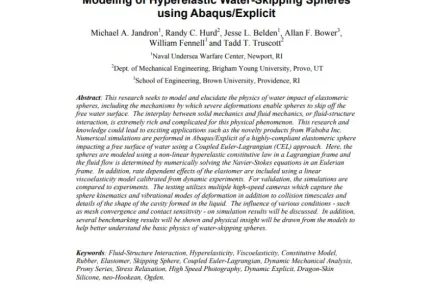
Modeling of Hyperelastic Water-Skipping Spheres using Abaqus/Explicit

This research seeks to model and elucidate the physics of water impact of elastomeric spheres, including the mechanisms by which severe deformations enable spheres to skip off the free water surface. The interplay between solid mechanics and fluid mechanics, or fluid-structure interaction, is extremely rich and complicated for this physical phenomenon. This research and knowledge could lead to exciting applications such as the novelty products from Waboba Inc. Numerical simulations are performed in Abaqus/Explicit of a highly-compliant elastomeric sphere impacting a free surface of water using a Coupled Euler-Lagrangian (CEL) approach.

Customer Papers

Modeling of Hyperelastic Water-Skipping Spheres using Abaqus/Explicit
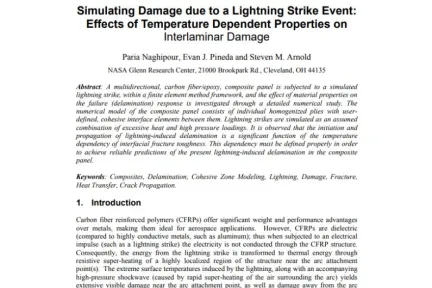
Simulating Damage due to a Lightning Strike Event: Effects of Temperature Dependent Properties on Interlaminar Damage

A multidirectional, carbon fiber/epoxy, composite panel is subjected to a simulated lightning strike, within a finite element method framework, and the effect of material properties on the failure (delamination) response is investigated through a detailed numerical study. The numerical model of the composite panel consists of individual homogenized plies with userdefined, cohesive interface elements between them. Lightning strikes are simulated as an assumed combination of excessive heat and high pressure loadings. It is observed that the initiation and propagation of lightning-induced delamination is a significant function of the temperature dependency of interfacial fracture toughness.

Customer Papers

Simulating Damage due to a Lightning Strike Event: Effects of Temperature Dependent Properties on Interlaminar Damage
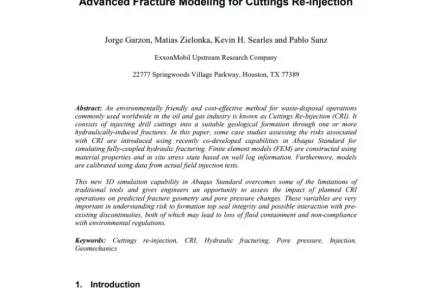
Advanced Fracture Modeling for Cuttings Re-injection

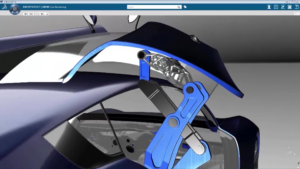
An environmentally friendly and cost-effective method for waste-disposal operations commonly used worldwide in the oil and gas industry is known as Cuttings Re-Injection (CRI). It consists of injecting drill cuttings into a suitable geological formation through one or more hydraulically-induced fractures. In this paper, some case studies assessing the risks associated with CRI are introduced using recently co-developed capabilities in Abaqus Standard for simulating fully-coupled hydraulic fracturing. Finite element models (FEM) are constructed using material properties and in situ stress state based on well log information. Furthermore, models are calibrated using data from actual field injection tests.

Customer Papers
Advanced Fracture Modeling for Cuttings Re-injection
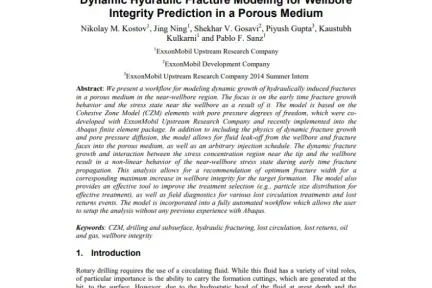
Dynamic Hydraulic Fracture Modeling for Wellbore Integrity Prediction in a Porous Medium

We present a workflow for modeling dynamic growth of hydraulically induced fractures in a porous medium in the near-wellbore region. The focus is on the early time fracture growth behavior and the stress state near the wellbore as a result of it. The model is based on the Cohesive Zone Model (CZM) elements with pore pressure degrees of freedom, which were codeveloped with ExxonMobil Upstream Research Company and recently implemented into the Abaqus finite element package. In addition to including the physics of dynamic fracture growth and pore pressure diffusion, the model allows for fluid leak-off from the wellbore and fracture faces into the porous medium, as well as an arbitrary injection schedule.

Customer Papers

Dynamic Hydraulic Fracture Modeling for Wellbore Integrity Prediction in a Porous Medium
Optimization of Curved Fir-Tree Root of Steam Turbine Using Computer Aided Optimization and Finite Element Analysis

This paper is concerned with optimization of the design of a turbine blade curved fir-tree root and rim by integrating a knowledge of computer aided optimization (CAO) and finite element analysis (FEA). The optimization software Isight and FEA software Abaqus are applied in an effort to optimize the shape of the curved fir-tree root of a given turbine blade. Several critical geometrical features such as the radius of root centerline, (x, y) coordinate of center point of the centerline, and distances from blade center to leading and trailing edge of the platform, are taken as design variables and the maximum equivalent stress of root and rim as objective function.

Customer Papers

Optimization of Curved Fir-Tree Root of Steam Turbine Using Computer Aided Optimization and Finite Element Analysis
Process integration between CAD and CAE applications for Isight-based DOE analysis

Product development engineers often use simulation to evaluate the performance of a single design - a part or a system - characterized by a specific CAD representation, specific input data, and materials properties. This paper is focused on CAD and CAE workflow integration for the design of a Gas Turbine vane. The model of the complete process, implemented in the SEE-Fiper environment and involving all the calculation tools, is described.

Customer Papers

Process integration between CAD and CAE applications for Isight-based DOE analysis
Increasing the efficiency of offshore rigid pipeline lateral buckling assessments using a dedicated GUI and Isight

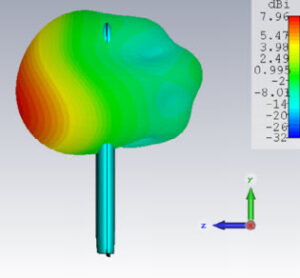
The design phase for offshore rigid pipelines can be lengthy and demanding. A significant number of engineering hours can be burned before the various analyses attain target results. The assessment of the lateral buckling phenomenon is one aspect of the pipeline design that requires numerous finite element simulations. The purpose of such simulations is to determine if the pipeline has a genuine tendency for lateral buckling and, if so, whether control of the buckling behavior is required to ensure that the pipeline stresses and strains are within allowable limits.

Customer Papers
Increasing the efficiency of offshore rigid pipeline lateral buckling assessments using a dedicated GUI and Isight
Large scale models for A350

In order to secure the A350 structural test campaign, the Virtual Full Scale Test project (ViFST) was launched to predict more accurately the behaviour of the aircraft, especially to better handle nonlinear effects (large displacements, plasticity, contact ...). The project covers most of the aircraft structure and brings together teams from 5 countries (Germany, England, Spain, India and France). The presentation will focus on the central model, which is composed of the central fuselage and the two wings. This is the largest model of the project (68 millions of variables). The presentation will detail the particular challenges overcome by Airbus and Simulia teams.

Customer Papers

Large scale models for A350
Experience and lessons learnt from the SMART 2013 benchmark

The French CEA, together with EDF and the IAEA, recently organised an international benchmark to evaluate the ability to model the mechanical behaviour of a typical nuclear reinforced concrete structure subjected to seismic demands. The paper presents the conclusions of the pre-test exercise, as well as some observations from additional simulations conducted after the experimental results were made available.

Customer Papers

Experience and lessons learnt from the SMART 2013 benchmark
Simplified approaches for modelling a sealed and partly fluid filled container

Containers (bottles) made of polymers are exposed to manifold loads during their life cycle. They are open or sealed as well as empty or filled. Depending on the mentioned conditions a container behaves different under loading. This effect can be observed in everyday life. Imagine opening a shaken plastic bottle filled with a carbonated beverage. Abaqus provides simulation methods for completely filled containers with either a pneumatic or a hydraulic fluid. Real containers barely are totally filled with a hydraulic fluid. In general there is always a so called head space filled with gas (pneumatic fluid). This paper presents two methods for modelling the two-phase system (liquid and gas) inside a partly filled container using a fluid cavity instead of meshing the volume inside the container.

Customer Papers

Simplified approaches for modelling a sealed and partly fluid filled container
Validation of flow simulation on ABAQUS/CELTM

The main topic of the paper is to show the validation of the Coupled EulerianLagrangian (CEL) analysis technique applied to Newtonian fluid dynamics simulations described by an equation of state (EOS) suggested by Mie-Grüneisen. The model is driven only by body forces through cavity filling. This implementation allows to obtain free surfaces profile, splash droplet formation, velocity field, instantaneous pressure at the contact points between solid and fluid, as well as in solid parts, stresses and strains, all at the same time. The free surface validation obtained in the fluid is made through comparisons with radiographs obtained experimentally.

Customer Papers

Validation of flow simulation on ABAQUS/CELTM
There are 245 results

Customer stories

There are 129 results

From the communities

There are 6 results

SIMULIA Self Learning

We provide hundreds of self-learning modules so you can continue to learn at your convenience

Blogs

Read the SIMULIA blog on the latest news and innovations from our experts.

There are 694 results
Blinded by Science!

Dassault Systèmes SIMULIA is excited to announce that it’s partnering with sister...

Article

Blinded by Science!

Learn What SIMULIA Can Do for You

Speak with a SIMULIA expert to learn how our solutions enable seamless collaboration and sustainable innovation at organizations of every size.

Get Started

Courses and classes are available for students, academia, professionals and companies. Find the right SIMULIA training for you. 

Get Help

Find information on software & hardware certification, software downloads, user documentation, support contact and services offering