What Does Artificial Intelligence Mean in Manufacturing?

AI in Manufacturing refers to the use of AI technologies to optimize operations, improve efficiency, support workforce development, and enhance decision-making. It becomes valuable when it improves factory-floor operations, and trusted when it is grounded in real data, transparent, and connected to execution.

It plays a role when it helps to aggregate information, structure inputs, guide decisions, and automate repetitive tasks. Its benefit lies in supporting everyday activities such as process planning, robot programming, factory layout, quality checks, and commissioning. This enables teams to accelerate and scale with fewer errors and more consistent execution.

By 2029, more than half of manufacturing AI use cases will support process improvements, up from 34% in 2025

Gartner

Generative insights + Operational Reality

Industrial AI turns production and supply chain data into real-time intelligence in 3D UNIV+RSES; driving efficiency, agility, and resilience across manufacturing and supply chain operations.

Why 'Accurate' AI Recommendations Often Fail to Deliver Real-World Operational Impact

AI systems that lack a scientific foundation or a comprehensive model of the production environment (physics knowledge, plant layout, process constraints, resource availability, quality tolerances, execution history, etc.) can produce recommendations that appear accurate in isolation, but prove impractical in real operational context.

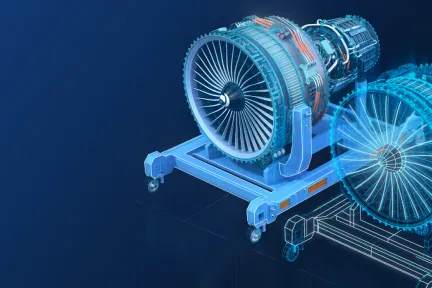
The virtual twin resolves this. By providing a continuously updated, science-informed digital representation of the production environment, the virtual twin gives AI the operational context it requires to generate recommendations that are not merely statistically sound but operationally executable.

This is the distinction between AI that simply analyzes manufacturing data and AI that understands the manufacturing environment.

6 High-Impact AI in Manufacturing Use Cases

How can you use artificial intelligence in manufacturing?

Generative Toolpath for NC Machining

Problem: NC programmers spend hours defining and validating machining strategies, feeds, speeds, and toolpaths. Less experienced programmers often rely on conservative parameters or manually recreate proven processes, increasing programming time and leaving machining efficiency untapped.

What DELMIA does: DELMIA Machining uses AI-assisted programming capabilities, validated through virtual twin simulation, to recommend machining operations, toolpaths, and cutting parameters based on proven machining know-how and similar part geometries.

Human role: NC Programmers review, refine, and approve suggested operations based on machine behavior, tooling, material requirements, shop-floor constraints, and production priorities. AI assists by reducing manual programming effort and surfacing optimized options faster.

Measured outcome: 40–75% reduction in NC programming time through feature recognition, programming reuse, and automation workflows, alongside 30–70% machining cycle time improvement in applicable scenarios

Additive Manufacturing Defect Detection

Problem: Layer-by-layer defects in additive manufacturing are invisible until post-process inspection, at which point the part is already scrapped and cycle time is lost.

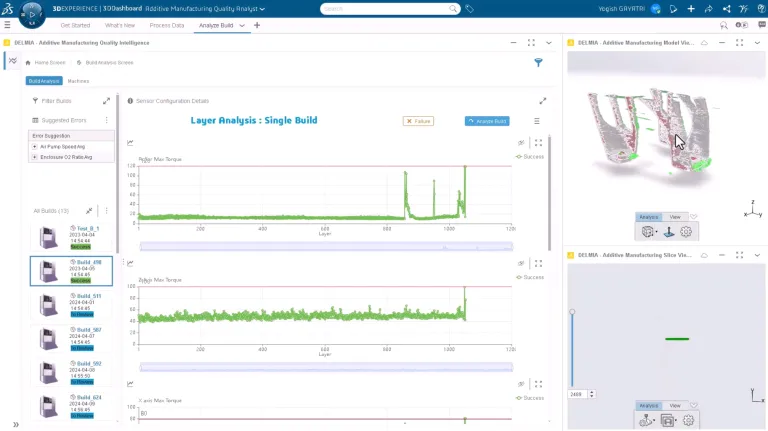
What DELMIA does: Layer and melt images are used to reconstruct an as-built 3D model. Computer vision classifies defect types in real time, triggering process corrections before the next layer deposits.

Human role: Quality engineers review classifications, validate flagged anomalies, and adjust process parameters. The AI catches what the human cannot observe in real time.

Measured outcome: Earlier defect detection reduces scrap rates. Specific figures depend on material and machine configuration, but pilot deployments in aerospace show >30% reduction in post-process reject rates.

Augmented Worker Support

Problem: Complex assembly and quality inspection tasks depend on individual operator expertise that is difficult to transfer, slow to train, and vulnerable to workforce turnover.

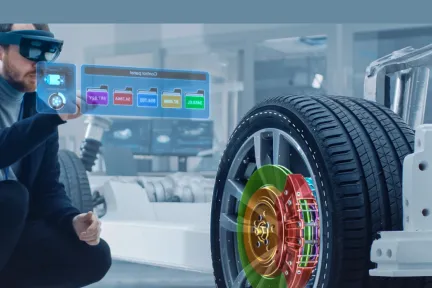
What DELMIA does: Generative AI, combined with augmented reality overlays, guides operators through complex tasks with real-time visual instruction. AR-enabled quality checks replace manual visual inspection with machine-assisted precision.

Human role: Operators perform the physical work, confirm AI-guided steps, and escalate anomalies. The AR layer extends capability rather than replacing it.

Measured outcome: Reduction in cost of poor quality; shorter onboarding time for new operators. One aerospace customer reported 40% reduction in first-time quality failures on complex assemblies.

Robot & Equipment Detection and Identification

Problem: Factory layouts change. Keeping the virtual twin synchronized with physical reality requires manual measurement and CAD updates, a task that falls behind and creates a growing gap between the model and the floor.

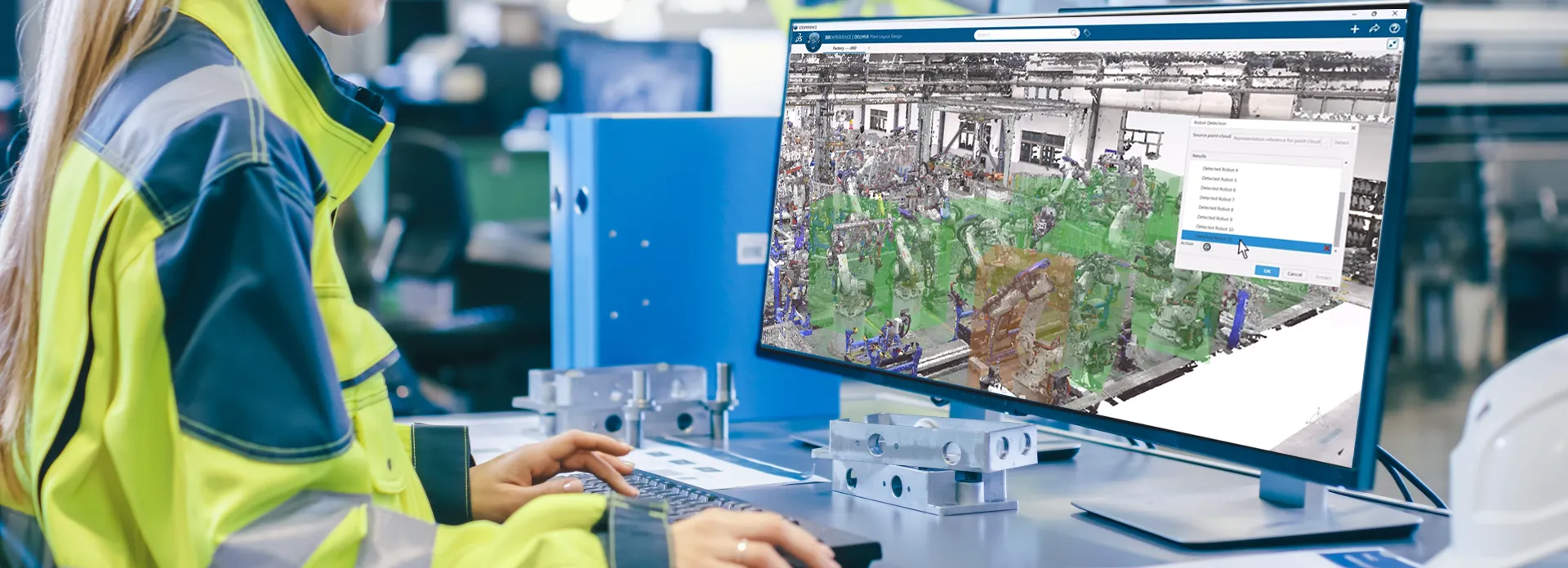
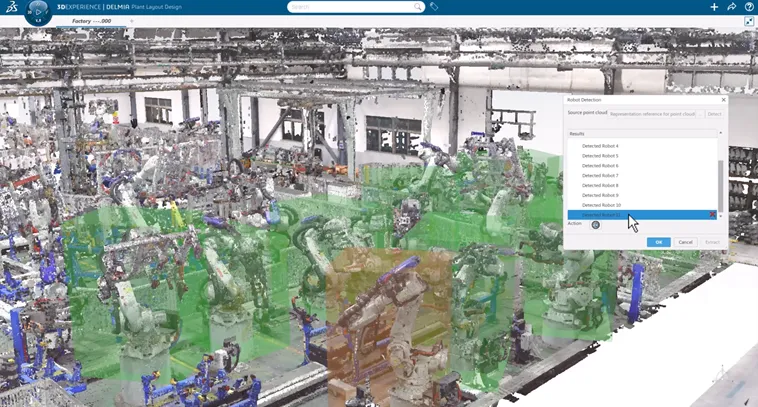
What DELMIA does: AI detects robots and equipment within point cloud scans, retrieves the corresponding CAD models, and positions them in the factory digital model automatically.

Human role: Engineers validate placements, correct misidentifications, and approve updates. Keeps the virtual twin current with significantly less manual effort.

Measured outcome: Factory survey-to-updated-model time reduced from weeks to hours in tested deployments. Quality of the virtual twin improves, which increases the accuracy of downstream AI recommendations.

Generative MBOM & Process

Problem: Manufacturing BOM generation and process planning for new products draws heavily on past industrializations work that is currently done manually, inconsistently, and slowly.

What DELMIA does: AI generates MBOM proposals, process sequences, work instructions, and resource programming by drawing on historical industrialization data. Automated consistency checks flag EBOM/MBOM discrepancies before they reach the floor.

Human role: Process engineers review AI-generated plans, apply product-specific engineering judgment, and approve. The AI provides a structured first draft; the engineer ensures it's fit for purpose.

Measured outcome: Estimated 50%+ reduction in manufacturing preparation lead time. Right-first-time rates improve because data consistency checks catch structural errors early.

AI & Scheduling Optimization

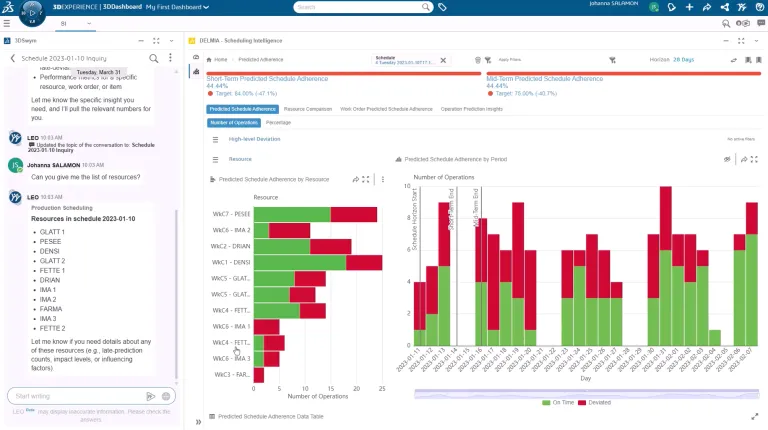
Problem: Uncontrolled schedule variation. Manufacturing schedules change constantly, but teams often lack clarity on which deviations matter, why they occur, and how they impact performance, limiting their ability to learn and improve future decisions.

What DELMIA does: DELMIA Scheduling Intelligence turns schedule history into actionable insight by comparing planned and actual performance, highlighting meaningful deviations, and using AI-based suggestions to help planners understand causes, impacts, and improvement opportunities.

Human role: Schedulers evaluate proposed resolutions, weigh trade-offs (customer priority, cost, asset utilization), and make the call. The system surfaces the options; the planner owns the decision. 

Measured outcome: +20% estimated improvement in on-time delivery performance; -50% reduction in scheduling time from improved cross-team communication efficiency.

Key Considerations When Integrating AI into Manufacturing

Data Silos & Governance

Manufacturing data is frequently distributed across disconnected systems: ERP, MES, quality management, supply chain planning, in formats that are incompatible, inconsistently structured, or inaccessible to AI inference pipelines. 

Establishing data governance frameworks that connect these sources, without compromising data integrity or regulatory compliance, is a prerequisite for scalable AI deployment.

Security & Data Privacy

Data security and privacy are critical in industrial AI implementation. Manufacturers handle proprietary process data, product IP, and customer-sensitive information. AI solutions requiring data transfer to third parties create risk.

DELMIA's approach to Trusted AI prioritizes certifiable, auditable, sovereign AI deployments that keep sensitive operational data within governed boundaries.

Human-in-the-Loop Model

Autonomous AI without human validation creates accountability risks, especially in regulated industries like aerospace, defense, and life sciences.

The human-in-the-loop model, in which AI surfaces recommendations and operators validate or adjust recommendations, preserves human accountability while substantially reducing decision cycle time. 

Transparency and auditability remain essential.

What are the KPIs to look for when you integrate AI in manufacturing?

  • Decision Adoption

  • Productivity Improvement

  • Lead time reduction

  • Right-first-time performance

  • OEE improvement

Why Choose DELMIA to Integrate AI into Your Factory?

The difference lies in industrial context, not model complexity. AI that operates within a science-based operational model, one that understands the relationships between products, processes, resources, constraints, and execution history, is far better equipped to generate recommendations that are accurate, explainable, and safe to act on in manufacturing.

DELMIA's position in this landscape is defined by 40 years of accumulated domain knowledge and know-how in manufacturing and supply chain, along with a virtual twin platform that provides the industrial context layer AI requires.

The future operating model for manufacturers is not a collection of AI copilots. It is a coherent, governed intelligence layer that advises, automates selectively, and acts within defined boundaries, grounded in the virtual twin, accountable to human operators, and measurable in business terms. That is the manufacturing AI vision DELMIA is building toward.

Curious to learn more about DELMIA Virtual Twin & AI capabilities?

We are here to help

Because our industry world models are science-grounded, our AI is trustworthy and explainable

Florence Hu‑Aubigny

Executive Vice President, Research & Development

Start Your Journey

The world of artificial intelligence in manufacturing is changing. Discover how to stay a step ahead with DELMIA.

FAQs about AI in Manufacturing

Also Discover

Learn What DELMIA Can Do for You

Speak with a DELMIA expert to learn how our solutions enable seamless collaboration and sustainable innovation at organizations of every size.

Get Started

Courses and classes are available for students, academia, professionals and companies. Find the right DELMIA training for you. 

Get Help

Find information on software & hardware certification, software downloads, user documentation, support contact and services offering