There are 1489 results
Simulating the Pouch Forming Process Using a Detailed Fluid-Structure Interaction

A deeper understanding of the interaction between machine, packaging material and liquid product during the forming process of pouches is enabled by the use of numerical simulation. Tetra Pak pouch forming system forms the pouches in a continuous fashion starting from a tube of packaging material filled with the liquid to be packaged. Simulating the pouch forming, including a detailed fluid-structure interaction is the goal of this paper. The simulation is performed coupling Abaqus for the structural side and FlowVision for the fluid side through a Direct Coupling interface. The definition of the problem as well the results of the simulation are presented in the paper.

Customer Papers
Simulating the Pouch Forming Process Using a Detailed Fluid-Structure Interaction
Finite Element Analysis of Casing and Casing Connections for Shale Gas Wells

The application of horizontal drilling and hydraulic fracturing has enabled operators to rapidly develop shale gas procution from deep shale formations over the past decade. It has, however, presented significant challenges to casing and casing connection designs due to the complicated and extreme load conditions within these wells. Advanced Finite Element Analysis (FEA) is therefore required to understand casing deformation using Abaqus for analyzing casing and casing connections under shale gas well load scenarios, such as horizontal well installation, perforating and hydraulic fracturing pressures, and formation shear movement. Analysis examples are provided.

Customer Papers

Finite Element Analysis of Casing and Casing Connections for Shale Gas Wells
Air Blast Loaded Safety Devise Dynamical Response Analysis

Equipment of many oil and gas processing plants in Russian Federation is considerably worn-out. This cause the decrease of reliability and durability of equipment, and to rise of accident rate. An air explosion is the one of the most dangerous cases for plants in oil and gas industry, usually caused by uncontrolled emission and inflammation of oil products. Air explosion can lead to significant danger for life and health of plant staff, so it needs necessity of safety device usage. New type of safety device designed. Numerical simulation is necessary to analyze design parameters and performance of safety device, subjected to air blast loading. Coupled fluid-structure interaction analysis performed to determine strength of protective devise and its performance.

Customer Papers

Air Blast Loaded Safety Devise Dynamical Response Analysis
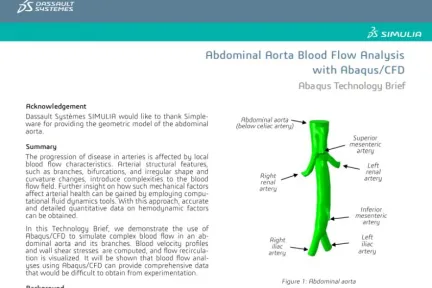
Abdominal Aorta Blood Flow Analysis with Abaqus/CFD

In this Technology Brief, we demonstrate the use of Abaqus/CFD to simulate complex blood flow in an abdominal aorta and its branches. Blood velocity profiles and wall shear stresses are computed, and flow recirculation is visualized. It will be shown that blood flow analyses using Abaqus/CFD can provide comprehensive data that would be difficult to obtain from experimentation.

Tech Notes

Abdominal Aorta Blood Flow Analysis with Abaqus/CFD
MAN Diesel & Turbo - Industrial Equipment Case Study

A century ago this year, the first ocean-going diesel ship in the world, the M/S Selandia, embarked on her maiden voyage. She was a technological wonder, and both her hull and engines were built by Burmeister & Wain (B&W) of Copenhagen, Denmark. B&W is now a part of MAN Diesel & Turbo—a company with 12,000 employees worldwide—and the marine low-speed business unit is located in Copenhagen. The unit has capitalized on B&W’s historic expertise to produce new engines that can weigh up to 2800 metric tons and tower 16 meters high. Once such behemoth engines are installed, they have to be serviced in place—and they must require servicing as infrequently as possible.

Tech Notes

MAN Diesel & Turbo - Industrial Equipment Case Study
Development and Validation of Fully-Coupled Hydraulic Fracturing Simulation Capabilities

The problem of the propagation of a hydraulically driven fracture in a fully saturated, permeable, and porous medium is investigated. Fluid driven fracture propagation in porous media is a coupled problem with four unknown fields: the flow of the fracturing fluid within the fracture, the flow of the pore fluid within the pores, the porous medium deformation, and the fracture configuration. The corresponding governing equations are the mass balance of the fracturing fluid, mass balance of the pore fluid, equilibrium of the porous medium, and fracture initiation and propagation criteria. In this work, the recently co-developed Abaqus fully-coupled hydraulic fracturing modeling capabilities are evaluated by assessing their consistency, convergence, and accuracy qualities.

Customer Papers

Development and Validation of Fully-Coupled Hydraulic Fracturing Simulation Capabilities
Numerical Modeling of Spudcan Footing Penetration in Sand

Spudcans are a type of footing foundation to provide a secure operation of mobile jackup rigs. They are connected to each of the independent legs of a jack-up rig. The current practice to assess the penetration depths of spudcans and the risk of geotechnical failure (punch-through) involves calculating the bearing capacity of the footing at discrete depths. The finite element method offers the possibility to model the complex spudcan penetration process while involving detailed soil parameters and spudcan geometry. In this paper, the use of Coupled EulerianLagrangian (CEL) model elements, available in ABAQUS, to simulate large soil deformations during the spudcan penetration process is described.

Customer Papers

Numerical Modeling of Spudcan Footing Penetration in Sand
Co-Simulation for Wind Turbines: Using the SIMULIA Co-Simulation Engine for Aiming Towards Fluid-Structure Interaction with Control

Within this paper we show a challenging simulation representing problems within the renewable energy sector. The simulation of a wind turbine involving the interaction of the generator/gearbox with the wind is presented (signal field co-simulation). The simulation results are validated against measurement data from the National Renewable Energy Laboratory (NREL) Unsteady Aerodynamic Experiment Phase VI performed in the NASA AMES wind tunnel (Hand, 2001). In the outlook we present the methodology to extend the co-simulation to a fluid-structure-signal interaction by using the SIMULIA Co-Simulation Engine coupling Abaqus/Standard, OpenFOAM and MATLAB to capture the realist behavior by appropriately modeling the interaction of various components.

Customer Papers

Co-Simulation for Wind Turbines: Using the SIMULIA Co-Simulation Engine for Aiming Towards Fluid-Structure Interaction with Control
Analysis of Fatigue Life Estimate for the M119 Cradle Assembly with a Gouge Cut Defect

The M119 howitzer is a lightweight towed 105mm field artillery weapon system. It is an indirect-fire (gunfire delivered to a target that is not in a direct line of sight) weapon that primarily fires projectiles along a curved trajectory. This paper will discuss the impact of a manufactured tooling groove defect in the firing plate on the life cycle of the cradle. Results predicted that the cradle with the gouge cut in the firing plate would have a design life greater than 1000 cycles. Results are consistent with the 200+ successful shots that have been completed on fielded M119 howitzers with this gouge.

Customer Papers

Analysis of Fatigue Life Estimate for the M119 Cradle Assembly with a Gouge Cut Defect
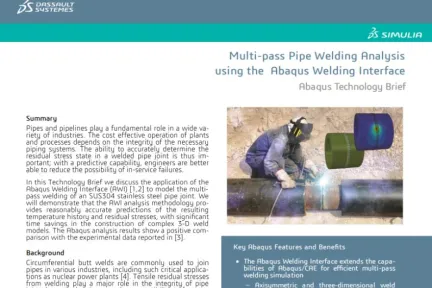
Multi-pass Pipe Welding Analysis using the Abaqus Welding Interface

In this Technology Brief we discuss the application of the Abaqus Welding Interface (AWI) to model the multipass welding of an SUS304 stainless steel pipe joint. We will demonstrate that the AWI analysis methodology provides reasonably accurate predictions of the resulting temperature history and residual stresses, with significant time stresses savings in the construction of complex 3-D weld models. The Abaqus analysis results show a positive comparison with the experimental data reported.

Tech Notes

Multi-pass Pipe Welding Analysis using the Abaqus Welding Interface
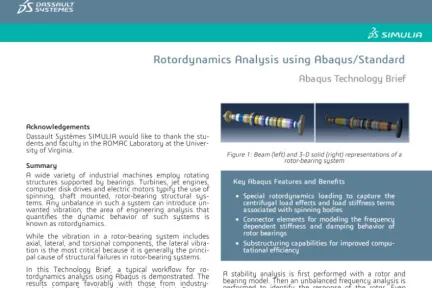
Rotordynamics Analysis using Abaqus/Standard

In this Technology Brief, a typical workflow for rotordynamics analysis using Abaqus is demonstrated. The results compare favorably witht those from industry-standard codes from the University of Virginia's Rotating Machinery and Controls Laboratory (commonly known as ROMAC). A substructuring application is also discussed

Tech Notes

Rotordynamics Analysis using Abaqus/Standard
There are 245 results

Customer stories

There are 129 results

From the communities

There are 6 results

SIMULIA Self Learning

We provide hundreds of self-learning modules so you can continue to learn at your convenience

Blogs

Read the SIMULIA blog on the latest news and innovations from our experts.

There are 694 results

Learn What SIMULIA Can Do for You

Speak with a SIMULIA expert to learn how our solutions enable seamless collaboration and sustainable innovation at organizations of every size.

Get Started

Courses and classes are available for students, academia, professionals and companies. Find the right SIMULIA training for you. 

Get Help

Find information on software & hardware certification, software downloads, user documentation, support contact and services offering