There are 1489 results
Design Knowledge Exploration for the Conceptual Design of Tire Contours

The importance of the rule of simulation at a conceptual design stage is pointed out recently. The methodology using multi-objective design optimization and data mining, which is called MODE (Multi-Objective Design Exploration), is helpful to find out design knowledge. In this study, we show that the design knowledge found by MODE is fruitful for decision making at a conceptual design stage of real world example i.e. contour design of a fuel efficient tire. Our procedure of MODE consists of nonlinear FEA to predict tire performance, evolutional computation to get desirable solutions including Pareto solution, and data mining to find out design knowledge.

Customer Papers
Design Knowledge Exploration for the Conceptual Design of Tire Contours
Weld and Adhesive Optimization Process Development And Implementation on Vehicle Body Structure Development

This paper presents an automated Weld & Adhesive Optimization process developed at FORD to improve vehicle structural performance using a unique parametric technique developed by DEP, Inc. Variables include weld pitch and its alternative forms such as number of welds in a given weld line and % change to the weld count, type of welds, layers of adhesive bonds and adhesive bond dimensions. This process was implemented successfully on a passenger car currently in production with the primary objective to increase modal frequency separation between body-in-prime bending and torsional modes while maintaining the current number of total welds in BIP structure.

Customer Papers

Weld and Adhesive Optimization Process Development And Implementation on Vehicle Body Structure Development
Simulation of Hail Impact Using the Smoothed Particle Hydrodynamic Method in Abaqus/Explicit

Numerically simulating high speed ice or hail impact is challenging because of the extreme deformation, fragmentation, contact, and material model complexity. In this Technology Brief we demonstrate how the Smoothed Particle Hydrodynamics functionality in Abaqus/Explicit can be used to analyze impact. Favorable comparison with experimental data will be shown.

Tech Notes

Simulation of Hail Impact Using the Smoothed Particle Hydrodynamic Method in Abaqus/Explicit
Comparative analysis of floor response spectra in civil structures of NPP using different methods of dynamic analysis

In the research the most important problem is to determine kinematic parameters of the ‘soil-structure’ system through the use of the following methods from SIMULIA(ABAQUS): direct integration method, modal method and advanced modal method (SIM-architecture), where projected damping matrix is considered as completely filled. This paper offers theoretical description of the above-mentioned methods, their advantages and disadvantages, and the comparative analysis of their results for the schematic model of the ‘soil-structure’ system. Besides here one can find results of the calculation for a typical NPP building.

Customer Papers

Comparative analysis of floor response spectra in civil structures of NPP using different methods of dynamic analysis
Using Abaqus/Explicit to Link the Manufacturing Process to the Final Part Quality for Continuous Fiber-Reinforced Composite Fabrics

The manufacture of continuous fiber-reinforced composite parts often involves a designbuild-test methodology which can be expensive and time-consuming. A predictive design tool, such as the finite element method, is valuable to assist in understanding the relationship between the composite processing conditions and part quality, thus reducing the dependence on the designbuild-test methodology. The ability of the design tool to predict part quality based on manufacturing process parameters is dependent upon the mechanical behavior of the fabric reinforcements, which includes the in-plane shearing and tensile behaviors, bending stiffness and friction between contacting surfaces during the manufacturing process.

Customer Papers

Using Abaqus/Explicit to Link the Manufacturing Process to the Final Part Quality for Continuous Fiber-Reinforced Composite Fabrics
Pipeline Rupture in Abaqus/Standard with Ductile Failure Initiation

Defects may be introduced in metal pipelines during construction, repair, or by accident. A common example ia a gouge from a backhoe bucket or other heavy equipment. At the site of a local defect operating stresses may become sufficiently concentrated to induce plastic deformation and material damage, possibly resulting in eventual failure of the pipeline.

Tech Notes

Pipeline Rupture in Abaqus/Standard with Ductile Failure Initiation
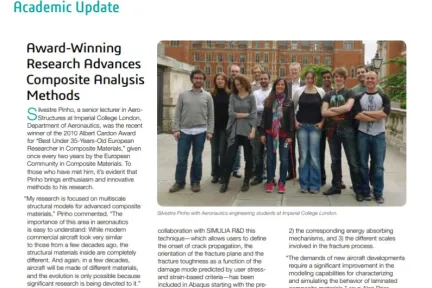
Award-Winning Research Advances Composite Analysis Methods

Silvestre Pinho, a senior lecturer in AeroStructures at Imperial College London, Department of Aeronautics, was the recent winner of the 2010 Albert Cardon Award for “Best Under 35-Years-Old European Researcher in Composite Materials,” given once every two years by the European Community in Composite Materials. To those who have met him, it’s evident that Pinho brings enthusiasm and innovative methods to his research.

Customer Papers

Award-Winning Research Advances Composite Analysis Methods
Shape Optimization of Rubber Bushings Using Differential Evolution Algorithm

he main functions of a rubber bushing are basically to join the elements between rigid structures in the vehicles, isolate vibrations through to the chassis and avoid the transmission of noise. Due to the increasing interest of multibody simulations of complete vehicles or subsystems, it is important to develop and effective models to represent the static stiffness of these rubber bushings. During the vehicle development process, shape optimization of rubber products is also need to have desired stiffness curves. The objective of this study is to optimize rubber bushings to meet the stiffness curve requirements. A Fortran code has been developed to find the optimum shape parameters of 3D bushing models using differential evolution algorithm.

Customer Papers

Shape Optimization of Rubber Bushings Using Differential Evolution Algorithm
Using Abaqus to Model Delamination in FiberReinforced Composite Materials

The strength of laminated fiber-reinforced composite materials depends on the combination of the orientations of the stacked plies with respect to the applied loads and the state of the bonding between adjacent plies. Prior work has focused on developing forming simulations using Abaqus to track fiber orientations as a stack of fabric plies conforms to the shape of a mold. Knowing the final fiber orientations, cured composite properties can be defined to model the behavior of a resin-infused solid structural composite part. In this paper, a failure criterion and damage properties are investigated to model delaminations in composite parts. Delaminations due to Mode I failure are studied by testing unidirectional coupon specimens.

Customer Papers

Using Abaqus to Model Delamination in FiberReinforced Composite Materials
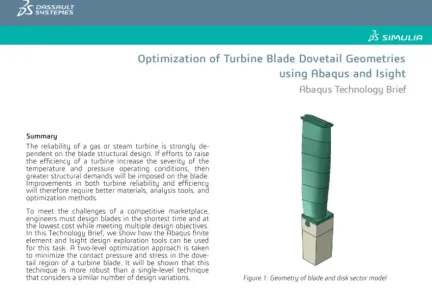
Optimization of Turbine Blade Dovetail Geometries using Abaqus and Isight

The reliability of a gas or steam turbine is strongly dependent on the blade structural design. It efforts to raise the efficiency of a turbine increase the severity of the temperature and pressure operating conditions, then greater structural demands will be imposed on the blade. Improvments iin both turbine reliability and efficiency will therefore require better materials, analysis tools, and optimization methods.

Tech Notes

Optimization of Turbine Blade Dovetail Geometries using Abaqus and Isight
Using Isight Simulation Automation Tools to Reduce the Cycle Time for Ship Structural Analysis Processes

Huntington Ingalls Industries – Ingalls Shipbuilding (HII) is required to perform several different types of structural shock and vibration analyses under the terms of US Navy shipbuilding contracts. Some of these required analyses include whipping, longitudinal strength, linearized stress, pipe shock test, bolt stress, equipment foundation, pipe hanger stress, and ship weight analysis. Historically, these analyses were run interactively by Ingalls Shipbuilding (i.e., without the benefit of Simulation Automation). The first section of this paper presents an overview of some of the ship structural analyses, the simulation automation Isight models created, and a summary of the predicted man-hour reductions. The second section of the paper discusses how Isight is predicted to enable meeting schedule demands.

Customer Papers

Using Isight Simulation Automation Tools to Reduce the Cycle Time for Ship Structural Analysis Processes
Using Abaqus to understand the orthotropic material interactions that enable zero thermal expansion laminates to be designed.

Poisson’s ratio effects, to a large extent, control the thermal expansion characteristics of angle-ply laminates. It is possible to design laminates, that have been manufactured from some highly orthotropic laminae, to exhibit a zero coefficient of expansion along one of its directions, even though none of the expansion coefficients of the laminae themselves are negative. It is often mistakenly believed that at least one of the expansion coefficients has to be negative in order for this effect to be achieved. However, it is the internal coupling of the individual expansion coefficients via the very high laminate Poisson’s ratio that actually enables this. The paper illustrates the effect via a simple Abaqus model and in so doing graphically cements the idea in the minds of the FEM analyst.

Customer Papers

Using Abaqus to understand the orthotropic material interactions that enable zero thermal expansion laminates to be designed.
There are 245 results

Customer stories

There are 129 results

From the communities

There are 6 results

SIMULIA Self Learning

We provide hundreds of self-learning modules so you can continue to learn at your convenience

Blogs

Read the SIMULIA blog on the latest news and innovations from our experts.

There are 694 results

Learn What SIMULIA Can Do for You

Speak with a SIMULIA expert to learn how our solutions enable seamless collaboration and sustainable innovation at organizations of every size.

Get Started

Courses and classes are available for students, academia, professionals and companies. Find the right SIMULIA training for you. 

Get Help

Find information on software & hardware certification, software downloads, user documentation, support contact and services offering