There are 1489 results
Study of Feedback Controlled Variable Cone Expansion Process

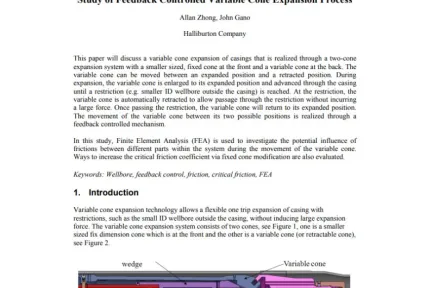
This paper will discuss a variable cone expansion of casings that is realized through a two-cone expansion system with a smaller sized, fixed cone at the front and a variable cone at the back. The variable cone can be moved between an expanded position and a retracted position. During expansion, the variable cone is enlarged to its expanded position and advanced through the casing until a restriction (e.g. smaller ID wellbore outside the casing) is reached. At the restriction, the variable cone is automatically retracted to allow passage through the restriction without incurring a large force. Once passing the restriction, the variable cone will return to its expanded position. The movement of the variable cone between its two possible positions is realized through a feedback controlled mechanism.

Customer Papers
Study of Feedback Controlled Variable Cone Expansion Process
Intermediate Crack Debonding Model of FRPStrengthened Concrete Beams Using XFEM

The use of fiber reinforced polymer (FRP) systems as externally bonded reinforcement has become very popular for the repair and strengthening of reinforced concrete (RC) structures as an alternative to the traditional techniques. One of the common failure modes of FRPstrengthened concrete beams is intermediate crack (IC) debonding of the FRP initiated at the tip of flexural or flexural/shear cracks in the substrate concrete; locations at which the interface is subjected to mixed-mode loading. This study presents a numerical analysis method using the extended finite element method (XFEM) implemented in Abaqus to model FRP intermediate crack debonding failure started at the tip of a flexural crack in a plain concrete beam specimen.

Customer Papers

Intermediate Crack Debonding Model of FRPStrengthened Concrete Beams Using XFEM
A Numerical Prediction of Particle Contaminations in the Seal Design for a Bearing by One Way Coupling

In recent years the tightening of fuel economy regulations and the trend towards environmentally friendly products increase demand for compact, lightweight and more efficient automotive transmissions. At the same time, the bearings in the transmission are always more often subject to harsh lubrication conditions. Contaminants in the lubricant have a strong lifereducing effect on rolling bearings. Past practices for protecting bearings from contamination include the use of lip seals make direct contact with raceway, but this solution lead to high frictional torque in the bearing system. Another practice includes the use of labyrinth isolators, but this solution also is not sufficient to prevent premature bearing failures due to contaminants.

Customer Papers

A Numerical Prediction of Particle Contaminations in the Seal Design for a Bearing by One Way Coupling
The Use of Abaqus in an Engine Bearing Design Environment

Abaqus is an integral part of the analysis process, proving data related to the structural stiffness of the housing, assembly deformations, inertia effects and journal/crankpin misalignment. This paper provides an overview of the different types of Abaqus analysis which have been developed and deployed in order to extract the required input data for SABRE-EHL. In addition to providing input data to SABRE-EHL, Abaqus can also be used to apply bearing pressures back onto the structural model. SABRE-EHL oil film pressures are mapped onto the Abaqus bearing mesh and used to perform a non-linear engine cycle analysis where housing stresses and detailed housing-bearing contact interactions can be investigated.

Customer Papers

The Use of Abaqus in an Engine Bearing Design Environment
Multi-disciplinary optimization of turbine components with the aid of surrogate modeling techniques

Turbomachinery components design and optimization process requires a multi disciplinary approach. These components are designed and optimized for aerodynamic efficiency with robust mechanical integrity requirements. Further analyses are also required for thermal stresses, rotor dynamics, acoustics and other design requirements. The analyses require different tools (in-house and commercial) which must be integrated within a fully automated process. The calculation time for these calculations, particularly for CFD, could be a limiting factor for the number of iterations used.

Customer Papers

Multi-disciplinary optimization of turbine components with the aid of surrogate modeling techniques
Application of Thermoplastic Polyester Elastomer for Honeycomb Shock Absorbing Components

Thermoplastic polyester elastomer (TPEE) possesses the properties of both rubber and engineering plastic. The most important feature of this material lies in its ability to combine the superior repulsion elasticity and flexibility of rubber with the rigidity of engineering plastic. This enables it to exhibit durability against fatigue, even when exposed repeatedly to large deformation. The most remarkable feature of TPEE is such that it can realize material properties with very small strain rate dependency. This paper attempts to develop shock absorbing components of small sizes with light weight for automobile applications.

Customer Papers

Application of Thermoplastic Polyester Elastomer for Honeycomb Shock Absorbing Components
Structural Mechanics of Steam Turbines: Facing challenges in FE-postprocessing with STARpost

This paper describes how Siemens Energy large scale steam turbines R&D has faced this challenge by developing ‘STARpost’ (i.e. Steam Turbine Analysis Routine – postprocessing), an efficient post-processing-plug-in for Abaqus/CAE: ‘STARpost’ automatically reads in the relevant temperature-dependent material data, assesses the existing stresses against the varying allowable stresses (for components with different materials and different calculation steps), provides many more field outputs beneficial for hot turbomachinery R&D and an environment for convenient visualization.

Customer Papers

Structural Mechanics of Steam Turbines: Facing challenges in FE-postprocessing with STARpost
Multiphysics Simulation of Metal Solidification Processes with Abaqus

A coupled thermo-mechanical model of solidifying shell (Koric, 2006, 2011), (Hibbeler, 2009) in Abaqus/Standard is combined with turbulent fluid flow in the liquid pool and thermal distortion of the mold to create an accurate multiphysics model of steel continuous casting. The new model is applied to calculate temperature stress and deformation in a commercial beam blank caster with complex geometry. Results from the complete system compare favorably with plant measurements of shell thickness.

Customer Papers

Multiphysics Simulation of Metal Solidification Processes with Abaqus
A New Understanding of the Application of Tissue Strain by Negative Pressure Wound Interfaces through 3-Dimensional Finite Element Analysis

Within the wound care arena, the understanding of the effects of Negative Pressure Wound Therapy (NPWT) upon tissue and the processes of healing are still being developed. Optimisation of the level of strain applied to the tissue to affect the healing process, without causing undue stress on the tissue and pain to the patient, remains a key clinical objective.

Customer Papers

A New Understanding of the Application of Tissue Strain by Negative Pressure Wound Interfaces through 3-Dimensional Finite Element Analysis
The Use of Optimization Software TOSCA in a Standard Flexplate Design Process

A drive train is only as strong as its weakest link. One of those links is the flexplate. It is used with automatic transmissions to connect the engine to the torque converter/transmission. A flexplate is a thin metal plate that operates at high RPM. Flexplates are optimized for stiffness, strength and mass. Stiffness controls the axial forces transmitted between the engine and transmission. The complexity of flexplate loading from the engine and transmission makes it an ideal candidate for applying optimization techniques for design of a robust plate.

Customer Papers

The Use of Optimization Software TOSCA in a Standard Flexplate Design Process
Simulation of the ballistic perforation of aluminum plates with Abaqus/Explicit

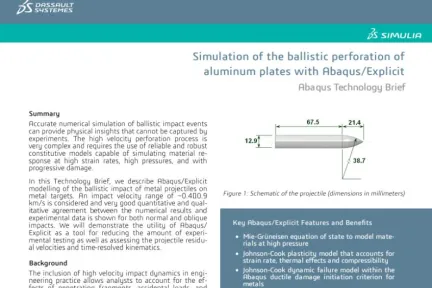
In this Technology Brief, we describe Abaqus/Explicit modelling of ballistic impact of metal projectiles on metal targets. An impact velocity range of ~0.4009 km/s is considered and very good quantitive and qualitative agreement between the numerical results and experimental data is shown for both normal and oblique impacts. We will demonstrate the utility of Abaqus/Explicit as a tool for reducing the amount of experimental testing as well as assessing the projectile residual velocities and time-resolved kinematics.

Tech Notes

Simulation of the ballistic perforation of aluminum plates with Abaqus/Explicit
There are 245 results

Customer stories

There are 129 results

From the communities

There are 6 results

SIMULIA Self Learning

We provide hundreds of self-learning modules so you can continue to learn at your convenience

Blogs

Read the SIMULIA blog on the latest news and innovations from our experts.

There are 694 results

Learn What SIMULIA Can Do for You

Speak with a SIMULIA expert to learn how our solutions enable seamless collaboration and sustainable innovation at organizations of every size.

Get Started

Courses and classes are available for students, academia, professionals and companies. Find the right SIMULIA training for you. 

Get Help

Find information on software & hardware certification, software downloads, user documentation, support contact and services offering