There are 1489 results
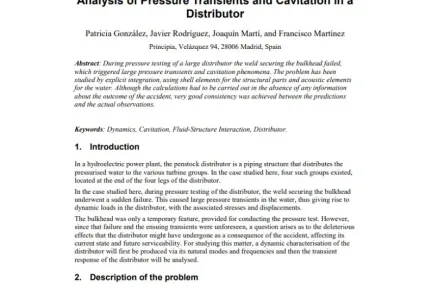
Analysis of Pressure Transients and Cavitation in a Distributor

During pressure testing of a large distributor the weld securing the bulkhead failed, which triggered large pressure transients and cavitation phenomena. The problem has been studied by explicit integration, using shell elements for the structural parts and acoustic elements for the water. Although the calculations had to be carried out in the absence of any information about the outcome of the accident, very good consistency was achieved between the predictions and the actual observations.

Customer Papers
Analysis of Pressure Transients and Cavitation in a Distributor
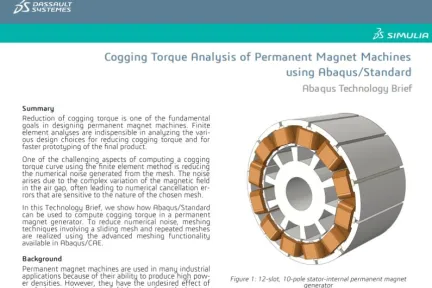
Cogging Torque Analysis of Permanent Magnet Machines using Abaqus/Standard

Reduction of cogging torque is one of the fundamental goals in designing permanent magnet machines. Finite element analyses are indispensible in analyzing the various design choices for reducing cogging torque and for faster prototyping of the final product. In this Technology Brief, we show how Abaqus/Standard can be used to compute cogging torque in a permanent magnet generator. To reduce numerical noise, meshing techniques involving a sliding mesh and repeated meshes are realized using the advanced meshing functionality available in Abaqus/CAE.

Tech Notes

Cogging Torque Analysis of Permanent Magnet Machines using Abaqus/Standard
3D Thermal Analysis of Li-ion Battery Cells with Various Geometries and Cooling Conditions Using Abaqus

Modeling thermal behavior of Li-ion cells for vehicle electrification applications is a challenging task. AVL has developed 3D-FEA models to simulate the electro-thermal behavior of Li-ion battery cells with various geometries using Abaqus. In these models, the Li-ion battery system is simplified and modeled as heterogeneous solid medium consisting of a single or multiple equivalent battery layers with composite electrical and thermal conductivities for the equivalent anode, cathode and separator. Thermal behaviors of cylindrical, prismatic and pouch Li-ion battery cells and modules were analyzed under different electrical loads and cooling conditions.

Customer Papers

3D Thermal Analysis of Li-ion Battery Cells with Various Geometries and Cooling Conditions Using Abaqus
Failure Analysis of Vise Jaw Holders

Sometime vise jaw holders of the hacksaw are broken due to accidental heavy loads or machine misusing. These broken part are the stationary and movable vise jaw holders and the connecter power screw between them. With the aim of investigating the failure of these components, a three dimensional finite element model for stress analysis has been performed. It starts by identifying the broken parts of the hacksaw machine. In addition, the material of the broken parts is identified, the CAD model is built, and the hacksaw mechanism is analyzed to get the accurate applied loads on the broken parts. After analyzing the model using Abaqus CAE software, the results show that the location of the high stresses are identical with the original broken parts.

Customer Papers

Failure Analysis of Vise Jaw Holders
FATIGUE ANALYSIS OF CENTRIFUGAL PUMPING EQUIPEMENT IMPELLER WITH FE-SAFE AND ABAQUS

Pumping equipment is used in oil refining plants to pump oil distillation products. This equipment has to withstand heavy combined hydrodynamic and thermal loads, and recently been reported to fail due to fatigue damage. The main problem appears to be crack growth on peripheral wheel parts. The wheel sustains fatigue damage in an accumulation period which is shorter than the maintenance period recommended by the manufacturer. A study of the wheel fatigue life has been conducted. A material investigation was also carried out to verify that the damage had indeed been caused by fatigue. An analytical solution developed is viable for crack growth study only, and cannot predict fatigue life.

Customer Papers

FATIGUE ANALYSIS OF CENTRIFUGAL PUMPING EQUIPEMENT IMPELLER WITH FE-SAFE AND ABAQUS
Realistic Simulation of NSM-CFRP Strengthened TBeam

This paper is a summary of finite element modeling approach used in the project for SC@UM Strengthening CFRP Challenge at FRPRCS-11. The modeling competition is to predict the behavior of a T-shaped reinforced concrete beam, shear and flexural strengthened with carbon reinforced polymer (CFRP) laminates according to the Near Surface Mounted (NSM) technique. A complete 3D Abaqus model was constructed to simulate the load displacement response of the CFRP laminates strengthened T-shaped reinforced concrete beam. Abaqus concrete damaged plasticity material model was employed to model concrete cracking/crushing failure. Embedded element was used to model concrete-rebar interaction.

Customer Papers

Realistic Simulation of NSM-CFRP Strengthened TBeam
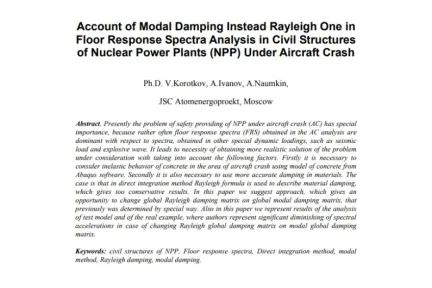
Account of Modal Damping Instead Rayleigh One in Floor Response Spectra Analysis in Civil Structures of Nuclear Power Plants Under Aircraft Crash

Presently the problem of safety providing of NPP under aircraft crash (AC) has special importance, because rather often floor response spectra (FRS) obtained in the AC analysis are dominant with respect to spectra, obtained in other special dynamic loadings, such as seismic load and explosive wave. In this paper we suggest approach, which gives an opportunity to change global Rayleigh damping matrix on global modal damping matrix, that previously was determined by special way. Also in this paper we represent results of the analysis of test model and of the real example, where authors represent significant diminishing of spectral accelerations in case of changing Rayleigh global damping matrix on modal global damping matrix.

Customer Papers

Account of Modal Damping Instead Rayleigh One in Floor Response Spectra Analysis in Civil Structures of Nuclear Power Plants Under Aircraft Crash
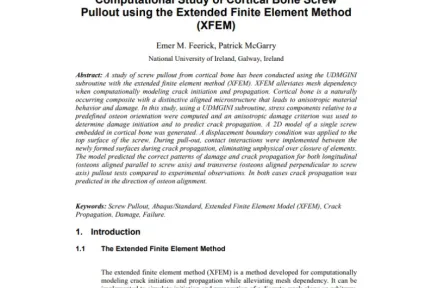
Computational Study of Cortical Bone Screw Pullout using the Extended Finite Element Method

A study of screw pullout from cortical bone has been conducted using the UDMGINI subroutine with the extended finite element method (XFEM). XFEM alleviates mesh dependency when computationally modeling crack initiation and propagation. Cortical bone is a naturally occurring composite with a distinctive aligned microstructure that leads to anisotropic material behavior and damage. In this study, using a UDMGINI subroutine, stress components relative to a predefined osteon orientation were computed and an anisotropic damage criterion was used to determine damage initiation and to predict crack propagation. A 2D model of a single screw embedded in cortical bone was generated. A displacement boundary condition was applied to the top surface of the screw.

Customer Papers

Computational Study of Cortical Bone Screw Pullout using the Extended Finite Element Method
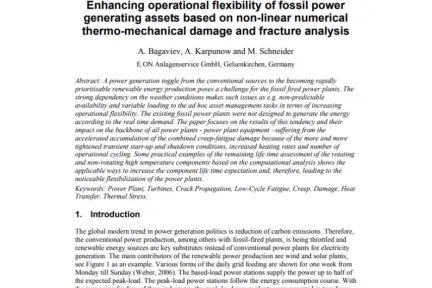
Enhancing operational flexibility of fossil power generating assets based on non-linear numerical thermo-mechanical damage and fracture analysis

A power generation toggle from the conventional sources to the becoming rapidly prioritisable renewable energy production poses a challenge for the fossil fired power plants. The strong dependency on the weather conditions makes such issues as e.g. non-predictable availability and variable loading to the ad hoc asset management tasks in terms of increasing operational flexibility. The paper focuses on the results of this tendency and their impact on the backbone of all power plants - power plant equipment –suffering from the accelerated accumulation of the combined creep-fatigue damage because of the more and more tightened transient start-up and shutdown conditions, increased heating rates and number of operational cycling.

Customer Papers

Enhancing operational flexibility of fossil power generating assets based on non-linear numerical thermo-mechanical damage and fracture analysis
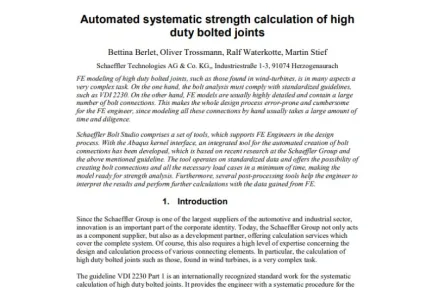
Automated systematic strength calculation of high duty bolted joints

FE modeling of high duty bolted joints, such as those found in wind-turbines, is in many aspects a very complex task. On the one hand, the bolt analysis must comply with standardized guidelines, such as VDI 2230. On the other hand, FE models are usually highly detailed and contain a large number of bolt connections. This makes the whole design process error-prone and cumbersome for the FE engineer, since modeling all these connections by hand usually takes a large amount of time and diligence.

Customer Papers

Automated systematic strength calculation of high duty bolted joints
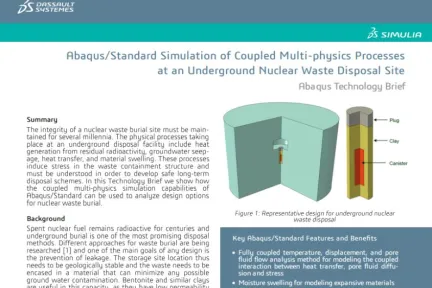
Abaqus/Standard Simulation of Coupled Multi-physics Processes at an Underground Nuclear Waste Disposal Site

The integrity of a nuclear waste burial site must be maintained for several millenia. The physical processes taking place at an underground disposal facility include seepage, heat transfer, and material swelling. These processes induce stress in the waste containment structure and must be understood in order to develop long-term disposal schemes. In this Technology Brief we show how the coupled multi-physics simulation capabilities of Abaqus/Standard can be used to analyze design options for nuclear waste burial.

Tech Notes

Abaqus/Standard Simulation of Coupled Multi-physics Processes at an Underground Nuclear Waste Disposal Site
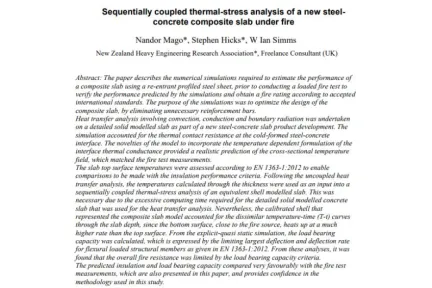
Sequentially coupled thermal-stress analysis of a new steelconcrete composite slab under fire

The paper describes the numerical simulations required to estimate the performance of a composite slab using a re-entrant profiled steel sheet, prior to conducting a loaded fire test to verify the performance predicted by the simulations and obtain a fire rating according to accepted international standards. The purpose of the simulations was to optimize the design of the composite slab, by eliminating unnecessary reinforcement bars. Heat transfer analysis involving convection, conduction and boundary radiation was undertaken on a detailed solid modelled slab as part of a new steel-concrete slab product development. The simulation accounted for the thermal contact resistance at the cold-formed steel-concrete interface.

Customer Papers

Sequentially coupled thermal-stress analysis of a new steelconcrete composite slab under fire
There are 245 results

Customer stories

There are 129 results

From the communities

There are 6 results

SIMULIA Self Learning

We provide hundreds of self-learning modules so you can continue to learn at your convenience

Blogs

Read the SIMULIA blog on the latest news and innovations from our experts.

There are 694 results

Learn What SIMULIA Can Do for You

Speak with a SIMULIA expert to learn how our solutions enable seamless collaboration and sustainable innovation at organizations of every size.

Get Started

Courses and classes are available for students, academia, professionals and companies. Find the right SIMULIA training for you. 

Get Help

Find information on software & hardware certification, software downloads, user documentation, support contact and services offering