There are 1489 results
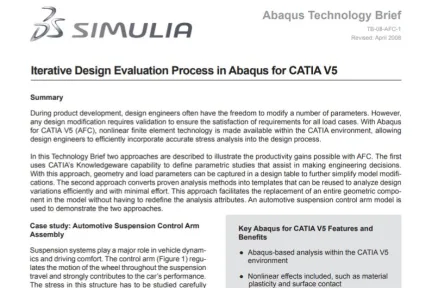
Iterative Design Evaluation Process in Abaqus for CATIA V5

In this Technology Brief two approaches are described to illustrate the productivity gains possible with AFC. The first uses CATIA’s Knowledgeware capability to define parametric studies that assist in making engineering decisions. With this approach, geometry and load parameters can be captured in a design table to further simplify model modifications. The second approach converts proven analysis methods into templates that can be reused to analyze design variations efficiently and with minimal effort.

Solution Briefs
Iterative Design Evaluation Process in Abaqus for CATIA V5
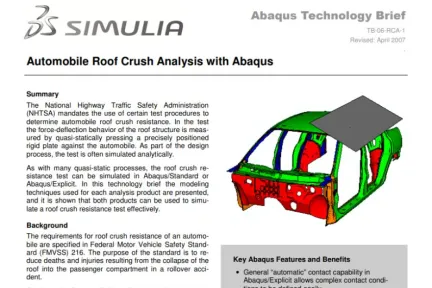
Automobile Roof Crush Analysis with Abaqus

As with many quasi-static processes, the roof crush resistance test can be simulated in Abaqus/Standard or Abaqus/Explicit. In this technology brief the modeling techniques used for each analysis product are presented, and it is shown that both products can be used to simulate a roof crush resistance test effectively.

Solution Briefs

Automobile Roof Crush Analysis with Abaqus
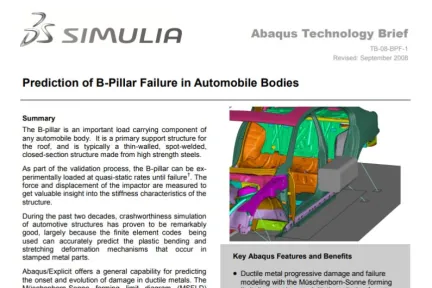
Prediction of B-Pillar Failure in Automobile Bodies

Abaqus/Explicit offers a general capability for predicting the onset and evolution of damage in ductile metals. The Müschenborn-Sonne forming limit diagram (MSFLD) damage initiation criterion allows for the prediction of necking instability in sheet metal. When combined with appropriate damage evolution criteria, sheet metal rupture initiated by necking can be captured in an Abaqus/ Explicit simulation. In this Technology Brief, the MSFLD criterion is employed to investigate the failure of a B-pillar structure. Abaqus/Explicit results are shown to match well with experimental data provided by BMW.

Solution Briefs

Prediction of B-Pillar Failure in Automobile Bodies
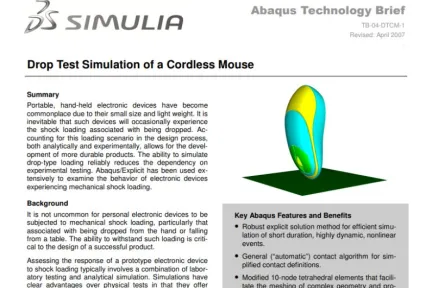
Drop Test Simulation of a Cordless Mouse

Portable, hand-held electronic devices have become commonplace due to their small size and light weight. It is inevitable that such devices will occasionally experience the shock loading associated with being dropped. Accounting for this loading scenario in the design process, both analytically and experimentally, allows for the development of more durable products. The ability to simulate drop-type loading reliably reduces the dependency on experimental testing. Abaqus/Explicit has been used extensively to examine the behavior of electronic devices experiencing mechanical shock loading.

Solution Briefs

Drop Test Simulation of a Cordless Mouse
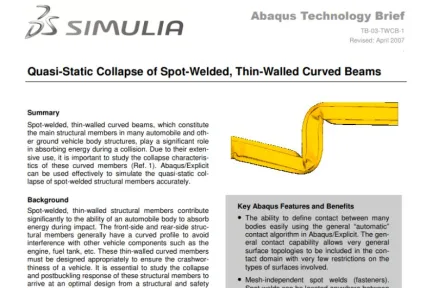
Quasi-Static Collapse of Spot-Welded, Thin-Walled Curved Beams

Spot-welded, thin-walled curved beams, which constitute the main structural members in many automobile and other ground vehicle body structures, play a significant role in absorbing energy during a collision. Due to their extensive use, it is important to study the collapse characteristics of these curved members. Abaqus/Explicit can be used effectively to simulate the quasi-static collapse of spot-welded structural members accurately.

Solution Briefs

Quasi-Static Collapse of Spot-Welded, Thin-Walled Curved Beams
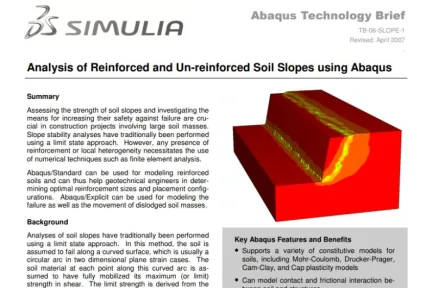
Analysis of Reinforced and Un-reinforced Soil Slopes using Abaqus

Assessing the strength of soil slopes and investigating the means for increasing their safety against failure are crucial in construction projects involving large soil masses. Slope stability analyses have traditionally been performed using a limit state approach. However, any presence of reinforcement or local heterogeneity necessitates the use of numerical techniques such as finite element analysis. Abaqus/Standard can be used for modeling reinforced soils and can thus help geotechnical engineers in determining optimal reinforcement sizes and placement configurations. Abaqus/Explicit can be used for modeling the failure as well as the movement of dislodged soil masses.

Solution Briefs

Analysis of Reinforced and Un-reinforced Soil Slopes using Abaqus
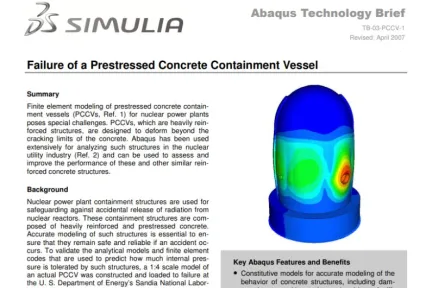
Failure of a Prestressed Concrete Containment Vessel

Finite element modeling of prestressed concrete containment vessels (PCCVs) for nuclear power plants poses special challenges. PCCVs, which are heavily reinforced structures, are designed to deform beyond the cracking limits of the concrete. Abaqus has been used extensively for analyzing such structures in the nuclear utility industry and can be used to assess and improve the performance of these and other similar reinforced concrete structures.

Solution Briefs

Failure of a Prestressed Concrete Containment Vessel
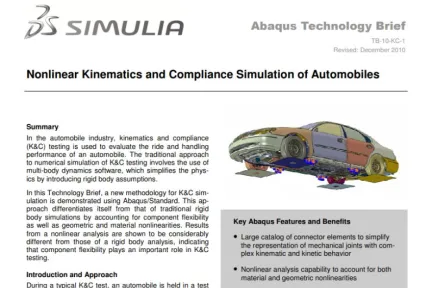
Nonlinear Kinematics and Compliance Simulation of Automobiles

In this Technology Brief, a new methodology for K&C simulation is demonstrated using Abaqus/Standard. This approach differentiates itself from that of traditional rigid body simulations by accounting for component flexibility as well as geometric and material nonlinearities. Results from a nonlinear analysis are shown to be considerably different from those of a rigid body analysis, indicating that component flexibility plays an important role in K&C testing.

Solution Briefs

Nonlinear Kinematics and Compliance Simulation of Automobiles
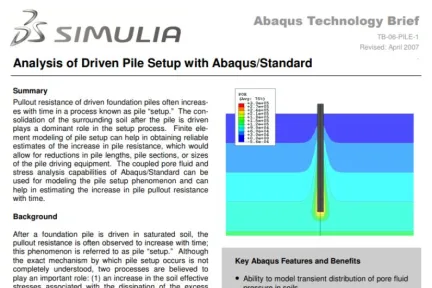
Analysis of Driven Pile Setup with AbaqusStandard

Pullout resistance of driven foundation piles often increases with time in a process known as pile “setup.” The consolidation of the surrounding soil after the pile is driven plays a dominant role in the setup process. Finite element modeling of pile setup can help in obtaining reliable estimates of the increase in pile resistance, which would allow for reductions in pile lengths, pile sections, or sizes of the pile driving equipment. The coupled pore fluid and stress analysis capabilities of Abaqus/Standard can be used for modeling the pile setup phenomenon and can help in estimating the increase in pile pullout resistance with time.

Solution Briefs

Analysis of Driven Pile Setup with AbaqusStandard
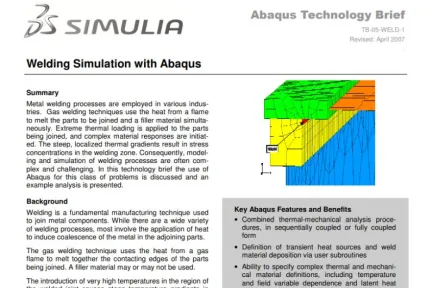
Welding Simulation with Abaqus

Metal welding processes are employed in various industries. Gas welding techniques use the heat from a flame to melt the parts to be joined and a filler material simultaneously. Extreme thermal loading is applied to the parts being joined, and complex material responses are initiated. The steep, localized thermal gradients result in stress concentrations in the welding zone. Consequently, modeling and simulation of welding processes are often complex and challenging. In this technology brief the use of Abaqus for this class of problems is discussed and an example analysis is presented.

Solution Briefs

Welding Simulation with Abaqus
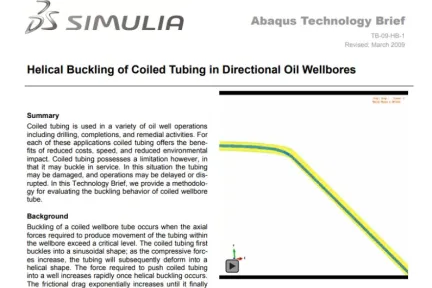
Helical Buckling of Coiled Tubing in Directional Oil Wellbores

Coiled tubing is used in a variety of oil well operations including drilling, completions, and remedial activities. For each of these applications coiled tubing offers the benefits of reduced costs, speed, and reduced environmental impact. Coiled tubing possesses a limitation however, in that it may buckle in service. In this situation the tubing may be damaged, and operations may be delayed or disrupted. In this Technology Brief, we provide a methodology for evaluating the buckling behavior of coiled wellbore tube.

Solution Briefs

Helical Buckling of Coiled Tubing in Directional Oil Wellbores
There are 245 results

Customer stories

There are 129 results

From the communities

There are 6 results

SIMULIA Self Learning

We provide hundreds of self-learning modules so you can continue to learn at your convenience

Blogs

Read the SIMULIA blog on the latest news and innovations from our experts.

There are 694 results

Learn What SIMULIA Can Do for You

Speak with a SIMULIA expert to learn how our solutions enable seamless collaboration and sustainable innovation at organizations of every size.

Get Started

Courses and classes are available for students, academia, professionals and companies. Find the right SIMULIA training for you. 

Get Help

Find information on software & hardware certification, software downloads, user documentation, support contact and services offering