There are 1489 results
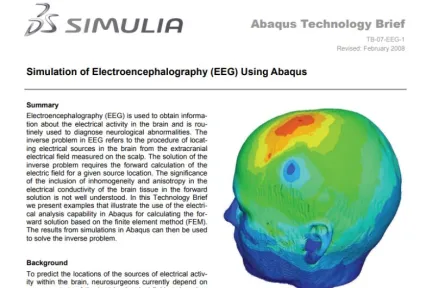
Simulation of Electroencephalography Using Abaqus

In this Technology Brief we present some results from simulations performed on a model of a human head [4]. The distributions of electrical potentials and currents within the model are calculated for known source locations in the brain. The electrical conductivity in the model is considered to be inhomogeneous as well as anisotropic.

Solution Briefs

Simulation of Electroencephalography Using Abaqus
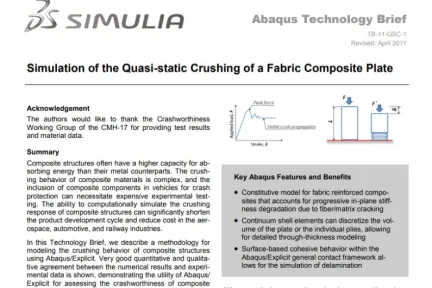
Simulation of the Quasi-static Crushing of a Fabric Composite Plate

In this Technology Brief, we describe a methodology for modeling the crushing behavior of composite structures using Abaqus/Explicit. Very good quantitative and qualitative agreement between the numerical results and experimental data is shown, demonstrating the utility of Abaqus/ Explicit for assessing the crashworthiness of composite structures and reducing the amount of costly experimental testing.

Solution Briefs

Simulation of the Quasi-static Crushing of a Fabric Composite Plate
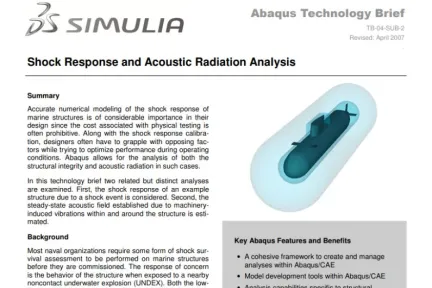
Shock Response and Acoustic Radiation Analysis

In this technology brief two related but distinct analyses are examined. First, the shock response of an example structure due to a shock event is considered. Second, the steady-state acoustic field established due to machineryinduced vibrations within and around the structure is estimated.

Solution Briefs

Shock Response and Acoustic Radiation Analysis
Dynamic Design Analysis Method Response Spectrum Analysis with Abaqus

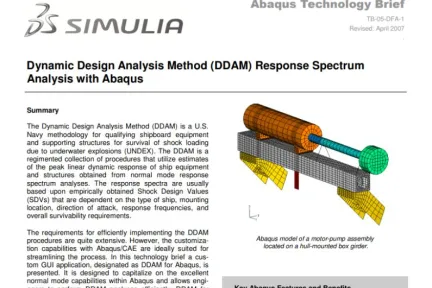
The Dynamic Design Analysis Method (DDAM) is a U.S. Navy methodology for qualifying shipboard equipment and supporting structures for survival of shock loading due to underwater explosions (UNDEX). The DDAM is a regimented collection of procedures that utilize estimates of the peak linear dynamic response of ship equipment and structures obtained from normal mode response spectrum analyses. The response spectra are usually based upon empirically obtained Shock Design Values (SDVs) that are dependent on the type of ship, mounting location, direction of attack, response frequencies, and overall survivability requirements.

Solution Briefs

Dynamic Design Analysis Method Response Spectrum Analysis with Abaqus
Filament Wound Composite Pressure Vessel Analysis with Abaqus

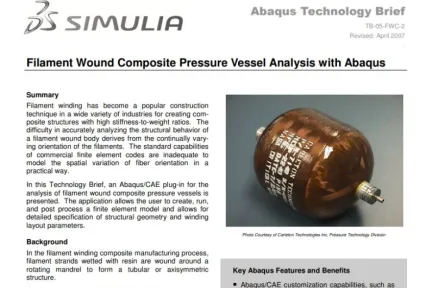
In this Technology Brief, an Abaqus/CAE plug-in for the analysis of filament wound composite pressure vessels is presented. The application allows the user to create, run, and post process a finite element model and allows for detailed specification of structural geometry and winding layout parameters.

Solution Briefs

Filament Wound Composite Pressure Vessel Analysis with Abaqus
Optimisation of Welds with Manufacturing Considerations

Fatigue is the main in-service failure mode for automotive chassis & suspension parts, especially weld fatigue. Over the years, Tata Steel Automotive Engineering (TSAE) has developed techniques for CAE durability assessment including the optimisation of seam-welded chassis/suspension structures. Seam weld optimisation at TSAE has previously been based on a constant weld length and constant gap between welds for each weld run. This method has two drawbacks; weld patterns generated are regular in nature, reducing the flexibility to position welds where they are most effective and· excessively short welds are often left at the end of a run of welds. The objective was to develop an improved optimisation technique using Isight that always produced a manufacturing feasible design and allowed more flexible and irregular positioning of welds. Manufacturing constraints considered were minimum weld length, minimum gap length and minimising the number of start/stop operations.

Customer Papers

Optimisation of Welds with Manufacturing Considerations
Water Landing of Space Flight Re-entry Vehicles Using AbaqusExplicit

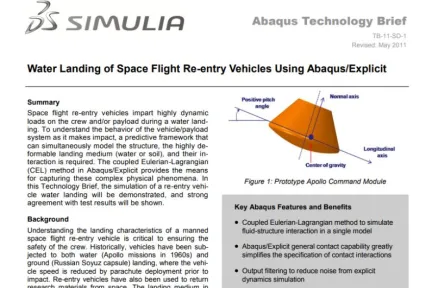
Space flight re-entry vehicles impart highly dynamic loads on the crew and/or payload during a water landing. To understand the behavior of the vehicle/payload system as it makes impact, a predictive framework that can simultaneously model the structure, the highly deformable landing medium (water or soil), and their interaction is required. The coupled Eulerian-Lagrangian (CEL) method in Abaqus/Explicit provides the means for capturing these complex physical phenomena. In this Technology Brief, the simulation of a re-entry vehicle water landing will be demonstrated, and strong agreement with test results will be shown.

Solution Briefs

Water Landing of Space Flight Re-entry Vehicles Using AbaqusExplicit
Lowest cost printer chassis design that would pass a series of transportation drop tests, utilizing design of experiments in conjunction with Abaqcus/ Explicit analysis.

A printer chassis provides an important function of locating and securing the relative position of all the sub-systems that makeup a printer. The customer location could be thousands of miles away from the factory and many modes of transportation are required from ship, train, trucks, forklift, to pushing across corridors, stairs and elevators. The transportation loads are the most sever the printer would see in its life time. These include impacts on all sides at 3 MPH to an 8 inch vertical drop. In today’s competitive market cost is as critical a function as performance to succeed in the market. To design the lowest cost chassis, 3 large highly stressed parts in the chassis were optimized for cost. Two parameters; sheet metal thickness, and material strength were used to minimize the chassis cost provided the combination passed each one of the six unique transportation tests. A six factor, two levels, Taguchi L12 matrix was utilized for the design of experiment (DOE). Abaqus/ Explicit analysis were used for virtual transportation testing to compute the output responses of the DOE. The design optimization exercise resulted in an addition 6% cost savings.

Customer Papers

Lowest cost printer chassis design that would pass a series of transportation drop tests, utilizing design of experiments in conjunction with Abaqcus/ Explicit analysis.
Full Vehicle NVH Analysis with Rolling Tires

Abaqus offers a methodology to include the pre-loading and gyroscopic effects of rolling tires in a forced response dynamic analysis of the moving vehicle. This article closely follows SIMULIA Technology Brief TB-08-TVC-1 and illustrates the use of substructures in a typical NVH analysis for a full vehicle model with steadily rolling tires.

Solution Briefs

Full Vehicle NVH Analysis with Rolling Tires
Simulation of Implantable Nitinol Stents

Self-expanding micro devices (stents) are cylindrical metal mesh tubes, made of materials such as Nitinol, that are inserted into blood vessels to counteract the effects associated with vascular diseases, such as narrowing of the blood vessels due to plaque build-up. Nitinol stents can be manufactured from thin tubes into which a pattern is electromachined. After a sequence of operations, a stent is mounted on a catheter and inserted into a blood vessel. After being released by this delivery system, the stent self-expands and exerts a radial force on the wall of the blood vessel.

Solution Briefs

Simulation of Implantable Nitinol Stents
There are 245 results

Customer stories

There are 129 results

From the communities

There are 6 results

SIMULIA Self Learning

We provide hundreds of self-learning modules so you can continue to learn at your convenience

Blogs

Read the SIMULIA blog on the latest news and innovations from our experts.

There are 694 results

Learn What SIMULIA Can Do for You

Speak with a SIMULIA expert to learn how our solutions enable seamless collaboration and sustainable innovation at organizations of every size.

Get Started

Courses and classes are available for students, academia, professionals and companies. Find the right SIMULIA training for you. 

Get Help

Find information on software & hardware certification, software downloads, user documentation, support contact and services offering