There are 1489 results
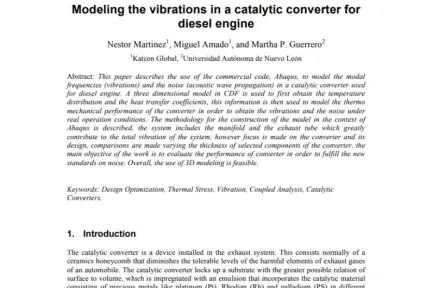
Modeling the vibrations in a catalytic converter for diesel engine

This paper describes the use of the commercial code, Abaqus, to model the modal frequencies (vibrations) and the noise (acoustic wave propagation) in a catalytic converter used for diesel engine. A three dimensional model in CDF is used to first obtain the temperature distribution and the heat transfer coefficients, this information is then used to model the thermo mechanical performance of the converter in order to obtain the vibrations and the noise under real operation conditions.

Customer Papers
Modeling the vibrations in a catalytic converter for diesel engine
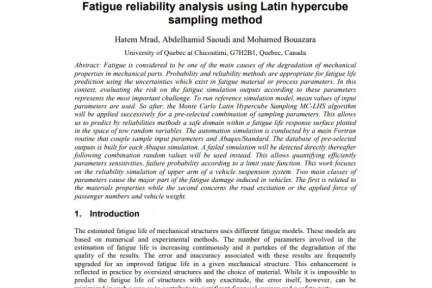
Fatigue reliability analysis using Latin hypercube sampling method

Fatigue is considered to be one of the main causes of the degradation of mechanical properties in mechanical parts. Probability and reliability methods are appropriate for fatigue life prediction using the uncertainties which exist in fatigue material or process parameters. In this context, evaluating the risk on the fatigue simulation outputs according to these parameters represents the most important challenge. To run reference simulation model, mean values of input parameters are used.

Customer Papers

Fatigue reliability analysis using Latin hypercube sampling method
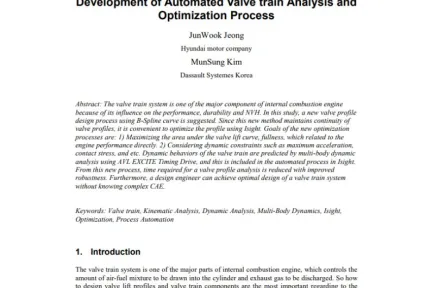
Development of Automated Valve train Analysis and Optimization Process

The valve train system is one of the major component of internal combustion engine because of its influence on the performance, durability and NVH. In this study, a new valve profile design process using B-Spline curve is suggested. Since this new method maintains continuity of valve profiles, it is convenient to optimize the profile using Isight.

Customer Papers

Development of Automated Valve train Analysis and Optimization Process
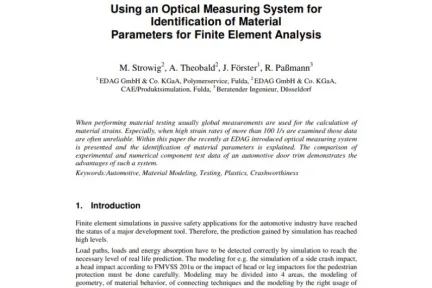
Using an Optical Measuring System for Identification of Material Parameters for Finite Element Analysis

When performing material testing usually global measurements are used for the calculation of material strains. Especially, when high strain rates of more than 100 1/s are examined those data are often unreliable. Within this paper the recently at EDAG introduced optical measuring system is presented and the identification of material parameters is explained. The comparison of experimental and numerical component test data of an automotive door trim demonstrates the advantages of such a system.

Customer Papers

Using an Optical Measuring System for Identification of Material Parameters for Finite Element Analysis
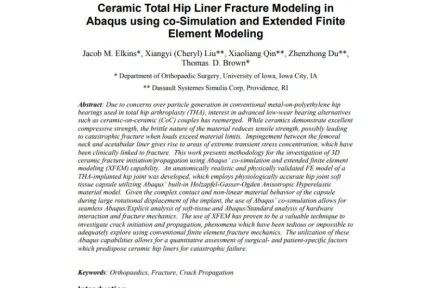
Ceramic Total Hip Liner Fracture Modeling in Abaqus using co-Simulation and Extended Finite Element Modeling

Due to concerns over particle generation in conventional metal-on-polyethylene hip bearings used in total hip arthroplasty, interest in advanced low-wear bearing alternatives such as ceramic-on-ceramic couples has reemerged. While ceramics demonstrate excellent compressive strength, the brittle nature of the material reduces tensile strength, possibly leading to catastrophic fracture when loads exceed material limits. Impingement between the femoral neck and acetabular liner gives rise to areas of extreme transient stress concentration, which have been clinically linked to fracture. This work presents methodology for the investigation of 3D ceramic fracture initiation/propagation using Abaqus’ co-simulation and extended finite element modeling capability.

Customer Papers

Ceramic Total Hip Liner Fracture Modeling in Abaqus using co-Simulation and Extended Finite Element Modeling
Material Modeling of Polylactide

Computational modeling of stents can provide insight into critical locations (high stress/strain regions), help with design iterations/optimization, and reduce the need for bench-top testing. This study focuses on the developmental efforts to create a material model that can capture the mechanical response of poly-L-lactide, the backbone of Abbott Vascular’s ABSORB Bioresorbable Vascular Scaffold.

Customer Papers

Material Modeling of Polylactide
High Performance Computing and CAE within a modern Engineering Environment

The state of the current automotive or heavy duty industries is changing rapidly, especially with the recent recession still in mind or to some extend still looming. In such an environment the competitiveness of a company is tested on every step. Engineering-based companies have to re-define their strategies, what means engineering to them.

Customer Papers

High Performance Computing and CAE within a modern Engineering Environment
Modelling an Advanced Gas-Cooled Reactor Core using ABAQUS

An irradiated graphite material UMAT subroutine models the through life behaviour of the core components, but the whole core structure is so large with many interactions that an ABAQUS model would normally put excessive demands on computational resources. However this difficulty has been overcome by making use of superelements and parallel programming.

Customer Papers

Modelling an Advanced Gas-Cooled Reactor Core using ABAQUS
Biomechanical study of a drop foot brace

A person specific drop foot brace was simulated in the commercial finite element code Abaqus.The geometry was imported from a 3D optical scan of the actual surface and modeled as a composite material layup defined in a local discrete material coordinate system. The finite element model was used in order to model the stance phase in a normal walking. The material choice is a challenging task giving flexibility to the brace together with sufficiently stiffness and fatigue strength. The simulation has been compared with measurements from a strain gauge mounted foot brace tested in use. Based on simulations, a large number of expensive trial and error iterations can be avoided. Simulations show a strong geometry interaction with the loading of the material.

Customer Papers

Biomechanical study of a drop foot brace
Optimization in the Vibro-Acoustic Design of Hearing Instruments

Maximizing gain while minimizing the possibility of feedback requires an optimal choice of design parameters. In this Technology Brief, we outline how Abaqus/Standard and Isight can be combined in a process to optimize the vibro-acoustic characteristics of hearing instruments.

Solution Briefs

Optimization in the Vibro-Acoustic Design of Hearing Instruments
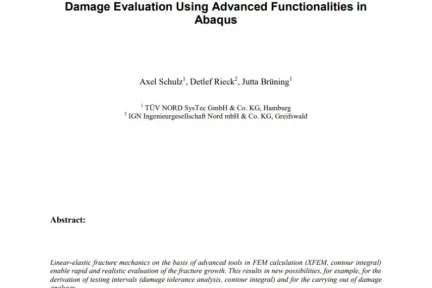
Damage Evaluation Using Advanced Functionalities in Abaqus

Linear-elastic fracture mechanics on the basis of advanced tools in FEM calculation (XFEM, contour integral) enable rapid and realistic evaluation of the fracture growth. This results in new possibilities, for example, for the derivation of testing intervals (damage tolerance analysis, contour integral) and for the carrying out of damage analyses. Using an industrial example, procedures and results of the Abaqus-supported determination of stress intensity factors will be explained. Considerations for the calculation of the fracture course with a dominant strain-induced load will be discussed.

Customer Papers

Damage Evaluation Using Advanced Functionalities in Abaqus
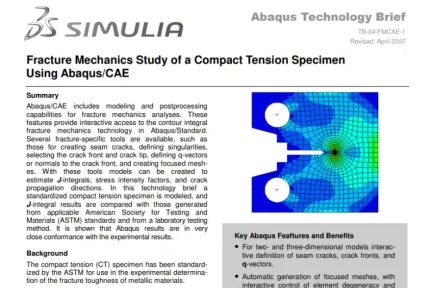
Fracture Mechanics Study of a Compact Tension Specimen Using Abaqus/CAE

Abaqus/CAE includes modeling and postprocessing capabilities for fracture mechanics analyses. These features provide interactive access to the contour integral fracture mechanics technology in Abaqus/Standard. Several fracture-specific tools are available, such as those for creating seam cracks, defining singularities, selecting the crack front and crack tip, defining q-vectors or normals to the crack front, and creating focused meshes. With these tools models can be created to estimate J-integrals, stress intensity factors, and crack propagation directions. In this technology brief a standardized compact tension specimen is modeled, and J-integral results are compared with those generated from applicable American Society for Testing and Materials (ASTM) standards and from a laboratory testing method. It is shown that Abaqus results are in very close conformance with the experimental results.

Solution Briefs

Fracture Mechanics Study of a Compact Tension Specimen Using Abaqus/CAE
There are 245 results

Customer stories

There are 129 results

From the communities

There are 6 results

SIMULIA Self Learning

We provide hundreds of self-learning modules so you can continue to learn at your convenience

Blogs

Read the SIMULIA blog on the latest news and innovations from our experts.

There are 694 results

Learn What SIMULIA Can Do for You

Speak with a SIMULIA expert to learn how our solutions enable seamless collaboration and sustainable innovation at organizations of every size.

Get Started

Courses and classes are available for students, academia, professionals and companies. Find the right SIMULIA training for you. 

Get Help

Find information on software & hardware certification, software downloads, user documentation, support contact and services offering