There are 1489 results
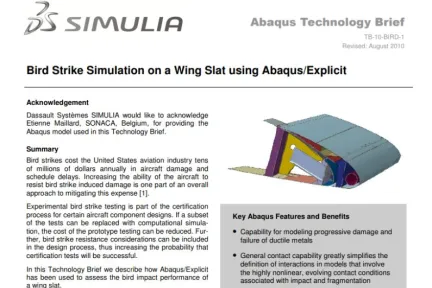
Bird Strike Simulation on a Wing Slat using AbaqusExplicit

Experimental bird strike testing is part of the certification process for certain aircraft component designs. If a subset of the tests can be replaced with computational simulation, the cost of the prototype testing can be reduced. Further, bird strike resistance considerations can be included in the design process, thus increasing the probability that certification tests will be successful. In this Technology Brief we describe how Abaqus/Explicit has been used to assess the bird impact performance of a wing slat.

Solution Briefs
Bird Strike Simulation on a Wing Slat using AbaqusExplicit
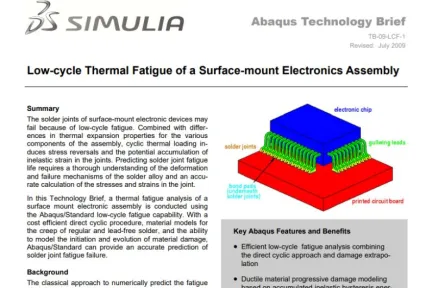
Low-cycle Thermal Fatigue of a Surface-mount Electronics Assembly

In this Technology Brief, a thermal fatigue analysis of a surface mount electronic assembly is conducted using the Abaqus/Standard low-cycle fatigue capability. With a cost efficient direct cyclic procedure, material models for the creep of regular and lead-free solder, and the ability to model the initiation and evolution of material damage, Abaqus/Standard can provide an accurate prediction of solder joint fatigue failure.

Solution Briefs

Low-cycle Thermal Fatigue of a Surface-mount Electronics Assembly
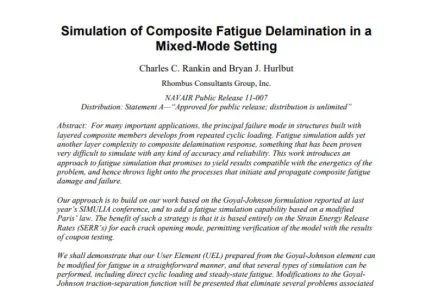
Simulation of Composite Fatigue Delamination in a Mixed-Mode Setting

For many important applications, the principal failure mode in structures built with layered composite members develops from repeated cyclic loading. Fatigue simulation adds yet another layer complexity to composite delamination response, something that has been proven very difficult to simulate with any kind of accuracy and reliability. This work introduces an approach to fatigue simulation that promises to yield results compatible with the energetics of the problem, and hence throws light onto the processes that initiate and propagate composite fatigue damage and failure.

Customer Papers

Simulation of Composite Fatigue Delamination in a Mixed-Mode Setting
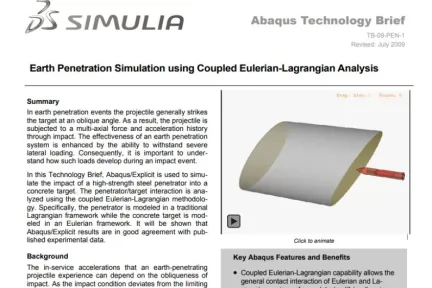
Earth Penetration Simulation using Coupled Eulerian-Lagrangian Analysis

In this Technology Brief, Abaqus/Explicit is used to simulate the impact of a high-strength steel penetrator into a concrete target. The penetrator/target interaction is analyzed using the coupled Eulerian-Lagrangian methodology. Specifically, the penetrator is modeled in a traditional Lagrangian framework while the concrete target is modeled in an Eulerian framework. It will be shown that Abaqus/Explicit results are in good agreement with published experimental data.

Solution Briefs

Earth Penetration Simulation using Coupled Eulerian-Lagrangian Analysis
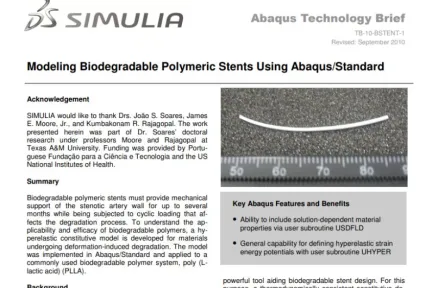
Modeling Biodegradable Polymeric Stents Using Abaqus/Standard

Biodegradable polymeric stents must provide mechanical support of the stenotic artery wall for up to several months while being subjected to cyclic loading that affects the degradation process. To understand the applicability and efficacy of biodegradable polymers, a hyperelastic constitutive model is developed for materials undergoing deformation-induced degradation. The model was implemented in Abaqus/Standard and applied to a commonly used biodegradable polymer system, poly (Llactic acid) (PLLA).

Solution Briefs

Modeling Biodegradable Polymeric Stents Using Abaqus/Standard
Creep Analysis of Lead-Free Solders Undergoing Thermal Loading

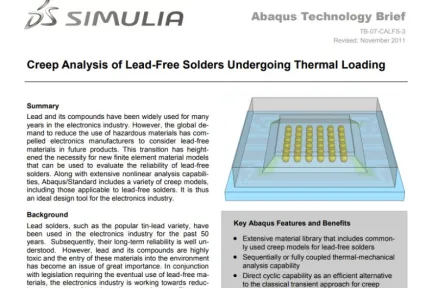
Lead and its compounds have been widely used for many years in the electronics industry. However, the global demand to reduce the use of hazardous materials has compelled electronics manufacturers to consider lead-free materials in future products. This transition has heightened the necessity for new finite element material models that can be used to evaluate the reliability of lead-free solders. Along with extensive nonlinear analysis capabilities, Abaqus/Standard includes a variety of creep models, including those applicable to lead-free solders. It is thus an ideal design tool for the electronics industry.

Solution Briefs

Creep Analysis of Lead-Free Solders Undergoing Thermal Loading
Simulation of Adaptive Bone Remodeling with Abaqus/Standard

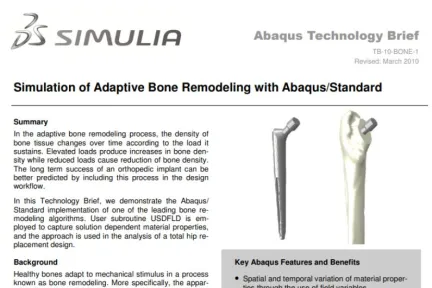
In this Technology Brief, we demonstrate the Abaqus/ Standard implementation of one of the leading bone remodeling algorithms. User subroutine USDFLD is employed to capture solution dependent material properties, and the approach is used in the analysis of a total hip replacement design.

Solution Briefs

Simulation of Adaptive Bone Remodeling with Abaqus/Standard
Modeling the Interaction of Subsea Pipelines with the Seabed

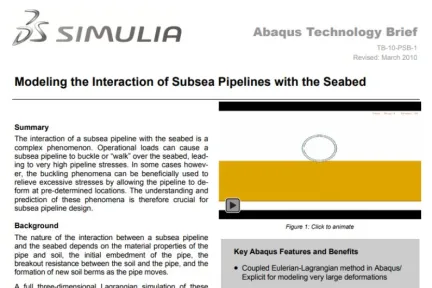
The interaction of a subsea pipeline with the seabed is a complex phenomenon. Operational loads can cause a subsea pipeline to buckle or “walk” over the seabed, leading to very high pipeline stresses. In some cases however, the buckling phenomena can be beneficially used to relieve excessive stresses by allowing the pipeline to deform at pre-determined locations. The understanding and prediction of these phenomena is therefore crucial for subsea pipeline design.

Solution Briefs

Modeling the Interaction of Subsea Pipelines with the Seabed
Bottle Conveying System Analysis

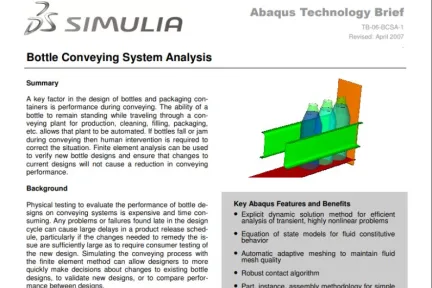
A key factor in the design of bottles and packaging containers is performance during conveying. The ability of a bottle to remain standing while traveling through a conveying plant for production, cleaning, filling, packaging, etc. allows that plant to be automated. If bottles fall or jam during conveying then human intervention is required to correct the situation. Finite element analysis can be used to verify new bottle designs and ensure that changes to current designs will not cause a reduction in conveying performance.

Solution Briefs

Bottle Conveying System Analysis
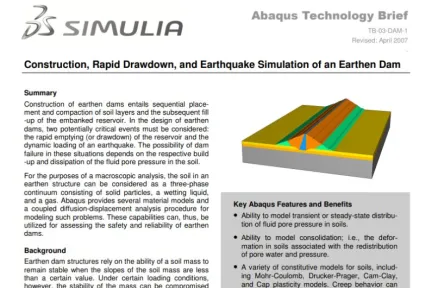
Construction, Rapid Drawdown, and Earthquake Simulation of an Earthen Dam

Construction of earthen dams entails sequential placement and compaction of soil layers and the subsequent fill -up of the embanked reservoir. In the design of earthen dams, two potentially critical events must be considered: the rapid emptying (or drawdown) of the reservoir and the dynamic loading of an earthquake. The possibility of dam failure in these situations depends on the respective build -up and dissipation of the fluid pore pressure in the soil.

Solution Briefs

Construction, Rapid Drawdown, and Earthquake Simulation of an Earthen Dam
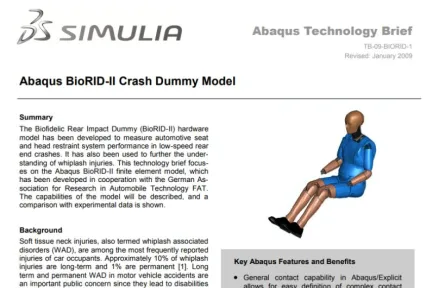
Abaqus BioRID-II Crash Dummy Model

The Biofidelic Rear Impact Dummy (BioRID-II) hardware model has been developed to measure automotive seat and head restraint system performance in low-speed rear end crashes. It has also been used to further the understanding of whiplash injuries. This technology brief focuses on the Abaqus BioRID-II finite element model, which has been developed in cooperation with the German Association for Research in Automobile Technology FAT. The capabilities of the model will be described, and a comparison with experimental data is shown.

Solution Briefs

Abaqus BioRID-II Crash Dummy Model
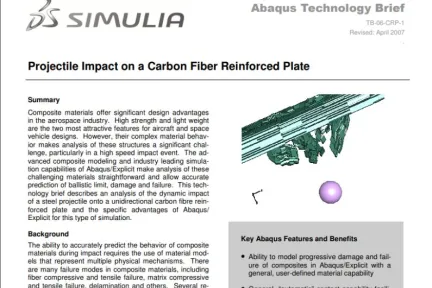
Projectile Impact on a Carbon Fiber Reinforced Plate

Composite materials offer significant design advantages in the aerospace industry. High strength and light weight are the two most attractive features for aircraft and space vehicle designs. However, their complex material behavior makes analysis of these structures a significant challenge, particularly in a high speed impact event. The advanced composite modeling and industry leading simulation capabilities of Abaqus/Explicit make analysis of these challenging materials straightforward and allow accurate prediction of ballistic limit, damage and failure. This technology brief describes an analysis of the dynamic impact of a steel projectile onto a unidirectional carbon fibre reinforced plate and the specific advantages of Abaqus/ Explicit for this type of simulation.

Solution Briefs

Projectile Impact on a Carbon Fiber Reinforced Plate
There are 245 results

Customer stories

There are 129 results

From the communities

There are 6 results

SIMULIA Self Learning

We provide hundreds of self-learning modules so you can continue to learn at your convenience

Blogs

Read the SIMULIA blog on the latest news and innovations from our experts.

There are 694 results

Learn What SIMULIA Can Do for You

Speak with a SIMULIA expert to learn how our solutions enable seamless collaboration and sustainable innovation at organizations of every size.

Get Started

Courses and classes are available for students, academia, professionals and companies. Find the right SIMULIA training for you. 

Get Help

Find information on software & hardware certification, software downloads, user documentation, support contact and services offering