There are 1489 results
Analysis of Crack Propagation in Polyurethane Panels Subject to Cyclic Compressive Buckling

When a panel of an elastomeric material, such as polyurethane, is subject to large cyclic in-plane displacements which result in cyclic compressive buckling, cracks will be observed to form at the center and edges of the panel. These cracks tend to propagate across the panel in the region of maximum deflection. If the magnitude of the applied cyclic deflection is held constant, the crack growth rate is observed to be nearly a constant over much of the width of the panel. This paper will present a method for evaluating the strain energy release rate in compressively flexed elastomeric panels and present results showing the influence of basic geometric parameters on the strain energy release rate.

Customer Papers
Analysis of Crack Propagation in Polyurethane Panels Subject to Cyclic Compressive Buckling
Mesh Human Phantoms with MCNP

Improvements in technology and computing have provided highly detailed representations of the human body for biomedical simulations. One specific application is the use of these computational phantoms for particle transport in MCNP, a general purpose particle transport code developed by Los Alamos National Laboratory (LANL). Traditional mathematical based phantoms, such as the ICRP 23 Reference Man, MIRD-5 Adult Male and the Snyder phantom, use equations to specify the surfaces and volumes of organs within the body. Image based models, such as the Visible Photographic Man (VIP-Man), Zubal model, and Extended cardiac-torso (XCAT), use segmented CT and MRI data to construct a three dimensional model of the body.

Customer Papers

Mesh Human Phantoms with MCNP
A plasticity and damage model for fiber reinforced polymers

The Abaqus damage model for fiber reinforced plastics has been reimplemented as UMAT user material. As an extension, the plastic behavior of the matrix material is taken into account. Therefore, two modes are considered independently from each other: matrix shear and matrix compression. The original as well as the new material model have been verified by means of single element tests, mesh dependency tests, and the standard plate-with-a-hole problem. In addition, a shell-type structure, namely an industrial model of the Boeing-777 Winglet, has been analyzed.

Customer Papers

A plasticity and damage model for fiber reinforced polymers
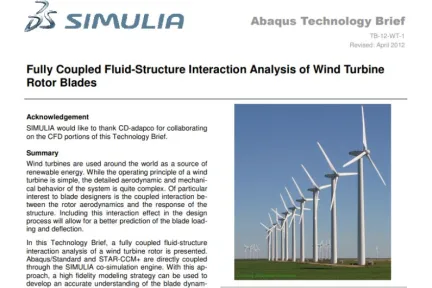
Fully Coupled Fluid-Structure Interaction Analysis of Wind Turbine Rotor Blades

In this Technology Brief, a fully coupled fluid-structure interaction analysis of a wind turbine rotor is presented. Abaqus/Standard and STAR-CCM+ are directly coupled through the SIMULIA co-simulation engine. With this approach, a high fidelity modeling strategy can be used to develop an accurate understanding of the blade dynamics.

Solution Briefs

Fully Coupled Fluid-Structure Interaction Analysis of Wind Turbine Rotor Blades
Simulation of Beneficial Compressive Residual Stress Fields as Design Tool in Manufacturing Internally Pressurized Parts

: Internally pressurized steel parts, such as components of fuel injection systems, are often treated with manufacturing processes which selectively induce beneficial compressive residual stresses. An available manufacturing technology to do so is hydraulic Autofrettage (AF). With the help of a single over-pressurization, the compressive residual stress field is established right at the most failure critical area of the components, e.g. around the bore in a thick-walled cylinder or at the bore intersection in a pressure distributor block. This allows for the full exploitation of the material potential and the successful implementation of lightweight design concepts. This paper presents several approaches to model the material behavior and the corresponding residual stress generation during AF for two representative geometries.

Customer Papers

Simulation of Beneficial Compressive Residual Stress Fields as Design Tool in Manufacturing Internally Pressurized Parts
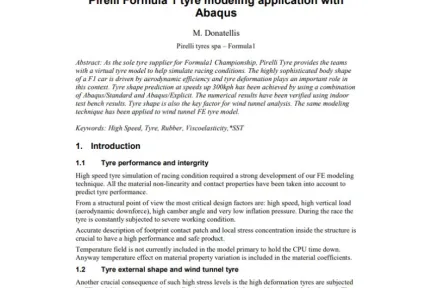
Pirelli Formula 1 tyre modeling application with Abaqus

As the sole tyre supplier for Formula1 Championship, Pirelli Tyre provides the teams with a virtual tyre model to help simulate racing conditions. The highly sophisticated body shape of a F1 car is driven by aerodynamic efficiency and tyre deformation plays an important role in this context. Tyre shape prediction at speeds up 300kph has been achieved by using a combination of Abaqus/Standard and Abaqus/Explicit. The numerical results have been verified using indoor test bench results. Tyre shape is also the key factor for wind tunnel analysis. The same modeling technique has been applied to wind tunnel FE tyre model.

Customer Papers

Pirelli Formula 1 tyre modeling application with Abaqus
Integrated Tool for Strain Extraction in Virtual Testing

This paper presents an automated approach to extract strains of aircraft structural models from widely used CAD and FE environments. The developed approach has been implemented as an integrated tool in widely used CATIA V5 and Abaqus environments. The integrated tool eliminates tedious procedures involved in manual extraction of strains using FEA models at appropriate strain gage locations. This integrated tool is a quick, inexpensive and effective technique for predicting structural strains. This work uses Abaqus-Python, CATIA-VB and Visual Basic environment to develop integrated tool for identifying location, direction and strains in the strain gages present in an aircraft structure.

Customer Papers

Integrated Tool for Strain Extraction in Virtual Testing
Validation of VUEOS in Abaqus/Explicit and Application to Noble-Abel and Mie-Grüneisen Equations of State

In the release of Abaqus 6.13-1, SIMULIA is adding a new user subroutine capability in Explicit termed VUEOS. This capability allows the user to define a hydrodynamic material model in which the material's volumetric response is determined by a user-defined equation of state (EOS). The introduction of this capability gives the user the ability define an EOS based on a constitutive relationship involving pressure, energy, and density, where the pressure may have parameter fits or empirical data. In order to validate this new user subroutine framework, the U.S. Army – ARDEC developed three user EOS’s for comparison with analytical and published data.

Customer Papers

Validation of VUEOS in Abaqus/Explicit and Application to Noble-Abel and Mie-Grüneisen Equations of State
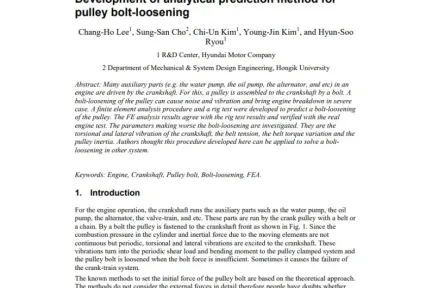
Development of analytical prediction method for pulley bolt-loosening

Many auxiliary parts (e.g. the water pump, the oil pump, the alternator, and etc) in an engine are driven by the crankshaft. For this, a pulley is assembled to the crankshaft by a bolt. A bolt-loosening of the pulley can cause noise and vibration and bring engine breakdown in severe case. A finite element analysis procedure and a rig test were developed to predict a bolt-loosening of the pulley. The FE analysis results agree with the rig test results and verified with the real engine test. The parameters making worse the bolt-loosening are investigated. They are the torsional and lateral vibration of the crankshaft, the belt tension, the belt torque variation and the pulley inertia. Authors thought this procedure developed here can be applied to solve a boltloosening in other system.

Customer Papers

Development of analytical prediction method for pulley bolt-loosening
Correlation of the Vibroacoustic Response of Structural Panels with Isight for Use in Statistical Energy Analysis in Aerospace Applications

With the increasingly common use of advanced composite materials in the design of aerospace structures, vibroacoustic loads have become an important factor for structural design and integrity. Vibroacoustic analysis at high frequency is often performed by statistical energy analysis (SEA) using software products such as ESI’s VA One. A difficulty in performing SEA on complex aerospace structures is ensuring that the SEA subsystem (e.g., a structural panel) properly represents the actual structure. The model is often checked by comparing the response of a subsystem to that of a refined finite element (FE) mesh of the subsystem.

Customer Papers

Correlation of the Vibroacoustic Response of Structural Panels with Isight for Use in Statistical Energy Analysis in Aerospace Applications
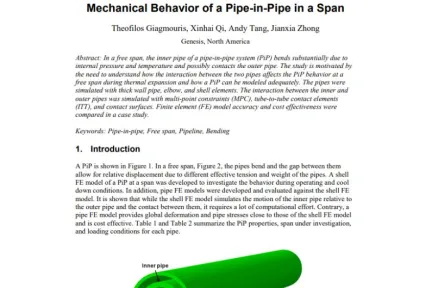
Mechanical Behavior of a Pipe-in-Pipe in a Span

In a free span, the inner pipe of a pipe-in-pipe system (PiP) bends substantially due to internal pressure and temperature and possibly contacts the outer pipe. The study is motivated by the need to understand how the interaction between the two pipes affects the PiP behavior at a free span during thermal expansion and how a PiP can be modeled adequately. The pipes were simulated with thick wall pipe, elbow, and shell elements. The interaction between the inner and outer pipes was simulated with multi-point constraints (MPC), tube-to-tube contact elements (ITT), and contact surfaces. Finite element (FE) model accuracy and cost effectiveness were compared in a case study.

Customer Papers

Mechanical Behavior of a Pipe-in-Pipe in a Span
There are 245 results

Customer stories

There are 129 results

From the communities

There are 6 results

SIMULIA Self Learning

We provide hundreds of self-learning modules so you can continue to learn at your convenience

Blogs

Read the SIMULIA blog on the latest news and innovations from our experts.

There are 694 results

Learn What SIMULIA Can Do for You

Speak with a SIMULIA expert to learn how our solutions enable seamless collaboration and sustainable innovation at organizations of every size.

Get Started

Courses and classes are available for students, academia, professionals and companies. Find the right SIMULIA training for you. 

Get Help

Find information on software & hardware certification, software downloads, user documentation, support contact and services offering