There are 1489 results
Analysis of DuPont Engineering Polymers – Challenges and Solutions

This paper describes the material behavior for different families of materials of the DuPont product offering, the performance of a selection of different material models for these materials using the extensive possibilities available in Abaqus, and the collaboration between DuPont and Simulia to advance the developments for a more accurate prediction of their behavior. In addition to the topic of modelling, the challenge of resource-effective data generation, state-of-the-art laboratory testing and corresponding data management on a global scale is discussed.

Customer Papers
Analysis of DuPont Engineering Polymers – Challenges and Solutions
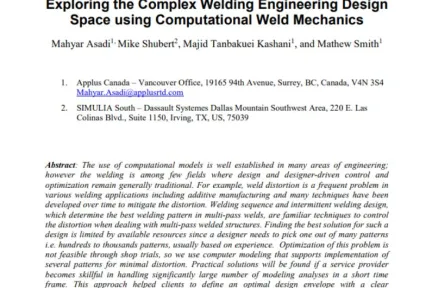
Exploring the Complex Welding Engineering Design Space using Computational Weld Mechanics

The use of computational models is well established in many areas of engineering; however the welding is among few fields where design and designer-driven control and optimization remain generally traditional. For example, weld distortion is a frequent problem in various welding applications including additive manufacturing and many techniques have been developed over time to mitigate the distortion. Welding sequence and intermittent welding design, which determine the best welding pattern in multi-pass welds, are familiar techniques to control the distortion when dealing with multi-pass welded structures.

Customer Papers

Exploring the Complex Welding Engineering Design Space using Computational Weld Mechanics
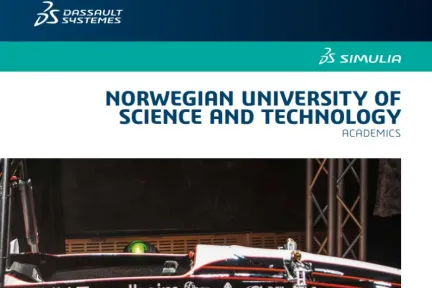
NORWEGIAN UNIVERSITY OF SCIENCE AND TECHNOLOGY ACADEMICS

University students participating the NTNU Revolve team, a contestant in the international Formula Student racing competition, needed a way to design strong, lightweight, and cost-effective vehicle components. Using Dassault Systèmes’ SIMULIA portfolio, including Abaqus FEA, Tosca topology optimization and Isight automation tools, students were able to develop highly competitive but safe component designs.

Tech Notes

NORWEGIAN UNIVERSITY OF SCIENCE AND TECHNOLOGY ACADEMICS
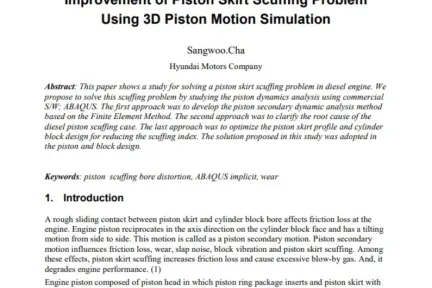
Improvement of Piston Skirt Scuffing Problem Using 3D Piston Motion Simulation

This paper shows a study for solving a piston skirt scuffing problem in diesel engine. We propose to solve this scuffing problem by studying the piston dynamics analysis using commercial S/W; ABAQUS. The first approach was to develop the piston secondary dynamic analysis method based on the Finite Element Method. The second approach was to clarify the root cause of the diesel piston scuffing case. The last approach was to optimize the piston skirt profile and cylinder block design for reducing the scuffing index. The solution proposed in this study was adopted in the piston and block design.

Customer Papers

Improvement of Piston Skirt Scuffing Problem Using 3D Piston Motion Simulation
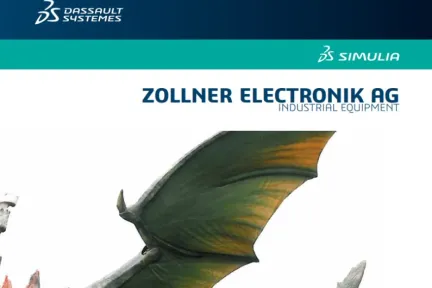
ZOLLNER ELECTRONIK AG INDUSTRIAL EQUIPMENT

Zollner Electronik AG engineers were tasked with designing a fully functional, fire-breathing mechatronic dragon for the German Further Drachenstich festival. The team used SIMPACK multi-body simulation software from Dassault Systèmes’ SIMULIA to generate and solve 3D models that predicted and visualized motion, coupling forces, and stresses on the entire flexible system.

Tech Notes

ZOLLNER ELECTRONIK AG INDUSTRIAL EQUIPMENT
Personalized Medical Devices Contact Lens

Personalized medical devices require 3 enabling technologies: biometric measurements, automated simulation and customized manufacture. Every customized device be it an external prosthetic or an implantable device will follow a similar workflow. For the purpose of this paper, a customized contact lens design will be investigated. A contact lens in essence is an optical suction cup which corrects the abnormalities of the patient’s vision. The lens interfaces with the anterior surface of the cornea by way of a suction pressure. This suction pressure is balanced by the energy stored in the deformed shape of the contact lens. The lens is free to move on the cornea finding its equilibrium position which will be unique for each eye.

Customer Papers

Personalized Medical Devices Contact Lens
Cylinder Head Water Jacket Fatigue Optimization Workflow

The water jacket is an integral part of the engine, ensuring that liquid coolant can flow efficiently over the cylinder heads. However, this structure is also very susceptible to fatigue because of the high pressure and loading frequency to which it is exposed. This paper describes a process we developed to optimize the fatigue durability of a cylinder head water jacket using multiple products from the Simulia portfolio.The results of this study provided excellent design guidance for the sample part and yielded a workflow that could be applied to optimize the durability of other complex components.

Customer Papers

Cylinder Head Water Jacket Fatigue Optimization Workflow
Comparison of ALE, CEL and SPH for Self-piercing riveting

SPR (Self-piercing riveting) is a cold forming process that is used to fasten together two or more sheets of different materials mechanically with a rivet. Also SPR emulates the results and quality of spot welding without many of the risks, such as toxic fumes, sparks and noise. Thus circumstanced, this technique is widely used on the various filed especially within automobile industry. SPR, in particular, is excellent for lightweight manufacturing and for precise working while dramatically reducing cost and production time. The process deformation depends on the sheet size, shape of die, material flow, stiffness, etc. Also material deformation in both of rivet and workpiece sheets is tremendous large, for instance thinning, necking, shear and penetration.

Customer Papers

Comparison of ALE, CEL and SPH for Self-piercing riveting
Reliability Based Design Optimization of Subsystems / Component using Monte Carlo Simulation of Isight

With the advent of CAE high fidelity simulations, both non parametric and parametric optimization methods are gaining rapid momentum in order to find the optimum design that satisfies the performance requirements. Usually, each input design variable such as material property, load and manufacturing processes of a component / sub-system will have uncertainties which have to be accounted while performing the optimization. Since, the output parameters of mechanical sub-systems are highly nonlinear and sensitive to variation of input design variables. The Monte Carlo Simulation (MCS) method of Isight has been used to define variation of input design variables thereby to assess the risk factor of the optimum design.

Customer Papers

Reliability Based Design Optimization of Subsystems / Component using Monte Carlo Simulation of Isight
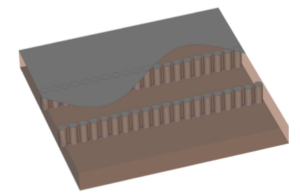
Front-End Loader Linkage Durability Analysis Using Load Input from True-Load

This document describes the use of Abaqus/CAE, Abaqus/Standard, True-Load, and Verity weld analysis in fe-safe software to evaluate the durability of a front-end loader linkage. Dynamic field loading for FEA of construction equipment is not always easily replicated by traditional linear static loading methods. Wolf Star Technologies True-Load software along with unit load FEA in Abaqus was used to determine time history loads for a field operation with dynamic loading that resulted in fatigue failures of the linkage. The time history loading was then used in fe-safe to compare the durability of design alternatives and determine a design that met the simulation criteria. The methodology greatly improved the confidence of the design developed through simulation because the field loading was accurately reproduced.

Customer Papers
Front-End Loader Linkage Durability Analysis Using Load Input from True-Load
Mechanical Testing of FDM Parts for Process Simulation

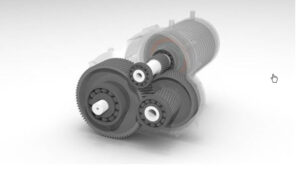
In this study, the relationship between the layer-by-layer build process and the resulting mechanical properties is investigated. The build orientations are selected based on the assumption that the printed parts demonstrate orthotropic behavior, in which the properties will vary in the primary directions orthotropic to the build layer plane. This assumption is validated by mechanical testing of tensile and Iosipescu (shear) specimens fabricated with layer-by-layer orientations orthotropic to the loading axes. Properties that are obtained from the mechanical testing include tensile modulus, tensile strength, shear modulus and Poisson’s ratio.

Customer Papers
Mechanical Testing of FDM Parts for Process Simulation
There are 245 results

Customer stories

There are 129 results

From the communities

There are 6 results

SIMULIA Self Learning

We provide hundreds of self-learning modules so you can continue to learn at your convenience

Blogs

Read the SIMULIA blog on the latest news and innovations from our experts.

There are 694 results

Learn What SIMULIA Can Do for You

Speak with a SIMULIA expert to learn how our solutions enable seamless collaboration and sustainable innovation at organizations of every size.

Get Started

Courses and classes are available for students, academia, professionals and companies. Find the right SIMULIA training for you. 

Get Help

Find information on software & hardware certification, software downloads, user documentation, support contact and services offering