There are 1489 results
CFD Topology and Shape Optimization of Ford Applications using Tosca Fluid

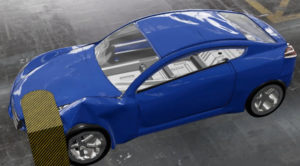
Modern engine architectures need compact designs driven by vehicle package constraints. Furthermore, an engine should fit into several vehicle applications and parts have to be modified to match all package configurations. The optimization of the individual parts and the system by Computational Fluid Dynamics (CFD) may help to minimize or even delete these drawbacks. Meanwhile, there are several powerful optimization methods for three-dimensional flows on the market. While comparing their strengths and weaknesses, efficiency and easy handling are also important for engineers in research and product development. In this paper, a combined optimization strategy using CFD topology optimization followed by a shape optimization is presented using the software tools Tosca Fluid and STAR-CCM+.

Customer Papers
CFD Topology and Shape Optimization of Ford Applications using Tosca Fluid
Experimental Design to Characterize the Interface of Flexible Hybrid Electronics under Mixed-Mode Fracture

Flexible Hybrid Electronics (FHEs) are finding increasing applications since they overcome the limitations of rigid and non-deformable traditional electronic boards and circuits. A key parameter in FHE performance is the adhesion of printed conductive silver pastes to the flexible substrate. Prediction of the failure mechanism of the interface, under large deformations and with a considerable material mismatch, is fundamental to future design efforts. However, due to the complex nonlinear behavior of the materials and size of components, common interfacial characterization tests may not always be feasible. In this study, a biaxial loading configuration was designed to extract the mixed mode tractionseparation parameters.

Customer Papers
Experimental Design to Characterize the Interface of Flexible Hybrid Electronics under Mixed-Mode Fracture
High power mercury target design exploration using Isight

The stainless-steel target vessel directs the flow of mercury at the Spallation Neutron Source (SNS) facility in Oak Ridge National Laboratory, Tennessee, and is struck by cyclic (60hz) proton beam pulses to release neutrons for scientific experiments. The target works under various severe conditions: temperature, radiation, mercury flow, and proton beam pulse pressures. Insufficient strength and durability of the target stainless steel vessel from beam pulse and thermal cyclic loads can lead to mercury leaks and premature target life termination. Neutron production and the scientific user programs at SNS has been disrupted on several occasions due to such incidents.

Customer Papers
High power mercury target design exploration using Isight
Automation of T-Spline based 3D High-Fidelity Isogeometric Analysis in Abaqus

Isogeometric analysis (IGA) has shown its attractive feature recently for integrating a Finite Element Analysis (FEA) and Computer Aided Design (CAD) into a single unified process. For stress analysts, it is common practice to convert a spline/NURBS based CAD model to polynomial based finite element mesh for analysis. However, for complex geometries such as optimized 3D printing objects, it is known that smooth curved geometry cannot be exactly represented by a discretized finite element mesh. As a consequence, the simulation results can either be imprecise or costly due to the geometric misrepresentation or a larger number of degrees of freedom required to achieve the same accuracy. A Tspline based 3D IGA is developed by CMU to fill the gap.

Customer Papers

Automation of T-Spline based 3D High-Fidelity Isogeometric Analysis in Abaqus
Human Foot Hitting a Soccer Ball Analysis Using Finite Element Methods

This paper is related to using Finite Element Analysis to analyze the stresses in the human foot bones when hitting a soccer ball. The result is a determination of the optimal position to hit the ball to have minimal stresses in the foot bones. The results will not only show the direction the ball will travel, but how far it will travel as well. The stresses in the human leg bones are determined for each impact and compared. The primary goal of this research was to show the advantages of utilizing finite element analysis applications in sports. The results will show that accurate results can be attained if the simulations mimic the real case. All simulations are ran using Abaqus/Explicit.

Customer Papers

Human Foot Hitting a Soccer Ball Analysis Using Finite Element Methods
Steam Turbine Critical Crack Evaluation and Ranking Cracks to Prioritize Inspection

Ranking the cracks by comparing their K values reveals the most severe crack location and crack shape. The critical crack size for the most severe crack case is determined using the Failure Assessment Diagram method. The evaluation points on the FAD plot are obtained using a combination of elastic K and elastic-plastic J-integral results. Determining the most severe crack location and critical crack size help inspectors prioritize where to look for cracking during the next scheduled maintenance and to select inspection methods to find cracks.

Customer Papers

Steam Turbine Critical Crack Evaluation and Ranking Cracks to Prioritize Inspection
3D PRINT -MATERIAL AND PROCESS MODEL AND EFFECT OF DEFECTS ON PART PERFORMANCE

Additive Manufacturing (AM) is helping to achieve significant time and fabrication cost savings, as well as creating complex geometries and material that are otherwise impossible using conventional manufacturing processes. 3D printed "AS-Built" metal parts are exhibiting surface roughness, warping, defects, and scatter in mechanical properties (strength, stiffness). Path Coverage visualization using machine printing pattern and orientation can detect the formation of voids and defects, which impact mechanical properties related to the as-built part as well as associated AM process simulation.

Customer Papers

3D PRINT -MATERIAL AND PROCESS MODEL AND EFFECT OF DEFECTS ON PART PERFORMANCE
An in-vivo experimental evaluation of Abaqus Knee Simulator for Total Knee Replacement

A large number of experimental in-vitro pre-clinical testing devices have been used in the evaluation of new implant designs for total knee replacement, but it is time-consuming and cost prohibitive to evaluate hundreds of design variations during design phase. In-silico knee simulator has provided an efficient way to perform component design evaluations under a variety of dynamic loadings, while it remains a challenge to evaluate the predictive accuracy due to the lack of in-vivo verification. The commercial software Abaqus, Isight and a specialized tool Abaqus Knee Simulator have been widely used to predict implanted knee mechanics. In the paper, a systematical in-vivo experimental evaluation has been carried out in Abaqus Knee Simulator with calibrated soft-tissue properties for gait cycle.

Customer Papers

An in-vivo experimental evaluation of Abaqus Knee Simulator for Total Knee Replacement
3D-FE Implementation of Evolutionary Cyclic Plasticity Model for Fully Mechanistic Fatigue Life Evaluation

Large uncertainties exist in the current methods of fatigue life evolution for nuclear components due to the overdependence on approaches that use empirical stress/strain-life (S~N) curves. Argonne National Laboratory (ANL), under the sponsorship of Department of Energy's Light Water Reactor sustainability (LWRS) program, seeks to develop a fully mechanistic approach for more accurate fatigue life estimation of nuclear components. To this end, ANL has developed evolutionary cyclic plasticity models for reactor steels based on uniaxial fatigue tests to capture the material aging behavior such as stress hardening/softening. In this paper, we introduce an implementation of the evolutionary cyclic plasticity model within the commercial finite element software ABAQUS through the use of an in-house developed user material subroutine.

Customer Papers

3D-FE Implementation of Evolutionary Cyclic Plasticity Model for Fully Mechanistic Fatigue Life Evaluation
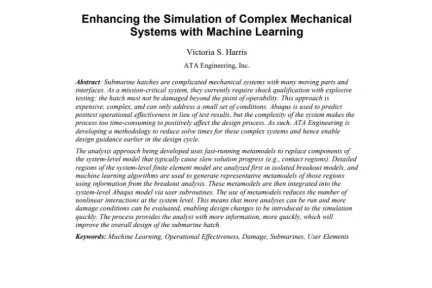
Enhancing the Simulation of Complex Mechanical Systems with Machine Learning

Submarine hatches are complicated mechanical systems with many moving parts and interfaces. As a mission-critical system, they currently require shock qualification with explosive testing: the hatch must not be damaged beyond the point of operability. This approach is expensive, complex, and can only address a small set of conditions. Abaqus is used to predict posttest operational effectiveness in lieu of test results, but the complexity of the system makes the process too time-consuming to positively affect the design process. As such, ATA Engineering is developing a methodology to reduce solve times for these complex systems and hence enable design guidance earlier in the design cycle.

Customer Papers

Enhancing the Simulation of Complex Mechanical Systems with Machine Learning
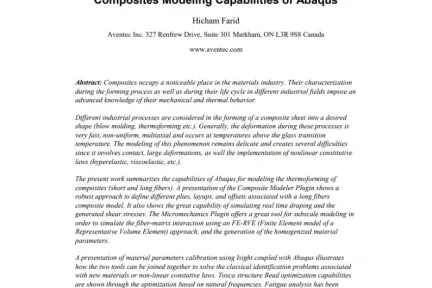
Composites Modeling Capabilities of Abaqus

Composites occupy a noticeable place in the materials industry. Their characterization during the forming process as well as during their life cycle in different industrial fields impose an advanced knowledge of their mechanical and thermal behavior. A presentation of material parameters calibration using Isight coupled with Abaqus illustrates how the two tools can be joined together to solve the classical identification problems associated with new materials or non-linear constative laws. Tosca structure Bead optimization capabilities are shown through the optimization based on natural frequencies. Fatigue analysis has been performed using Fe-safe and shows the fatigue life contours.

Customer Papers

Composites Modeling Capabilities of Abaqus
There are 245 results

Customer stories

There are 129 results

From the communities

There are 6 results

SIMULIA Self Learning

We provide hundreds of self-learning modules so you can continue to learn at your convenience

Blogs

Read the SIMULIA blog on the latest news and innovations from our experts.

There are 694 results

Learn What SIMULIA Can Do for You

Speak with a SIMULIA expert to learn how our solutions enable seamless collaboration and sustainable innovation at organizations of every size.

Get Started

Courses and classes are available for students, academia, professionals and companies. Find the right SIMULIA training for you. 

Get Help

Find information on software & hardware certification, software downloads, user documentation, support contact and services offering