There are 1489 results
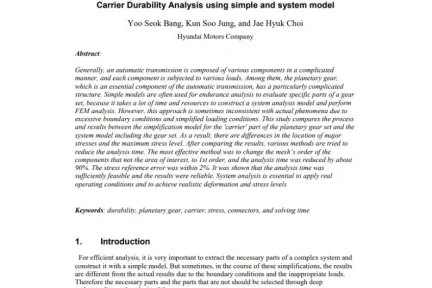
Carrier Durability Analysis using simple and system model

Generally, an automatic transmission is composed of various components in a complicated manner, and each component is subjected to various loads. Among them, the planetary gear, which is an essential component of the automatic transmission, has a particularly complicated structure. Simple models are often used for endurance analysis to evaluate specific parts of a gear set, because it takes a lot of time and resources to construct a system analysis model and perform FEM analysis. However, this approach is sometimes inconsistent with actual phenomena due to excessive boundary conditions and simplified loading conditions. This study compares the process and results between the simplification model for the 'carrier' part of the planetary gear set and the system model including the gear set.

Customer Papers
Carrier Durability Analysis using simple and system model
Shape optimization with fatigue criterion on cylinder head water jacket, by means of Tosca, Abaqus and Fe-safe coupling

In the hyper-competitive environment of the automotive industry, engineers are constantly looking for ways to improve the quality, durability and performances of their engines. Traditional shape optimization is a great solution for design improvements in later product development stages by minimizing stress or strain. Indeed, stress reduction often leads to a significant increase in durability, but stress peaks, as identified by static analysis, may differ largely from areas of maximum damage. Therefore, fatigue life simulation should always be included in the optimization loop, if the location of maximum damage and maximum stress are not matching.

Customer Papers

Shape optimization with fatigue criterion on cylinder head water jacket, by means of Tosca, Abaqus and Fe-safe coupling
Applications of Abaqus/Explicit to Flexible Packaging

This paper showcases the applications of Abaqus/Explicit to the R&D of flexible plastic packaging films and products that Bemis Company is currently engaging to, particularly in the areas of liquid pouch packaging and thermoforming of medical device packages. The pouch burst strength was analyzed using the shell element with fluid cavity technique and it was found that the material ductility affected the pouch failure modes or locations. The pouch liquid filling and drop impact performance was modeled with the smoothed particle hydrodynamics (SPH) method, which revealed that upon impact from a drop height of 4 to 5 feet the deformation rate in the pouch was on the level of or over a hundred per second.

Customer Papers

Applications of Abaqus/Explicit to Flexible Packaging
Personalized Neuromodulation: A Computational Workflow to Guide Noninvasive Clinical Treatment of Neurological and Psychiatric Disorders

Transcranial Electrical Stimulation (tES) is a noninvasive neuromodulation technique wherein low intensity electrical current is applied to the head via scalp-mounted electrodes. Transcranial Direct Current Stimulation (tDCS, a form of tES) is increasingly being used in the treatment of several neurological and psychiatric disorders such as stroke recovery, depression, and schizophrenia. However, tDCS-induced electrical current patterns in the brain show marked inter-individual variation due to underlying differences in brain morphology and choice of treatment protocol. It is therefore difficult to predict the clinical outcome of tDCS treatment in a particular subject.

Customer Papers
Personalized Neuromodulation: A Computational Workflow to Guide Noninvasive Clinical Treatment of Neurological and Psychiatric Disorders
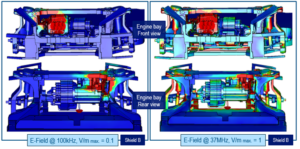
How to improve performance of Abaqus/Explicit models

For a cost and time efficient virtual development process three main objectives can be identified: Minimize the turnaround time, maximize the throughput, and minimize license and hardware costs. Beside the fact, that these are contrary objectives, optimizing the model to reduce the runtime helps for every objective.

Customer Papers
How to improve performance of Abaqus/Explicit models
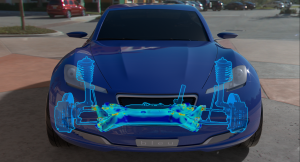
Giving Arthritis the Finger: Customized Medical Device, Optimized for Durability

Rheumatoid arthritis is an autoimmune disorder that frequently affects the fingers and results in swollen and/or painful joints. Total joint replacement surgery is commonly required, in which a silicone elastomer prosthetic is implanted to restore patient hand/finger function and alleviate pain. Design qualification requirements specify that the prosthetic must endure at least 10 million cycles in which the finger joint is flexed through 90 degrees, which is typically determined and verified through a battery of costly physical testing routines. However, physics-based simulation is becoming a commonly used method as an enhancement or replacement to physical testing by medical device companies to save time and money when submitting a device for approval to the US Food and Drug Administration (FDA) and the European Medicines Evaluation Agency (EMEA).

Customer Papers
Giving Arthritis the Finger: Customized Medical Device, Optimized for Durability
Finite Element Analysis of Tubing Buckling in Oil Wells

In oil wells, there are numerous reported field cases of tubing buckling during the installation and operation. The tubing buckling mode typically starts with a single lateral wave, which with increased compression transitions into multiple waves and then into a helically buckled configuration within the borehole or cased hole. In this paper, Abaqus Finite Element Analysis (FEA), with consideration of material plasticity and pipe-in-pipe contact, was used to perform the buckling analysis of tubular strings. This paper proposes an FEA-based design approach, which takes into account of the post-buckling behavior of the tubing string, to achieve the improved certainty, integrity, safety and economy of the design.

Customer Papers

Finite Element Analysis of Tubing Buckling in Oil Wells
Stanford Living Heart Project Focusing on Drug Induced Arrhythmia with Abaqus in the Cloud

This project has been performed by researchers from the Living Matter Laboratory at Stanford University, supported by Living Heart Project members from SIMULIA (Abaqus 2017), Advania (cloud resources), and UberCloud (software containers), and sponsored by Hewlett Packard Enterprise and Intel. It is based on the development of a Living Heart Model (LHM) for Abaqus that encompasses advanced fluid-structure-electro-physiological modeling. The goal of this project was to create a biventricular finite element model to be used to study drug-induced arrhythmias of a human heart. The team was able to perform 1600 hours on 160 CPU cores, and simulation results compared with physical measurements show excellent consistency.

Customer Papers

Stanford Living Heart Project Focusing on Drug Induced Arrhythmia with Abaqus in the Cloud
Precise Calculation of Mesh Stiffness Fluctuation for Predicting Gear Noise

Nabtesco manufactures diverse configurations of reduction gears for varied applications in a wide range of industries worldwide. With changing markets demanding quieter operation, the perennial issue of noise generated by spur gears has become an even greater concern. Our traditional development strategy was designing gear shape modifications empirically and producing prototypes for testing. However, producing multiple gears and conducting noise evaluations is very cost and time intensive. We could not determine the exact effect various shape modifications would have on noise and why. While there are some longestablished methods for analyzing gearbox noise, these methods are not appropriate for predicting gear shapes as size differences among gear shape modifications are much smaller than parameters established for gearbox noise evaluation.

Customer Papers

Precise Calculation of Mesh Stiffness Fluctuation for Predicting Gear Noise
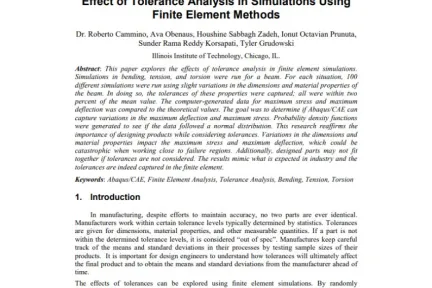
Effect of Tolerance Analysis in Simulations Using Finite Element Methods

This paper explores the effects of tolerance analysis in finite element simulations. Simulations in bending, tension, and torsion were run for a beam. For each situation, 100 different simulations were run using slight variations in the dimensions and material properties of the beam. In doing so, the tolerances of these properties were captured; all were within two percent of the mean value. The computer-generated data for maximum stress and maximum deflection was compared to the theoretical values. The goal was to determine if Abaqus/CAE can capture variations in the maximum deflection and maximum stress. Probability density functions were generated to see if the data followed a normal distribution.

Customer Papers

Effect of Tolerance Analysis in Simulations Using Finite Element Methods
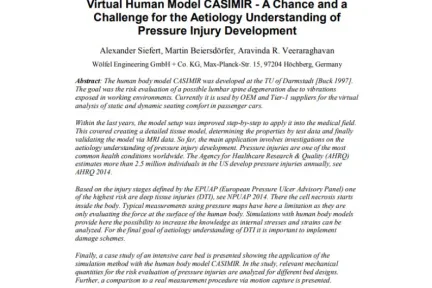
Virtual Human Model CASIMIR - A Chance and a Challenge for the Aetiology Understanding of Pressure Injury Development

The human body model CASIMIR was developed at the TU of Darmstadt [Buck 1997]. The goal was the risk evaluation of a possible lumbar spine degeneration due to vibrations exposed in working environments. Currently it is used by OEM and Tier-1 suppliers for the virtual analysis of static and dynamic seating comfort in passenger cars. Finally, a case study of an intensive care bed is presented showing the application of the simulation method with the human body model CASIMIR. In the study, relevant mechanical quantities for the risk evaluation of pressure injuries are analyzed for different bed designs. Further, a comparison to a real measurement procedure via motion capture is presented.

Customer Papers

Virtual Human Model CASIMIR - A Chance and a Challenge for the Aetiology Understanding of Pressure Injury Development
There are 245 results

Customer stories

There are 129 results

From the communities

There are 6 results

SIMULIA Self Learning

We provide hundreds of self-learning modules so you can continue to learn at your convenience

Blogs

Read the SIMULIA blog on the latest news and innovations from our experts.

There are 694 results
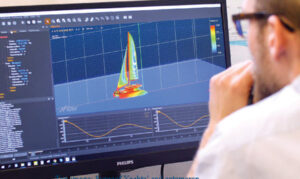
Case Study: Sunreef Yachts

Discover how Sunreef’s response time has considerably improved using SIMULIA XFlow, reducing...

Article

Case Study: Sunreef Yachts

Learn What SIMULIA Can Do for You

Speak with a SIMULIA expert to learn how our solutions enable seamless collaboration and sustainable innovation at organizations of every size.

Get Started

Courses and classes are available for students, academia, professionals and companies. Find the right SIMULIA training for you. 

Get Help

Find information on software & hardware certification, software downloads, user documentation, support contact and services offering