There are 1489 results
Manufacturing Simulation of Composites Compression Molding in Abaqus/Explicit

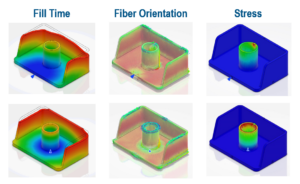
In composite materials, as anisotropic systems, the orientation state of parts highly impacts the resulting performance characteristics. In high rate processes of discontinuous material systems, the final orientation state is often dictated by molding flows rather than direct prescription. In this work, we address flow simulation of the compression molding process for prepreg platelet molding systems with the purpose of predicting orientation state. Such systems are formed by cutting and slitting prepreg composite tape into rectangular platelets of prescribed length and width. Typical molding simulation approaches have been previously developed for injection molding processes in which the fiber scale to part scale dictates relatively smooth spatial variation in orientation state.

Customer Papers
Manufacturing Simulation of Composites Compression Molding in Abaqus/Explicit
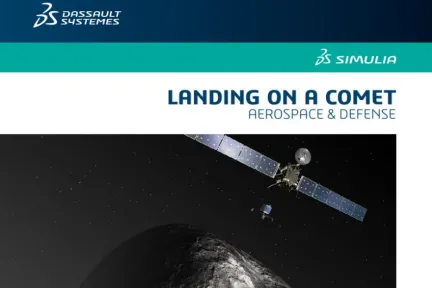
LANDING ON A COMET AEROSPACE & DEFENSE

Scientists watched with bated breath as the Philae lander left the European Space Agency’s Rosetta spacecraft and touched down on the surface of a comet last November after a 10-year, 4-billion-mile journey. Among those glued to their screens was Dr. Martin Hilchenbach, one of the original designers of the lander. He and his team used SIMPACK simulation software (now part of the Dassault Systèmes SIMULIA portfolio), between 1996 and the 2004 takeoff of Rosetta from Earth, to model scenarios for the Philae’s landing and guide design changes that helped ensure its survival. A presenter at the 2015 SCC in Berlin, Dr. Hilchenbach answered some questions for SCN earlier this spring.

Tech Notes

LANDING ON A COMET AEROSPACE & DEFENSE
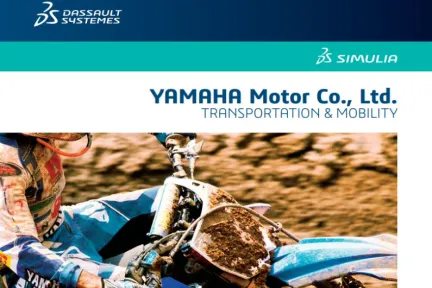
YAMAHA Motor Co., Ltd. TRANSPORTATION & MOBILITY

Yamaha Motor Company wanted to improve performance of its off-road motorcycle of its off-road motorcycle radiator assemblies and was looking for a way to reduce time-consuming realworld testing. Abaqus FEA from Dassault Systèmes SIMULIA provided accurate, realistic simulations of the simulations of the mechanism of motorcycle of motorcycle tipovers on the deformation of the components.

Tech Notes

YAMAHA Motor Co., Ltd. TRANSPORTATION & MOBILITY
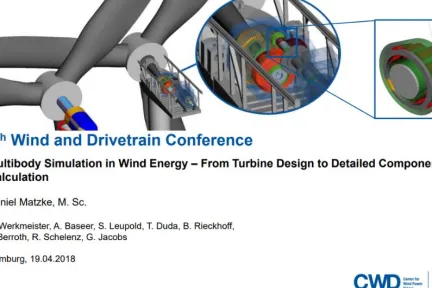
4 th Wind and Drivetrain Conference

4 th Wind and Drivetrain Conference Multibody Simulation in Wind Energy – From Turbine Design to Detailed Component Load Calculation

E-seminars

4 th Wind and Drivetrain Conference
Fatigue Behavior of Engineering Polymers and Its Numerical Implementation

As a material supplier, it is our role to understand the behavior and performance of our materials and to support designers and engineers in their optimal use. In this paper we will describe the material behavior of semi-crystalline engineering polymers, illustrated with material test data on Delrin POM and their influence on their fatigue performance, in particular their non-linear elastic (hyperelastic) response, hysteresis, temperature dependence and self-heating effects. These have been included in an in-house tool based on Abaqus for improved prediction of the fatigue performance of engineering polymer parts in real-life conditions.

Customer Papers
Fatigue Behavior of Engineering Polymers and Its Numerical Implementation
Progressive Damage Modeling of Thick Laminated Composites: Robust Deterministic and Probabilistic Implementation

The objective of this work is to a) generate robust and physically reasonable Abaqusbased FEA solutions to model multi-step damage processes in laminated composite materials and structures and b) demonstrate their efficiency on representative examples. The examples are focused on scenarios of composites with complex networks of multiple interlaminar damages. Computational implementation is based on cohesive zone modeling approach allowing one to model both damage initiation and growth. Demonstration of computational robustness is shown on cases with increased levels of complexity starting with single damage statements, then with multiple damages, and finally, with probabilistic statements assuming statistical variability of properties representing different damage paths.

Customer Papers
Progressive Damage Modeling of Thick Laminated Composites: Robust Deterministic and Probabilistic Implementation
Defects Assessment of Composite Laminates from Scanning to Modeling

Defects induced in the fabrication and application of composite laminates have substantial influence on the performance of composite structures. The effects of these undesired defects on the static and fatigue mechanical behavior are very important in the reliability and sustainability assessment. An integrative approach is developed to evaluate the major defects including voids and ply waviness from Computed Tomography (CT) scanning to multiscale modeling. Based on the CT scan results, voids and ply waviness can be captured quantitatively. These defects can be analyzed by using the represented volume element (RVE) model and statistical model in micro scale and their effects on the material properties (stiffness, strength and fracture toughness) are included into the macroscale model using a possibilistic uncertainty model.

Customer Papers

Defects Assessment of Composite Laminates from Scanning to Modeling
There are 245 results

Customer stories

There are 129 results

From the communities

There are 6 results

SIMULIA Self Learning

We provide hundreds of self-learning modules so you can continue to learn at your convenience

Blogs

Read the SIMULIA blog on the latest news and innovations from our experts.

There are 694 results

Learn What SIMULIA Can Do for You

Speak with a SIMULIA expert to learn how our solutions enable seamless collaboration and sustainable innovation at organizations of every size.

Get Started

Courses and classes are available for students, academia, professionals and companies. Find the right SIMULIA training for you. 

Get Help

Find information on software & hardware certification, software downloads, user documentation, support contact and services offering