There are 1489 results
Prediction of Printing Failure of a 3D Printed Drone Propeller using Fused Deposition Modeling

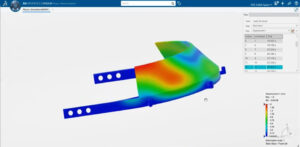
In this paper, a drone propeller is used as an example to illustrate the print failure modeling strategy. The commercial finite element software package ABAQUS is used to simulate the FDM printing process and in-service performance of the propeller. In order to analyze the printing process, a heat transfer analysis is done first to predict the temperature history of the part, which drives the stress analysis for distortion and residual stress predictions. The tool path patterns dictate how material is added during the printing and it also have direct influence in the residual stresses in the part. Abaqus uses machine tool path as a direct input and solves the local orthotropic material properties and evolving cooling surfaces using the event series and progressive element activation technologies.

Customer Papers
Prediction of Printing Failure of a 3D Printed Drone Propeller using Fused Deposition Modeling
Multiscale Modeling of Polymer Composites: From Atomistic Simulation to Structural Analysis

A multiscale modeling procedure was presented to design thermosetting resins and products of polymer composites. Heat curing and cross-linking reaction steps were considered with activation energy and heat generation via molecular dynamics simulation of BIOVIA Materials Studio. The mechanical properties and adhesive strength for fillers were also estimated, and were assigned to SIMULIA Abaqus. Using the Abaqus fracture analysis capability, the crack propagation behavior, including matrix-failure and interface-failure, was investigated.

Customer Papers

Multiscale Modeling of Polymer Composites: From Atomistic Simulation to Structural Analysis
Predictions of Fluid/Structural Interactions Using Abaqus Cosimulation and Advanced CFD Solvers

This work presents a coupled fluid-structural interaction (FSI) capability wherein pressure and thermal loads predicted by the CRUNCH CFD and CRAFT CFD Navier-Stokes solvers are exchanged with Abaqus/Standard and Abaqus/Explicit using the Co-Simulation Engine (CSE). Multiple domains may be simulated concurrently, on separate groups of processors. Data exchange is handled through SIMULIA’s Co-Simulation Engine API. The boundary surface common to the fluid and solid domains is defined, along with the specific scalar and/or vector fields to be exchanged. Point forces or pressures, heat fluxes, displacements, and temperatures are passed between the codes, and simulations may be either one-way or two-way coupled. Applications of the FSI simulation capability to problems of interest are presented and discussed.

Customer Papers

Predictions of Fluid/Structural Interactions Using Abaqus Cosimulation and Advanced CFD Solvers
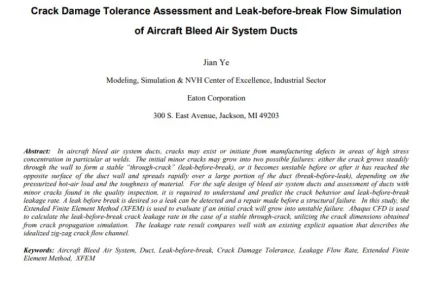
Crack Damage Tolerance Assessment and Leak-before-break Flow Simulation of Aircraft Bleed Air System Ducts

In aircraft bleed air system ducts, cracks may exist or initiate from manufacturing defects in areas of high stress concentration in particular at welds. The initial minor cracks may grow into two possible failures: either the crack grows steadily through the wall to form a stable “through-crack” (leak-before-break), or it becomes unstable before or after it has reached the opposite surface of the duct wall and spreads rapidly over a large portion of the duct (break-before-leak), depending on the pressurized hot-air load and the toughness of material. For the safe design of bleed air system ducts and assessment of ducts with minor cracks found in the quality inspection, it is required to understand and predict the crack behavior and leak-before-break leakage rate.

Customer Papers

Crack Damage Tolerance Assessment and Leak-before-break Flow Simulation of Aircraft Bleed Air System Ducts
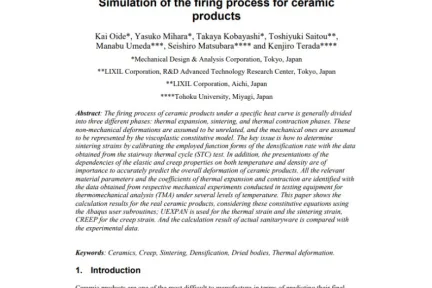
Simulation of the firing process for ceramic products

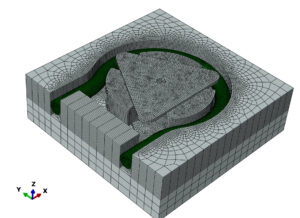
The firing process of ceramic products under a specific heat curve is generally divided into three different phases: thermal expansion, sintering, and thermal contraction phases. These non-mechanical deformations are assumed to be unrelated, and the mechanical ones are assumed to be represented by the viscoplastic constitutive model. The key issue is how to determine sintering strains by calibrating the employed function forms of the densification rate with the data obtained from the stairway thermal cycle (STC) test. In addition, the presentations of the dependencies of the elastic and creep properties on both temperature and density are of importance to accurately predict the overall deformation of ceramic products.

Customer Papers
Simulation of the firing process for ceramic products
There are 245 results

Customer stories

There are 129 results

From the communities

There are 6 results

SIMULIA Self Learning

We provide hundreds of self-learning modules so you can continue to learn at your convenience

Blogs

Read the SIMULIA blog on the latest news and innovations from our experts.

There are 694 results

Learn What SIMULIA Can Do for You

Speak with a SIMULIA expert to learn how our solutions enable seamless collaboration and sustainable innovation at organizations of every size.

Get Started

Courses and classes are available for students, academia, professionals and companies. Find the right SIMULIA training for you. 

Get Help

Find information on software & hardware certification, software downloads, user documentation, support contact and services offering