There are 1489 results
System Modeling and Simulation at Dana Holding

In this paper we explain what SMS means to Dana, how we approach this topic, and what technologies we are investigating in order to achieve this new level of engineering. Since the process is very complex, we decided to start with a business value assessment (BVA). This engineering assessment was undertaken to understand the current status of our engineering organizations and existing technology, and then identify the gaps to where we want to be with our business. This helped to formulate a foundational strategy and long-term roadmap. With an existing strong focus on the CAE environment this also meant we needed, as previously mentioned, enhance the mindset and our global culture to make the next step in our systems evolution.

Customer Papers
System Modeling and Simulation at Dana Holding
Developing a Constitutive Model for a Highly Deformable Latex Rubber with Implementations in Lagrangian Frameworks > Dassault Systèmes

To improve product design and enhance the realism of BD’s advanced finite element models, the development of a constitutive model capable of predicting mechanical behavior at high deformations was initiated for a commercially available latex rubber. A set of baseline experiments was conducted to determine the isothermal mechanical response(s) of the latex rubber. The experiments were designed to provide fundamental insight into any viscoelastic, hyperelastic, and Mullins effects exhibited by the material. A constitutive model was constructed for specific load cases from the aforementioned experimental data. Attention was given to the model’s primary use case, numerical stability, and its ability to perform at high deformation ranges..

Customer Papers

Developing a Constitutive Model for a Highly Deformable Latex Rubber with Implementations in Lagrangian Frameworks > Dassault Systèmes
FE Modeling of a Flatfoot Deformity for Improving Surgical Planning

This work presents a finite element (FE) model of a flatfoot deformity to study its biomechanics and improve the surgical plan for individual patients. Despite being a common foot deformity, the biomechanics of flatfoot is not fully understood. Regarding the optimal surgery, foot surgeons have different opinions for individual patients. Studies using cadaver feet are difficult to manage due to individual differences in foot geometry; therefore, these studies have made limited contributions to improving surgical planning. One option for solving this problem is to use a computer-based model. Due to the essence of continuum mechanics, the FE method has been used to model the human foot for various applications. In this work, the software package Abaqus was used to model and simulate flatfoot.

Customer Papers

FE Modeling of a Flatfoot Deformity for Improving Surgical Planning
Durability Assessment of Heavy Duty Diesel Engine Cylinder Head

The recent heavy duty truck market towards higher power output, lower fuel consumption and reduced emissions. This trend leads challenges in heavy duty diesel engine design due to increasing thermal loads for hot components. One of the most important design feature for heavy duty diesel engines is cylinder head fatigue durability and gasket sealing performance. Cylinder head is subjected to low cycle thermo-mechanical fatigue (TMF) and highcycle fatigue (HCF) which are driven by combustion process. Gasket sealing performance also has to be considered for avoiding any performance loss resulting from gas leakage.

Customer Papers

Durability Assessment of Heavy Duty Diesel Engine Cylinder Head
Consideration of manufacturing pre-history influence of fatigue life of sheet metal formed automotive parts

This contribution considers the effects of sheet metal forming processes on the fatigue performance of LCV wheel discs, manufactured from microalloyed steel. Traditionally, such parts had to pass standard cyclic load test in the process of experimental validation, but road tests in real life conditions sometimes show fatigue cracks in highly stressed areas, predominantly in bending loading mode. To estimate fatigue life and safety margins standard fatigue tests should be accompanied by numerical simulations based on FEA results. Unfortunately, in spite of the long history of fatigue analysis codes, based on FEA results, the industry still relies heavily on tests because of frequent disagreements between simulation and test results.

Customer Papers

Consideration of manufacturing pre-history influence of fatigue life of sheet metal formed automotive parts
Impact simulation of a hearing aid

In the development of hearing aids, many factors are important to make a good hearing aid. It can be the sound quality, design and easiness of use. However, it is also important that the device can withstand the environment that it is used in, both regarding moisture, sweat and to be dropped on a hard surface. One of the most sensitive parts in the hearing aid regarding dropping the device on a hard surface is the receiver (name for the loudspeaker in the hearing aid). The development of hearing aids demands shorter time to market and higher rate of success in achieving all the development requirements for the device. Therefore, it is important to be able to predict and improve designs in development projects.

Customer Papers

Impact simulation of a hearing aid
Thermal Management of Electronic Devices used in Automotive Safety – A DoE approach

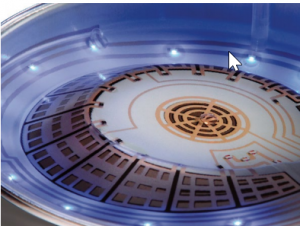
Electronic devices used in automotive safety has a trend to reduce size in packaging and increase performance of the product, both of which contribute to exponential increase in power consumption of the system consequently increasing the heat generation. Designers have very less choice on PCB board components but have flexibility in designing the enclosures over the PCBs. This calls the need for an optimal enclosure design to maximize the heat dissipation and to reduce the temperature well below the allowable operational limit. Majority of heat generated by these devices get dissipated by conduction and natural convection modes. Heat generated by the chip on PCB due to power consumption is transferred to the cover and housing via heat sink and thermal pads respectively by conduction.

Customer Papers
Thermal Management of Electronic Devices used in Automotive Safety – A DoE approach
Development of a Separator Plate for Valve Bodies in a Vehicle Automatic Transmission

Nowadays the automatic transmissions need to be an economically optimized system. To meet CO2 goals, the transmission has to be more efficient. One possibility is to raise the operating pressure in the hydraulic fluid. But this leads to a higher leakage rate and thus larger pressure pumps are required. To overcome this dilemma several innovative solutions were needed to develop a new generation of separator plates. These replace the conventional separator plates in new high efficient automatic transmissions. Lower leakage rates at higher pressure demand a more effective sealing solution. If this solution works particularly efficient it could provide an opportunity to reduce the amount of bolts required for the joint. This opens the possibility of more flexible design of the hydraulic channels.

Customer Papers
Development of a Separator Plate for Valve Bodies in a Vehicle Automatic Transmission
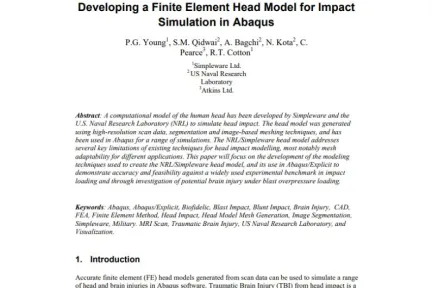
Developing a Finite Element Head Model for Impact Simulation in Abaqus

A computational model of the human head has been developed by Simpleware and the U.S. Naval Research Laboratory (NRL) to simulate head impact. The head model was generated using high-resolution scan data, segmentation and image-based meshing techniques, and has been used in Abaqus for a range of simulations. The NRL/Simpleware head model addresses several key limitations of existing techniques for head impact modelling, most notably mesh adaptability for different applications. This paper will focus on the development of the modeling techniques used to create the NRL/Simpleware head model, and its use in Abaqus/Explicit to demonstrate accuracy and feasibility against a widely used experimental benchmark in impact loading and through investigation of potential brain injury under blast overpressure loading.

Customer Papers
Developing a Finite Element Head Model for Impact Simulation in Abaqus
There are 245 results

Customer stories

There are 129 results

From the communities

There are 6 results

SIMULIA Self Learning

We provide hundreds of self-learning modules so you can continue to learn at your convenience

Blogs

Read the SIMULIA blog on the latest news and innovations from our experts.

There are 694 results

Learn What SIMULIA Can Do for You

Speak with a SIMULIA expert to learn how our solutions enable seamless collaboration and sustainable innovation at organizations of every size.

Get Started

Courses and classes are available for students, academia, professionals and companies. Find the right SIMULIA training for you. 

Get Help

Find information on software & hardware certification, software downloads, user documentation, support contact and services offering