There are 1489 results
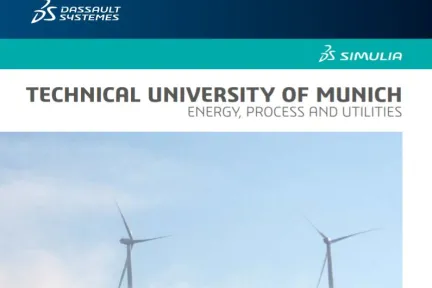
TECHNICAL UNIVERSITY OF MUNICH ENERGY, PROCESS AND UTILITIES

Research Associate Stefan Sicklinger employed SIMULIA’s co-simulation engine (CSE) to link four physics—flow, structure, multi-body dynamics and control—into highly accurate 3D models of wind turbine startup, run and emergency braking. Abaqus FEA’s robust solver provided extremely realistic simulations of the flexible turbine blades during operation.

Tech Notes

TECHNICAL UNIVERSITY OF MUNICH ENERGY, PROCESS AND UTILITIES
New constitutive model for woven thermoplastic composite materials.

This paper describes the behavior of the DuPont thermoplastic composite sheet offering, under the name DuPontTM VizilonTM and matches this to composite models as implemented in Abaqus. Subsequently, to obtain a more accurate description of the actual behavior of these materials, DuPont has developed a new material model by combining both plastic deformation of the thermoplastic matrix material with a more classical composite damage model for the description of the non-linear permanent deformation of the woven continuous fiber reinforcement and subsequent failure. The (current) results obtained with this model, implemented in Abaqus, are presented, demonstrating the potential of this model for thermoplastic composites.

Customer Papers

New constitutive model for woven thermoplastic composite materials.
Simulation of Pipe Bending Process with Abaqus

This paper presents several Finite elements modeling techniques for simulating and optimizing pipe bending process using Abaqus/Explicit. Designing and tuning pipe-metal forming tools are quite complicated and time consuming tasks. These tasks must take into consideration a number of potential issues, such as the rate of forming, pipe shape smoothness, reduction ratio of metal sheet thickness, and pipe metal wrinkling. This paper demonstrates Abaqus forming applications that helped resolve matters arising from realistic industrial forming design and production processes. Furthermore this paper argues the difference of three element types which are shell, continuum shell and solid.

Customer Papers

Simulation of Pipe Bending Process with Abaqus
Innovative Anisotropic Material Modelling Approach for Fiber Reinforced Thermoplastics

Current industrial state of the art for predictive engineering of fiber reinforced thermoplastic materials utilizes nonlinear isotropic material modelling and/or anisotropic linear modelling. Both approaches give inaccurate predictions, since the effect of the orientation and length of the fibers is not taken into account in the former. Whereas, the latter omits the plastic behavior typically observed in thermoplastics. An innovative approach is developed in the last years which takes into consideration the anisotropic nonlinear behavior of the material. This approach which is based on micromechanical homogenization theories that considers both correct processing and fiber orientation, can significantly improve the accuracy of mechanical predictions, but is unfortunately very costly in terms of analysis time.

Customer Papers

Innovative Anisotropic Material Modelling Approach for Fiber Reinforced Thermoplastics
IDIADA’s Virtual Proving Ground for durability analysis

It is usual that the loads applied on structural elements are in fluctuating situations. Sometimes the component can break under its ultimate or its yield strength. This breakage situation is due to the fluctuating loads that have been applied over long periods. For this purpose this breakage type is called “fatigue breaking”. Fatigue breaking is a consequence of crack growth. When no prototypes are available, it is necessary to calculate the life prediction as soon as possible. Simulation through the VPG is increasingly being used for life prediction. The present work shows a methodology that uses a finite element model (FEM) that runs on a proving ground. In this case, no MBS (multibody software) model is used to obtain the loads on the structure.

Customer Papers

IDIADA’s Virtual Proving Ground for durability analysis
Simulation of Fully Coupled Thermo-Mechanical Effects in a Disc Brake Rotor

In this paper, a fully- coupled, temperature- displacement analysis using Abaqus/Standard was carried out to take into the account both thermal and structural effects on the brake rotor. The effect on thermal performance of rotational speed (corresponding to braking conditions) and rotor temperature, due to the rotating heat source, has been evaluated. Disc thickness variations are shown to arise from the temperature profile across the disc cheek surface. The scenario simulated considers the thermal effect of braking a vehicle which was prone to generating an audible rumble noise. The simulation measured the thermal and geometric changes in the disc, demonstrating the disc thickness variation and thermal banding of the rotor, and the location of these on the disc surface due to the effect of the thermo-mechanical loading.

Customer Papers

Simulation of Fully Coupled Thermo-Mechanical Effects in a Disc Brake Rotor
Modeling the draping of NCF composite preforms.

Non-Crimp Fabrics (NCF) are widely used textile reinforcements in fibre reinforced composite structures. The most important prediction from a draping analysis featuring preforms from these materials is their resulting fibre orientations; the orientations influence several other properties including fabric permeability and final component strength. The analysis is complicated by the influence of localized stitching patterns and their constraint on relative sliding of individual layers within a single ply during the draping process. The modeling procedure involves a process of material characterization valid for fabric preform materials and has been carried out using the Abaqus/Explicit finite element analysis code.

Customer Papers

Modeling the draping of NCF composite preforms.
Virtual Simulation of the Engine Hood Misuse Test, Development Practices and Correlation Activities

Misuse analysis of the engine hood is a critical evaluation to verify robustness of vehicles. Major studies are carried out for the recent light commercial vehicle in Tofaş. Virtual simulation of the engine hood misuse test; development practices to improve performance and correlation activities with physical tests are stated on this study. Abaqus/Explicit solver is used for virtual simulations.

Customer Papers
Virtual Simulation of the Engine Hood Misuse Test, Development Practices and Correlation Activities
Brake system model reduction for squeal noise study

Although the problem of friction-induced vibration has been the subject of many investigations over recent decades, it is still responsible for a large number of nuisances in the field of automotive. Using Abaqus For CATIA V5 (AFC) and Abaqus, this study presents a numerical process based on modal reduction to generate a Super-Element for the whole brake system. The size of the model is minimized using a specific non-linear modeling at the frictional interface. Then, the Super-Element is used in Matlab to check is ability to predict the stability analysis of large Finite Element Models that correspond to real automotive braking systems subjected to friction-induced vibrations.

Customer Papers
Brake system model reduction for squeal noise study
There are 245 results

Customer stories

There are 129 results

From the communities

There are 6 results

SIMULIA Self Learning

We provide hundreds of self-learning modules so you can continue to learn at your convenience

Blogs

Read the SIMULIA blog on the latest news and innovations from our experts.

There are 694 results

Learn What SIMULIA Can Do for You

Speak with a SIMULIA expert to learn how our solutions enable seamless collaboration and sustainable innovation at organizations of every size.

Get Started

Courses and classes are available for students, academia, professionals and companies. Find the right SIMULIA training for you. 

Get Help

Find information on software & hardware certification, software downloads, user documentation, support contact and services offering