There are 1489 results
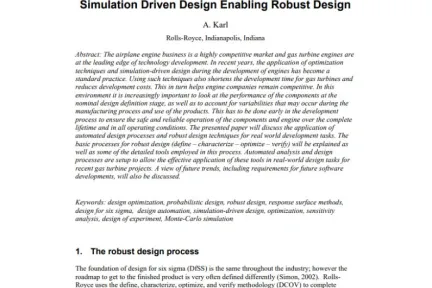
Simulation Driven Design Enabling Robust Design

The airplane engine business is a highly competitive market and gas turbine engines are at the leading edge of technology development. In recent years, the application of optimization techniques and simulation-driven design during the development of engines has become a standard practice. Using such techniques also shortens the development time for gas turbines and reduces development costs. This in turn helps engine companies remain competitive. The presented paper will discuss the application of automated design processes and robust design techniques for real world development tasks.

Customer Papers
Simulation Driven Design Enabling Robust Design
Analysis of Casing Connections Subjected to Thermal Cycle Loading

There are generally three types of connections used in intermediate or production casing of thermal wells: API (American Petroleum Institute) round, API buttress and proprietary premium connections. This paper presents finite element analysis of these three types of casing connections subjected to thermal cycle loading. Based on analysis results, this paper demonstrates that the premium connection, which has a metal-to-metal seal region, is the most suitable of these three connection designs for the use in thermal wells, in terms of structural integrity and sealability. This paper also presents recommendations for casing connection design for successful service in thermal well applications.

Customer Papers

Analysis of Casing Connections Subjected to Thermal Cycle Loading
The application of ABAQUS in seismic analysis of connected structures

The connected structure refers to the kind of building which is composed of two or more towers connected by the connecting body in a certain height, belonging to the irregular building structure system. According to “Technical Specification for Concrete Structures of Tall Building”, the time-history analysis method should be adopted in the seismic analysis of the connected structure. The structure may have a larger plastic deformation under rare earthquake, so it is difficult to converge when the implicit solution method is used by the conventional finite element software. While the explicit integral technology provided by ABAQUS can solve the nonlinear dynamics problems better, it has a broader application in elastic-plastic dynamic analysis. Taking a specific project as an object, the application of ABAQUS in seismic analysis of connected structures is presented in detail in this paper.

Customer Papers

The application of ABAQUS in seismic analysis of connected structures
The Engineering Practice of Elasto-plastic Dynamic Time-history Analysis on Complex Building Structures Using Abaqus

Compared with response spectrum method and the pushover method, Elasto-plastic dynamic time-history analysis method is considered to be a more accurate seismic analysis method. Because of Abaqus’s strong non-linear calculation function, the software makes it possible for the method mentioned above to be applied. Elasto-plastic dynamic analysis on complex structures using Abaqus has a rapid development in China. In this paper, with CCTV Building, Shanghai World Expo Axis Sun Valley, Dalian Xiaoping island super-high-rise apartment building and many other cases of engineering practice, the problem-solving experience of seismic analysis on major projects is described, which will provide some reference to the analysis method’s further development and engineering practice.

Customer Papers

The Engineering Practice of Elasto-plastic Dynamic Time-history Analysis on Complex Building Structures Using Abaqus
Calibration of Nonlinear Viscoelastic Materials in Abaqus Using the Adaptive Quasi-Linear Viscoelastic Model

This work presents a method for calibrating the built-in Abaqus hyperelasticviscoelastic material models based on test data from soft material loading and relaxation tests. This approach can be used to represent the uniaxial material behavior with 1-D Abaqus connector elements or by using the built-in 3-D material models. It is based on the Adaptive Quasi-Linear Viscoelastic (AQLV) theory, developed by Nekouzadeh, Pryse, Elson, and Genin, which offers an easy and powerful method for the calibration of highly viscoelastic materials such as soft tissue. In this paper, we first implement the AQLV method in ABAQUS using connector elements.

Customer Papers

Calibration of Nonlinear Viscoelastic Materials in Abaqus Using the Adaptive Quasi-Linear Viscoelastic Model
Linear Elastic Fracture Mechanics Analysis of Flaws within Residual Stress Fields

A procedure for calculating Linear Elastic Fracture Mechanics (LEFM) Stress Intensity Factors associated with postulated flaws located within regions of residual stress that result from large strain forming processes is presented. The procedure is validated by analyzing a structural system with residual stresses representative of a plane strain 3-point bending configuration, for which a known solution exists. The procedure is also applicable to the analysis of flaws in residual stress fields that result from in-service loads leading to large plastic strains, as illustrated by the determination of stress intensity factors associated with a postulated flaw in a deployed coronary stent. The procedure utilizes the ABAQUS import capability where the residual stresses are imported along with the updated model geometry.

Customer Papers

Linear Elastic Fracture Mechanics Analysis of Flaws within Residual Stress Fields
Application of «Soil» Dashpots in Modal Method Analysis of Civil Structures of Nuclear Power Plants

Now in world practice there are two methods of dynamic analysis, which are intensively used, that are direct integration method and modal method. Advantage of a modal method is the opportunity of the account of normative values of attenuation in soil-structure systems by means of using special option *Modal Composite in Abaqus. In direct integration method there is an activization of dashpot elements, which are necessary for the account of radiating attenuation, but used in materials Reyleigh damping provides too conservative results in comparison with normative values. For overcoming the arisen problem in the present work opportunities of the new approach developed in Abaqus which is the combination of the named two methods realized with help of SIM architecture are investigated.

Customer Papers

Application of «Soil» Dashpots in Modal Method Analysis of Civil Structures of Nuclear Power Plants
Advanced Body in White Architecture Optimization

During the BIW concept developing phase, some key design variables, such as rails and pillars width and position, shell thickness, etc, and multi-attribute responses from safety, NVH, and durability are considered to explore the design space. Isight DOE design drive is used to assess the impact of the variables on the objectives, and this helps the engineer to better understand the design space and give design recommendation. Approximations component is used sequentially to create fast-running surrogate models to replace the real CAE simulations. Finally, the Optimization tool is used to perform a trade-off study, and this helps engineer to know what is the minimum cost for the design to meet all design targets, or when the BIW weight is fixed, what is the potential maximum design performance.

Customer Papers

Advanced Body in White Architecture Optimization
Fracture analysis of the battery cans for Implantable Pulse Generators

The stresses in a battery housing used in Implantable Pulse Generators (IPGs), also known as pacemakers, were investigated using Abaqus/Standard. There were three levels of analysis: the global level, the three-dimensional submodel level and the plane strain submodel level. The output of the global analysis was fed into the three-dimensional submodel analysis and subsequently the output of the three-dimensional submodel analysis was fed into the plane strain submodel analysis. The simulation results of the global model were used to drive the more detailed three-dimensional submodels on long and short sides of the battery models.

Customer Papers

Fracture analysis of the battery cans for Implantable Pulse Generators
A numerical study on air squeeze-film damping based on structure-fluid co-simulation technique

CAE applications in dealing with multiphysics problems have been drawing much attention in product development in recent years. In particular, structure-fluid interaction (FSI) problems are of major concern. In this article, a numerical simulation on air squeeze-film damping which is important in MEMS design is presented. The study employs Abaqus and STARCD to perform a structure-fluid co-simulation. The squeeze-film damping phenomenon of a simple plate structure is demonstrated and its mechanism investigated. An equivalent modeling method to approximately represent the squeeze-film effects is also examined. It is considered that this coupling analysis method based on Abaqus Co-simulation could be an effective approach to deal with a broad range of FSI problems.

Customer Papers

A numerical study on air squeeze-film damping based on structure-fluid co-simulation technique
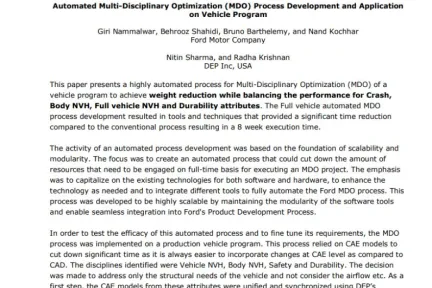
Automated Multi-Disciplinary Optimization Process Development and Application on Vehicle Program

This paper presents a highly automated process for Multi-Disciplinary Optimization (MDO) of a vehicle program to achieve weight reduction while balancing the performance for Crash, Body NVH, Full vehicle NVH and Durability attributes. The Full vehicle automated MDO process development resulted in tools and techniques that provided a significant time reduction compared to the conventional process resulting in a 8 week execution time.

Customer Papers

Automated Multi-Disciplinary Optimization Process Development and Application on Vehicle Program
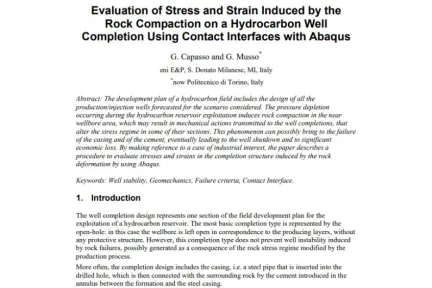
Evaluation of Stress and Strain Induced by the Rock Compaction on a Hydrocarbon Well Completion Using Contact Interfaces with Abaqus

The development plan of a hydrocarbon field includes the design of all the production/injection wells forecasted for the scenario considered. The pressure depletion occurring during the hydrocarbon reservoir exploitation induces rock compaction in the near wellbore area, which may result in mechanical actions transmitted to the well completions, that alter the stress regime in some of their sections. This phenomenon can possibly bring to the failure of the casing and of the cement, eventually leading to the well shutdown and to significant economic loss. By making reference to a case of industrial interest, the paper describes a procedure to evaluate stresses and strains in the completion structure induced by the rock deformation by using Abaqus.

Customer Papers

Evaluation of Stress and Strain Induced by the Rock Compaction on a Hydrocarbon Well Completion Using Contact Interfaces with Abaqus
There are 245 results

Customer stories

There are 129 results

From the communities

There are 6 results

SIMULIA Self Learning

We provide hundreds of self-learning modules so you can continue to learn at your convenience

Blogs

Read the SIMULIA blog on the latest news and innovations from our experts.

There are 694 results

Learn What SIMULIA Can Do for You

Speak with a SIMULIA expert to learn how our solutions enable seamless collaboration and sustainable innovation at organizations of every size.

Get Started

Courses and classes are available for students, academia, professionals and companies. Find the right SIMULIA training for you. 

Get Help

Find information on software & hardware certification, software downloads, user documentation, support contact and services offering