There are 1489 results
Designing Motorola Mobile Radio for Shock and Vibration Requirements

This paper presents the analyses techniques using ABAQUS to identify and prevent typical failure modes seen in shock and vibration testing. The analysis techniques are (i) Steady state response with base excitation for vibration requirement using implicit code, and (ii) Dynamic, explicit with impulse load at the base for shock using explicit code. These analysis methods are being used at Motorola to reduce overall development cycle time required to introduce a new product to market.

Customer Papers

Designing Motorola Mobile Radio for Shock and Vibration Requirements
Application of Abaqus for Practical Postbuckling Analyses of Cylindrical Shells under Axial Compression

For the buckling problem of circular cylindrical shells under axial compression, a number of experimental and theoretical studies have been made by many researchers. In the case of the very thin shell that exhibits elastic buckling, experimental results show that after the primary buckling, secondary buckling takes place accompanying successive reductions in the number of circumferential waves at every mode shift on systematic (one-by-one) basis. In this paper, we traced this successive buckling of circular cylindrical shells using the latest in generalpurpose FEM technology.

Customer Papers

Application of Abaqus for Practical Postbuckling Analyses of Cylindrical Shells under Axial Compression
The Effects of Overload on the Fatigue Life

Automotive vehicles undergo various ranges of road loads according to the driving conditions. Sometimes it experiences unusually large overload such as pot-hole impact or curb strike whose forces are several times of the vehicle weight. Those overloads may induce plastic deformations at some components and these plastic deformations reduce the fatigue life of the components. In some cases, the fatigue crack initiation points may be changed due to the residual stresses which were generated by the overloads. This study was performed to assess the effects of overload on the fatigue behavior of automotive suspension components and to develop a fatigue analysis methodology predicting the fatigue life under overload.

Customer Papers

The Effects of Overload on the Fatigue Life
Integrating Business and Technical Workflows to Achieve Asset-Level Production Optimization

The pressure on the oil and gas industry to meet the growing demand for energy when faced with fewer technical professionals, more complex reservoirs, and increased global competition is making it more critical than ever before for operators to make quick, accurate, and informed field development decisions that efficiently leverage the expertise of seasoned technical professionals. With experienced, technical professionals in short supply, the industry is looking for information technologies that can extend the reach of technical experts and better ground highlevel business decisions in the scientific evaluation of the asset.

Customer Papers

Integrating Business and Technical Workflows to Achieve Asset-Level Production Optimization
Stress Analysis Method for Bolt Thread Roots of Automotive Engine under Operating Condition

In order to analyze the stress at the thread roots of a bolt of an automotive engine under an operating condition, we developed a stress analysis method for it, which consists of a multibody dynamics analysis, a linear transient analysis and nonlinear static analyses. It is able to consider the motion of bolted structures,the contact behavior and the plastic deformations with practical calculation costs. In this paper, we showed that the developed method is applied to inline 4 engine systems as an example.

Customer Papers

Stress Analysis Method for Bolt Thread Roots of Automotive Engine under Operating Condition
Recent Applications of AbaqusExplicit in GM Chassis CAE

GM Chassis CAE has used ABAQUS successfully for many years. In the past most problems examined were more traditional durability and strength analyses of metallic structural components. Recently we have used ABAQUS/Explicit to great advantage to assess and solve for a wider range of component materials and loadings such as elastomers, sealing and impact. This presentation highlights some recent examples of these types of analyses, as well as sharing some general conclusions and lessons learned from these studies.

Customer Papers

Recent Applications of AbaqusExplicit in GM Chassis CAE
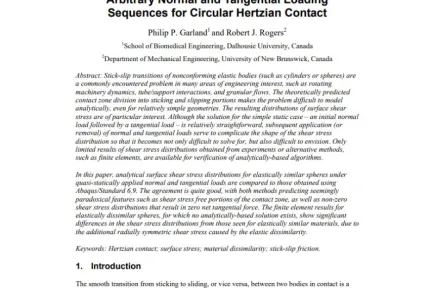
Arbitrary Normal and Tangential Loading Sequences for Circular Hertzian Contact

In this paper, analytical surface shear stress distributions for elastically similar spheres under quasi-statically applied normal and tangential loads are compared to those obtained using Abaqus/Standard 6.9. The agreement is quite good, with both methods predicting seemingly paradoxical features such as shear stress free portions of the contact zone, as well as non-zero shear stress distributions that result in zero net tangential force. The finite element results for elastically dissimilar spheres, for which no analytically-based solution exists, show significant differences in the shear stress distributions from those seen for elastically similar materials, due to the additional radially symmetric shear stress caused by the elastic dissimilarity.

Customer Papers

Arbitrary Normal and Tangential Loading Sequences for Circular Hertzian Contact
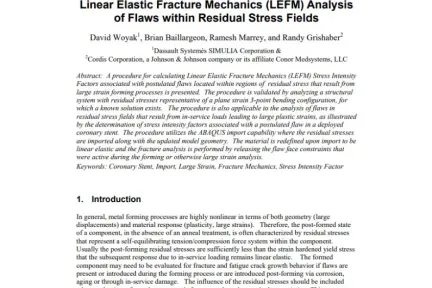
Linear Elastic Fracture Mechanics Analysis of Flaws within Residual Stress Fields

A procedure for calculating Linear Elastic Fracture Mechanics (LEFM) Stress Intensity Factors associated with postulated flaws located within regions of residual stress that result from large strain forming processes is presented. The procedure is validated by analyzing a structural system with residual stresses representative of a plane strain 3-point bending configuration, for which a known solution exists. The procedure is also applicable to the analysis of flaws in residual stress fields that result from in-service loads leading to large plastic strains, as illustrated by the determination of stress intensity factors associated with a postulated flaw in a deployed coronary stent.

Customer Papers

Linear Elastic Fracture Mechanics Analysis of Flaws within Residual Stress Fields
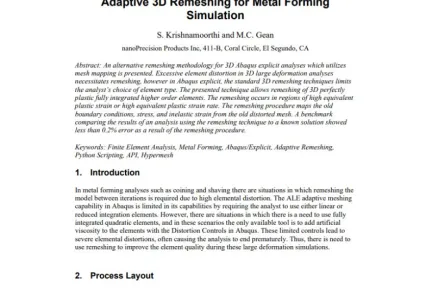
Adaptive 3D Remeshing for Metal Forming Simulation

An alternative remeshing methodology for 3D Abaqus explicit analyses which utilizes mesh mapping is presented. Excessive element distortion in 3D large deformation analyses necessitates remeshing, however in Abaqus explicit, the standard 3D remeshing techniques limits the analyst’s choice of element type. The presented technique allows remeshing of 3D perfectly plastic fully integrated higher order elements. The remeshing occurs in regions of high equivalent plastic strain or high equivalent plastic strain rate. The remeshing procedure maps the old boundary conditions, stress, and inelastic strain from the old distorted mesh.

Customer Papers

Adaptive 3D Remeshing for Metal Forming Simulation
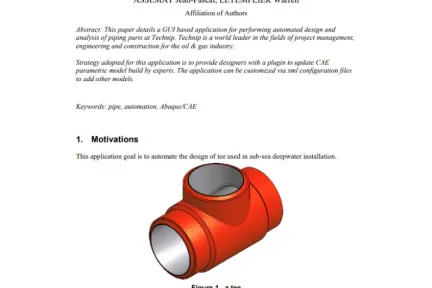
Tee Design Application

This paper details a GUI based application for performing automated design and analysis of piping parts at Technip. Technip is a world leader in the fields of project management, engineering and construction for the oil & gas industry. Strategy adopted for this application is to provide designers with a plugin to update CAE parametric model build by experts. The application can be customized via xml configuration files to add other models.

Customer Papers

Tee Design Application
Using Energy History Data to Obtain Load vs. Deflection Curves from Quasi-Static AbaqusExplicit Analyses

The modeling of quasi-static forming processes and loading conditions with Abaqus/Explicit can present challenges related to the generation of system level force vs. deflection curves and the investigation of general stability behavior. This paper describes a procedure whereby energy history data can be used to generate estimates of quasi-static force vs. deflection curves. The procedure utilizes the principle of virtual work to establish an estimate for the quasi-static equilibrium curve and is accurate when the dynamic inertial forces of the simulation remain small compared to the internal deformation induced forces. The force vs. deflection curves generated by this procedure can also be used to characterize general structural stability characteristics. The procedure is valid for loading conditions that are proportional and monotonic, and is applicable to general structures when simulating quasi-static conditions.

Customer Papers

Using Energy History Data to Obtain Load vs. Deflection Curves from Quasi-Static AbaqusExplicit Analyses
Virtual scaffolding and radial strength testing of stents

Over the past years the Abaqus solver has proven to be very efficient, accurate and robust to study the above mentioned stent design characteristics, both for balloon and self-expandable stents. This paper presents a novel simulation strategy and post-processing tool to accurately analyze balloon expandable stents in terms of radial strength and scaffolding. The underlying platform for this advanced and interactive pre- and post-processing tool is the open-source pyFormex design software.

Customer Papers

Virtual scaffolding and radial strength testing of stents
There are 245 results

Customer stories

There are 129 results

From the communities

There are 6 results

SIMULIA Self Learning

We provide hundreds of self-learning modules so you can continue to learn at your convenience

Blogs

Read the SIMULIA blog on the latest news and innovations from our experts.

There are 694 results

Learn What SIMULIA Can Do for You

Speak with a SIMULIA expert to learn how our solutions enable seamless collaboration and sustainable innovation at organizations of every size.

Get Started

Courses and classes are available for students, academia, professionals and companies. Find the right SIMULIA training for you. 

Get Help

Find information on software & hardware certification, software downloads, user documentation, support contact and services offering