There are 1489 results
Application of Inelastic Analysis of ABAQUS in Japanese Industry

In Japan, social demand for heavy industries seems to have been saturated, resulting in the center of the balance of the engineering population deviating toward the field of products with faster delivery times and lower prices. In such a field, while the constraints due to the trend in demand and cost always take precedence over all others, safety and environmental issues are inherently receiving public attention. Accordingly, the analysis of the ultimate state of products, as represented by the crash of automobiles or the dropping of mobile devices, is strongly desired within actual design cycles.

Customer Papers
Application of Inelastic Analysis of ABAQUS in Japanese Industry
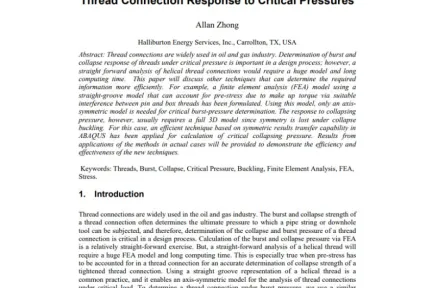
Thread Connection Response to Critical Pressures

Thread connections are widely used in oil and gas industry. Determination of burst and collapse response of threads under critical pressure is important in a design process; however, a straight forward analysis of helical thread connections would require a huge model and long computing time. This paper will discuss other techniques that can determine the required information more efficiently. Using this model, only an axissymmetric model is needed for critical burst-pressure determination.

Customer Papers

Thread Connection Response to Critical Pressures
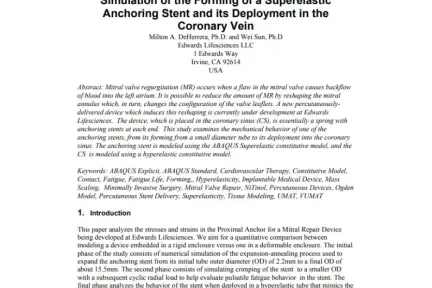
Simulation of the Forming of a Superelastic Anchoring Stent and its Deployment in the Coronary Vein

Mitral valve regurgitation (MR) occurs when a flaw in the mitral valve causes backflow of blood into the left atrium. It is possible to reduce the amount of MR by reshaping the mitral annulus which, in turn, changes the configuration of the valve leaflets. A new percutaneouslydelivered device which induces this reshaping is currently under development at Edwards Lifesciences. The device, which is placed in the coronary sinus (CS), is essentially a spring with anchoring stents at each end. This study examines the mechanical behavior of one of the anchoring stents, from its forming from a small diameter tube to its deployment into the coronary sinus. The anchoring stent is modeled using the ABAQUS Superelastic constitutive model, and the CS is modeled using a hyperelastic constitutive model.

Customer Papers

Simulation of the Forming of a Superelastic Anchoring Stent and its Deployment in the Coronary Vein
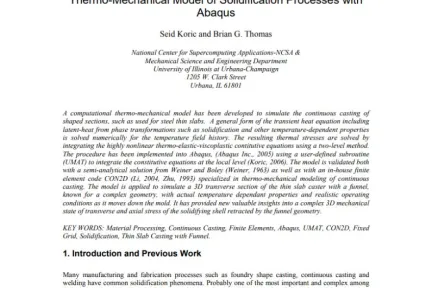
Thermo-Mechanical Model of Solidification Processes with Abaqus

A computational thermo-mechanical model has been developed to simulate the continuous casting of shaped sections, such as used for steel thin slabs. A general form of the transient heat equation including latent-heat from phase transformations such as solidification and other temperature-dependent properties is solved numerically for the temperature field history. The resulting thermal stresses are solved by integrating the highly nonlinear thermo-elastic-viscoplastic contitutive equations using a two-level method. The model is applied to simulate a 3D transverse section of the thin slab caster with a funnel, known for a complex geometry, with actual temperature dependant properties and realistic operating conditions as it moves down the mold.

Customer Papers

Thermo-Mechanical Model of Solidification Processes with Abaqus
Development of Benchmark Examples for QuasiStatic Delamination Propagation and Fatigue Growth Predictions

The development of benchmark examples for quasi-static delamination propagation and cyclic delamination onset and growth prediction is presented and demonstrated for Abaqus/Standard. The example is based on a finite element model of a Double-Cantilever Beam specimen. The example is independent of the analysis software used and allows the assessment of the automated delamination propagation, onset and growth prediction capabilities in commercial finite element codes based on the virtual crack closure technique (VCCT).

Customer Papers

Development of Benchmark Examples for QuasiStatic Delamination Propagation and Fatigue Growth Predictions
Finite Element Analysis of Blast Resistant Structures in the Oil and Gas Industry

A common requirement in the oil and gas industry is to design structures that are adequate against the effects of accidental gas explosions. This paper presents an overview on the methodologies involved in the study of the response of structures to resist blast and explosion, focusing on the use of nonlinear finite element analysis (NLFEA). NLFEA can be used to overcome the limitations of commonly used analytical methods which are predominantly developed for elastic response or limited plastic response and do not allow for large deflection and unstable responses.

Customer Papers

Finite Element Analysis of Blast Resistant Structures in the Oil and Gas Industry
Modeling Radiation Transport Using MCNP6 and AbaqusCAE

Los Alamos National Laboratory (LANL) has released a new version of MCNP, its general purpose Monte Carlo N-particle transport code, which has the ability to use unstructured meshes created with Abaqus/CAE as geometry descriptions. This improvement allows mechanical engineering models to be used in place of legacy constructive solid geometry descriptions, which are far less sophisticated. This capability also allows for the seamless integration of radiation transport calculations with analysis of the resulting thermal and mechanical effects on materials. Using Abaqus/CAE for visualization of the results calculated by MCNP6 is a major advantage over the previous ability to view results in two-dimensional space with MCNP’s native plotter.

Customer Papers

Modeling Radiation Transport Using MCNP6 and AbaqusCAE
ABAQUS High Performance Computing Environment at Nokia

The new commodity high performance computing (HPC) hardware together with the recent ABAQUS performance enhancements, have made it possible to build high performing ABAQUS computing environment cost effectively. Since ABAQUS supports the distributed memory parallel (DMP) hardware, the usage of the cluster type of hardware has become very interesting. This paper presents the current state of ABAQUS computing environment set-up at the company.

Customer Papers

ABAQUS High Performance Computing Environment at Nokia
New tools for analyzing biomechanical problems

The ability to automatically convert any 3D image dataset into high quality meshes, is becoming the new modus operandi for biomechanical analysis. New image processing and mesh generation techniques can now aid in the analysis of biological structures, particularly where the geometry is complex. Novel techniques have been developed for the automatic generation of volumetric meshes from 3D image data including image datasets of complex structures composed of two or more distinct domains and including complex interfacial mechanics. The techniques guarantee the generation of robust, low distortion meshes from 3D data sets for use in finite element analysis (FEA), computational fluid dynamics (CFD) computer aided design (CAD) and rapid prototyping (RP).

Customer Papers

New tools for analyzing biomechanical problems
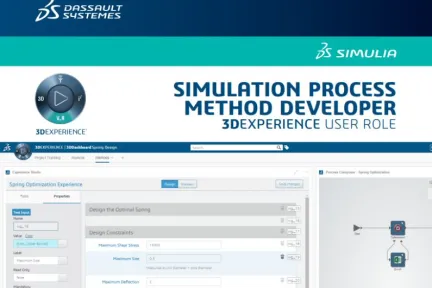
SIMULATION PROCESS METHOD DEVELOPER 3DEXPERIENCE USER ROLE

Simulation Process Method Developer helps experts deliver beautiful, customized experiences to their users without programming. With a drag-and-drop interface builder that is natively integrated with Simulation Process and Optimization and a web-based deployment framework, experts can democratize expertise faster, at lower cost and at greater scale.

Brochures

SIMULATION PROCESS METHOD DEVELOPER 3DEXPERIENCE USER ROLE
Development of 3D finite element model of umbilical systems for offshore application

Umbilical systems provide power and control (electricity, hydraulic power, chemical injection) to subsea oil and gas equipment. Electrical cables and hydraulic tubes are arranged in helical bundles and placed in successive layers depending on the design. Installations into increasingly deeper water place greater demands upon the structural components in terms of strength. 3D finite element analysis is an applicable technique in which to assess the strain and stress distribution and the interactions between components in such complex structures. The true geometry is respected and most of the simplifications of usual approaches can be relieved.

Customer Papers

Development of 3D finite element model of umbilical systems for offshore application
There are 245 results

Customer stories

There are 129 results

From the communities

There are 6 results

SIMULIA Self Learning

We provide hundreds of self-learning modules so you can continue to learn at your convenience

Blogs

Read the SIMULIA blog on the latest news and innovations from our experts.

There are 694 results

Learn What SIMULIA Can Do for You

Speak with a SIMULIA expert to learn how our solutions enable seamless collaboration and sustainable innovation at organizations of every size.

Get Started

Courses and classes are available for students, academia, professionals and companies. Find the right SIMULIA training for you. 

Get Help

Find information on software & hardware certification, software downloads, user documentation, support contact and services offering