There are 1489 results
Reverse-Engineering of Contact Lens Mechanical Properties from an In Situ Compression Test

Contact lenses correct the optics of the ocular system by placing a refractive element over the cornea. Modern lens materials are comprised of 30-90% water and exhibit viscoelasticity, hyperelasticity and thermal dependencies. Contact lens materials have traditionally proven to be extremely difficult to characterize for a number of reasons, primarily because the properties are dependent upon the processing conditions of the lenses themselves and the size and geometry of contact lenses makes them unsuitable for use in standard test apparatuses. In order to better characterize our contact lens materials we have developed an In Situ lens compression testing instrument, wherein a lens is placed in solution and compressed between two flat surfaces while applied force is recorded.

Customer Papers

Reverse-Engineering of Contact Lens Mechanical Properties from an In Situ Compression Test
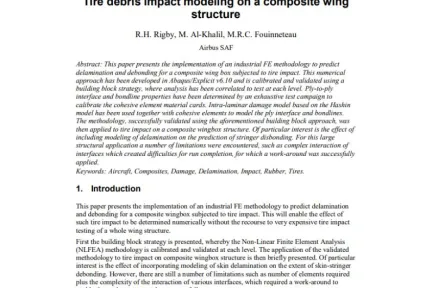
Tire debris impact modeling on a composite wing structure

This paper presents the implementation of an industrial FE methodology to predict delamination and debonding for a composite wing box subjected to tire impact. This numerical approach has been developed in Abaqus/Explicit v6.10 and is calibrated and validated using a building block strategy, where analysis has been correlated to test at each level. Ply-to-ply interface and bondline properties have been determined by an exhaustive test campaign to calibrate the cohesive element material cards. Intra-laminar damage model based on the Hashin model has been used together with cohesive elements to model the ply interface and bondlines. The methodology, successfully validated using the aforementioned building block approach, was then applied to tire impact on a composite wingbox structure.

Customer Papers

Tire debris impact modeling on a composite wing structure
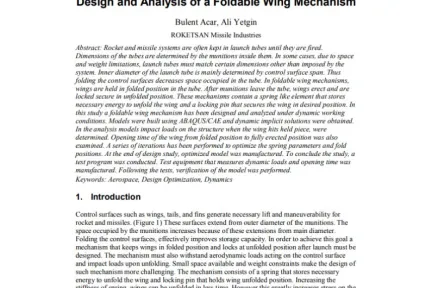
Design and Analysis of a Foldable Wing Mechanism

Rocket and missile systems are often kept in launch tubes until they are fired. Dimensions of the tubes are determined by the munitions inside them. In some cases, due to space and weight limitations, launch tubes must match certain dimensions other than imposed by the system. Inner diameter of the launch tube is mainly determined by control surface span. Thus folding the control surfaces decreases space occupied in the tube. In foldable wing mechanisms, wings are held in folded position in the tube. After munitions leave the tube, wings erect and are locked secure in unfolded position. These mechanisms contain a spring like element that stores necessary energy to unfold the wing and a locking pin that secures the wing in desired position.

Customer Papers

Design and Analysis of a Foldable Wing Mechanism
Analysis and Optimization of a Passenger Bus Frame Through Finite Element Software

The objective of this work is analyze and optimize a passenger bus frame using finite element software, in different static and dynamic conditions. Through a static analysis, torsion and bending constants were extracted using boundary conditions different sets for each one of them. With a linear perturbation step, free and forced vibration modes of the system were obtained and a frequency response analysis was developed. For dynamic analysis, boundary conditions were defined from dynamic automotive equations. Evaluated conditions were suspended weight, acceleration, braking, cornering, and cornering and braking together.

Customer Papers

Analysis and Optimization of a Passenger Bus Frame Through Finite Element Software
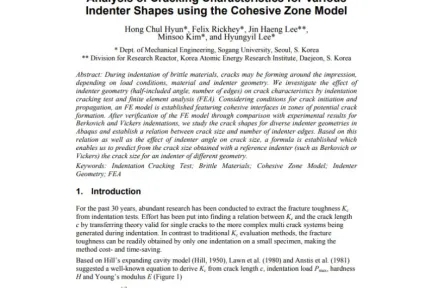
Analysis of Cracking Characteristics for Various Indenter Shapes using the Cohesive Zone Model

During indentation of brittle materials, cracks may be forming around the impression, depending on load conditions, material and indenter geometry. We investigate the effect of indenter geometry (half-included angle, number of edges) on crack characteristics by indentation cracking test and finite element analysis (FEA). Considering conditions for crack initiation and propagation, an FE model is established featuring cohesive interfaces in zones of potential crack formation. After verification of the FE model through comparison with experimental results for Berkovich and Vickers indentations, we study the crack shapes for diverse indenter geometries in Abaqus and establish a relation between crack size and number of indenter edges.

Customer Papers

Analysis of Cracking Characteristics for Various Indenter Shapes using the Cohesive Zone Model
Experimental and Numerical Investigations of the Dowel Effect of Pile Grates in Quay Wall Structures

The typical quay wall structures consist of combined sheet pile walls, pile grates and horizontal anchors in north Germany. Measurements have shown that the earth pressure on the sheet pile wall is shielded due to the dowel effect of the pile grates. The shielded earth pressure is transferred through the slab sections (reinforces concrete superstructure) to the anchor system. In the current design recommendation a higher frictions angle is used to take the dowel effect into account. Firstly, 1g small scaled model tests have been conducted to obtain a better understanding of the failure mechanisms of the soil with regard to pile grates. Soil arches behind piles are observed in the model tests. In additional, the development of the shear bands is illustrated by using the Particle Image Velocimetry (PIV) technique.

Customer Papers

Experimental and Numerical Investigations of the Dowel Effect of Pile Grates in Quay Wall Structures
System Level Design Simulation to Predict Passive Safety Performance for CFRP Automotive Structures

Despite increasingly stringent crash requirements, the body structures of future mainstream production cars need to get lighter. Carbon fiber reinforced polymer (CFRP) composites with a density 1/5th of steel and very high specific energy absorption represent a material technology where substantial mass can be saved when compared to traditional steel applications. BMW have addressed the demanding challenges of producing several hundred composite Body-in-White (BIW) assemblies a day and are committed to significant adoption of composites in future vehicle platforms, as demonstrated in the upcoming i3 and i8 models. A next step to further integrate composites into passenger cars is for primary structural members, which also perform critical roles in passive safety by absorbing large amounts of energy during a crash event.

White Papers

System Level Design Simulation to Predict Passive Safety Performance for CFRP Automotive Structures
Structural Optimization of a Cleat for a Springfree Trampoline

This paper reviews the structural optimization of a cleat from a Springfree Trampoline. In this innovative trampoline, instead of using metal springs the mat is suspended on flexible rods attached to cleats made of fibre glass reinforced polypropylene. A physical testing device was built which applies the load from a rod at the centre of the cleat and supports it at the sides. Nonlinear simulations were used to replicate this experiment and evaluate the effect of changes in the cleat geometry before prototyping. The density and orientation of the glass fibre has an effect on the anisotropic material properties and orientations. Also residual stresses have an effect on structural performance. Therefore an injection simulation was performed using MoldFlow.

Customer Papers

Structural Optimization of a Cleat for a Springfree Trampoline
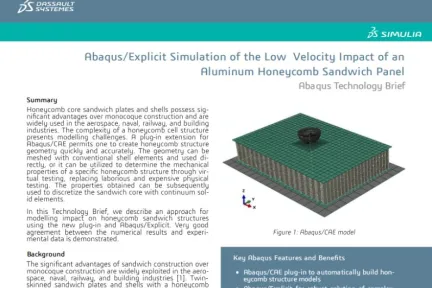
Abaqus/Explicit Simulation of the Low Velocity Impact of an Aluminum Honeycomb Sandwich Panel

Honeycomn core sandwich plates and shells possess significant advantages over monocoque construction and are widely used in the aerospace, naval, railway, and building industries. In this Technology Brief, we describe an approach for modelling impact on honeycomb sandwich structures using the new plug-in and Abaqus/Explicit. Very good agreement between the numerical results and experimental data is demonstrated.

Tech Notes

Abaqus/Explicit Simulation of the Low Velocity Impact of an Aluminum Honeycomb Sandwich Panel
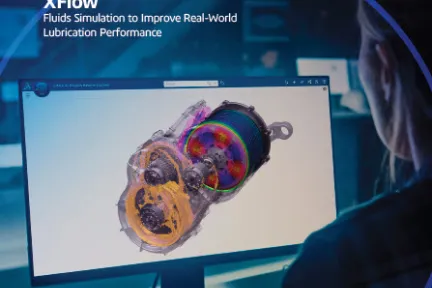
XFLOW Fluids Simulation to Improve Real-World Lubrication Performance

XFlow is a particle-based Lattice Boltzmann technology solver for high fidelity Computational Fluid Dynamics (CFD) applications as a part of SIMULIA’s Fluids Simulation portfolio. XFlow offers multiphase and moving parts modeling capabilities specially focused on lubrication workflows such as gearboxes and electric motor drives. Regardless of the system complexity, gear types or lubrication method, XFlow provides detailed insight into the system performance. Lubrication simulation can reduce the number of physical tests, reducing development times and costs. It also provides quantitative predictions for results like wetted area and churning losses that can be very difficult or impossible to measure experimentally.

Brochures

XFLOW Fluids Simulation to Improve Real-World Lubrication Performance
There are 245 results

Customer stories

There are 129 results

From the communities

There are 6 results

SIMULIA Self Learning

We provide hundreds of self-learning modules so you can continue to learn at your convenience

Blogs

Read the SIMULIA blog on the latest news and innovations from our experts.

There are 694 results

Learn What SIMULIA Can Do for You

Speak with a SIMULIA expert to learn how our solutions enable seamless collaboration and sustainable innovation at organizations of every size.

Get Started

Courses and classes are available for students, academia, professionals and companies. Find the right SIMULIA training for you. 

Get Help

Find information on software & hardware certification, software downloads, user documentation, support contact and services offering