There are 1489 results
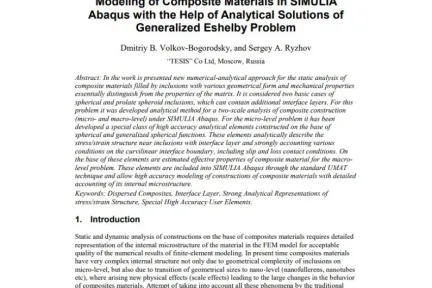
Modeling of Composite Materials in SIMULIA Abaqus with the Help of Analytical Solutions of Generalized Eshelby Problem

In the work is presented new numerical-analytical approach for the static analysis of composite materials filled by inclusions with various geometrical form and mechanical properties essentially distinguish from the properties of the matrix. It is considered two basic cases of spherical and prolate spheroid inclusions, which can contain additional interface layers. For this problem it was developed analytical method for a two-scale analysis of composite construction (micro- and macro-level) under SIMULIA Abaqus.

Customer Papers
Modeling of Composite Materials in SIMULIA Abaqus with the Help of Analytical Solutions of Generalized Eshelby Problem
Topology Optimization of Nacelle Components with ATOM

Weight reduction of components and systems is of utmost importance in Aerospace industry. Reducing weight translates into higher performance and lower fuel consumption. In this paper we identify two components as candidates for weight reduction. In order to achieve this goal without sacrificing the current performance of these components we use ATOM optimization software within Abaqus environment. Current geometry models are simulated with the specified load cases to establish a baseline performance in term of stiffness and stresses. We then generate design envelopes representing the available space for topology optimization.

Customer Papers

Topology Optimization of Nacelle Components with ATOM
Application of CAE to Aluminum Wheel Impact Test Analysis Using Dynamic Implicit

Aluminum Wheel Impact Test (13 Degree Lateral, SAE J157) is the way in order to guarantee the aluminum wheel strength. CAE Team in Hyundai Motor Company has been carrying out the wheel impact test analyses using CAE (Abaqus/Standard), and developing the accuracy of analysis results by comparing with the tests. In this study, aluminum wheel impact test analysis will carry out with test jig model. And we’ll use dynamic implicit analysis (Abaqus/Standard) in order to simulate the rear impact test.

Customer Papers

Application of CAE to Aluminum Wheel Impact Test Analysis Using Dynamic Implicit
Structural Design Optimization of the SAR Plate Assembly Through Genetic Algorithm

Advances in computational technologies allow further improvements regarding the efficiency of the preliminary design phase. Specialized softwares enable the integration and the optimization of a process flow with the scope of reducing time and costs while significantly improving product performance, quality, and reliability. This work consists of an Isight application with the aim of automation and optimization of a structural design process of the SAR Plate Assembly. The multiobjective optimization problem that regards this specific helicopter component is handled through the use of 4 different genetic algorithms.

Customer Papers

Structural Design Optimization of the SAR Plate Assembly Through Genetic Algorithm
Automated Industrial PTFE Billet Sintering Temperature Profile Optimization for Residual Stress Reduction

Because of its high viscosity in melted state, PTFE powder is typically sintered first as large billet, from which parts are machined such as films, seals, etc. In large industrial sinter billets that can reach beyond 1-2 meters in size, PTFE's low thermal conductivity and large crystallization volume change could introduce significant residual stress during cool down from sinter temperature, resulting in billet cracking and difficulties in the subsequent machining step. FEA models were developed to predict the residual stress in the billet for a given temperature profile.

Customer Papers

Automated Industrial PTFE Billet Sintering Temperature Profile Optimization for Residual Stress Reduction
Numerical Simulation of Severe Plastic Deformation during High Pressure Torsion Processing

The principle of achieving high strength and superior properties in metal alloys through the application of severe plastic deformation has been exploited in the metal processing industry for many decades. The High Pressure Torsion (HPT) process is one of the most promising techniques for imposing very high strains to a bulk solid without introducing a significant change in sample dimensions. The HPT process involves large shear and compressive plastic deformations, and offers the possibility to deform the material under very high hydrostatic pressures (up to several GPa), with continuous control of the degree of deformation.

Customer Papers

Numerical Simulation of Severe Plastic Deformation during High Pressure Torsion Processing
Structural optimization of a transversal rolling mill component to improve flexional stiffness

The structural component investigated is a roll mill bar which sustain a plug for a transversal rolling of steel pipes. The improvement of the stiffness of this component is the target of the simulation to achieve the desired flexional displacement. An optimization tool is used to achieve the target in a proper and fast way. A 3D FEM model is developed to perform several different static analyses as basis of optimization process. The bending response of the structure is studied on the basis of the real working condition introducing the loads measured in the plant. Explicit model is then used to simulate the new stiffness in the expanding roll process. The main purpose of the improved stiffness is to stabilize the rolling process to maintain the bar and the plug aligned with roll axis, keeping the setup of the machine.

Customer Papers

Structural optimization of a transversal rolling mill component to improve flexional stiffness
Thermal Expansion & Helical Buckling of Pipe-in-Pipe Flowline Systems

Helical buckling analyses are performed primarily to determine the critical effective axial load at which the inner pipe of a pipe-in-pipe (PiP) system snaps into a sinusoidal or helical buckling deformation mode. The expected behavior, when a flowline is compressed within a larger diameter tubular, is that it will first develop a sinusoidal buckle pattern as it lies along the bottom of the larger diameter pipe. Further compression of the inner pipeline will ultimately cause it to snap into a helical deformation pattern, which will lift the inner flowline off of the bottom of the outer pipe. The axial force that triggers the sinusoidal buckling is denoted as Fcs and the larger force needed for helical buckling is denoted as Fc.

Customer Papers

Thermal Expansion & Helical Buckling of Pipe-in-Pipe Flowline Systems
Advanced Finite Element Analysis to Tackle Challenging Problems in Pipeline Geotechnics

Offshore pipeline design is a multidisciplinary field of engineering that covers route optimization, mechanical wall thickness design, fracture mechanics, flow assurance, stress analysis, geotechnics.For decades, pipelines have been designed pursuing a stress based approach, based on analytical methods and semi-empirical rules of thumb. However, the challenging conditions in oil and gas exploration and production dictate the use of sophisticated numerical tools to assist the pipeline design engineer. In particular, pipe-soil interaction is a complicated phenomenon that governs the response of the offshore pipeline to operational load patterns.

Customer Papers

Advanced Finite Element Analysis to Tackle Challenging Problems in Pipeline Geotechnics
Failure Modeling of Thermoplastic Butt-Joint Stiffened Panels by Quasi-Static Loading

In this work the quasi-static response of thermoplastic butt-joint stiffened beam in bending conditions is modeled. In these panels, the stiffener is connected to the skin by a shortfiber reinforced filler. Although this type of connection performs very well in a pull-off loading (fracture loading is 10 times higher than welded connection), optimization is required regarding its impact performance. The main issue concerning this loading type is the extreme resistance to impact until a certain threshold, upon which the stiffener-skin connection fails in an instable manner, however leaving only barely visible damage on the skin side.

Customer Papers

Failure Modeling of Thermoplastic Butt-Joint Stiffened Panels by Quasi-Static Loading
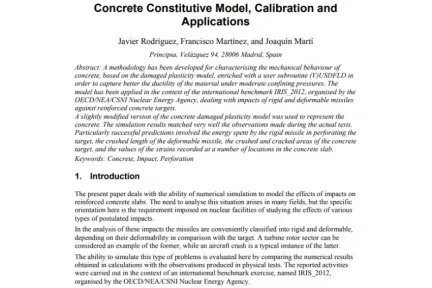
Concrete Constitutive Model, Calibration and Applications

A methodology has been developed for characterising the mechanical behaviour of concrete, based on the damaged plasticity model, enriched with a user subroutine (V)USDFLD in order to capture better the ductility of the material under moderate confining pressures. The model has been applied in the context of the international benchmark IRIS_2012, organised by the OECD/NEA/CSNI Nuclear Energy Agency, dealing with impacts of rigid and deformable missiles against reinforced concrete targets. A slightly modified version of the concrete damaged plasticity model was used to represent the concrete. The simulation results matched very well the observations made during the actual tests.

Customer Papers

Concrete Constitutive Model, Calibration and Applications
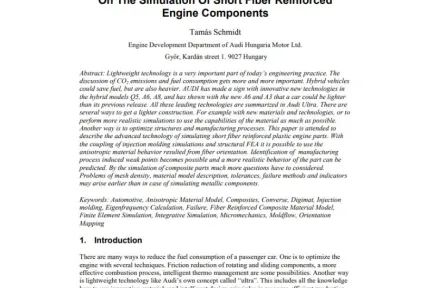
On The Simulation Of Short Fiber Reinforced Engine Components

Lightweight technology is a very important part of today’s engineering practice. The discussion of CO2 emissions and fuel consumption gets more and more important. Hybrid vehicles could save fuel, but are also heavier. AUDI has made a sign with innovative new technologies in the hybrid models Q5, A6, A8, and has shown with the new A6 and A3 that a car could be lighter than its previous release. All these leading technologies are summarized in Audi Ultra. There are several ways to get a lighter construction. This paper is attended to describe the advanced technology of simulating short fiber reinforced plastic engine parts.

Customer Papers

On The Simulation Of Short Fiber Reinforced Engine Components
There are 245 results

Customer stories

There are 129 results

From the communities

There are 6 results

SIMULIA Self Learning

We provide hundreds of self-learning modules so you can continue to learn at your convenience

Blogs

Read the SIMULIA blog on the latest news and innovations from our experts.

There are 694 results

Learn What SIMULIA Can Do for You

Speak with a SIMULIA expert to learn how our solutions enable seamless collaboration and sustainable innovation at organizations of every size.

Get Started

Courses and classes are available for students, academia, professionals and companies. Find the right SIMULIA training for you. 

Get Help

Find information on software & hardware certification, software downloads, user documentation, support contact and services offering