There are 1489 results
New design of a pressure vessel subjected to blast loads

A new design of containment vessel has been proposed to conduct confined detonation experiments. In order to guarantee the confinement of the detonation products, the risk expressed as a probability of failure has to be quantified. This quantification is done using probabilistic analyses which require data from experiments and simulations in order to be sustained. When a blast stresses a spherical vessel, many different mechanical phenomena appear and have to be studied using adapted models. A blast leads to reflected waves in the structure. A numerical chaining is used to access the vessel dynamic structural response. This chaining consists in linking CATIA V5 with Abaqus/CAE to realize the analysis models and in linking our hydrodynamic code to Abaqus /Explicit in a weak coupling.

Customer Papers
New design of a pressure vessel subjected to blast loads
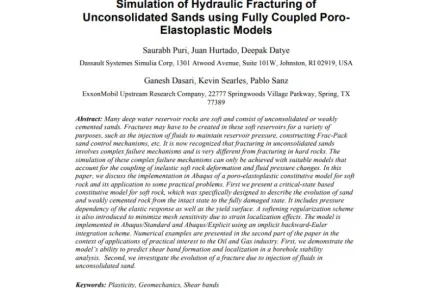
Simulation of Hydraulic Fracturing of Unconsolidated Sands using Fully Coupled PoroElastoplastic Models

Many deep water reservoir rocks are soft and consist of unconsolidated or weakly cemented sands. Fractures may have to be created in these soft reservoirs for a variety of purposes, such as the injection of fluids to maintain reservoir pressure, constructing Frac-Pack sand control mechanisms, etc. It is now recognized that fracturing in unconsolidated sands involves complex failure mechanisms and is very different from fracturing in hard rocks. The simulation of these complex failure mechanisms can only be achieved with suitable models that account for the coupling of inelastic soft rock deformation and fluid pressure changes. In this paper, we discuss the implementation in Abaqus of a poro-elastoplastic constitutive model for soft rock and its application to some practical problems.

Customer Papers

Simulation of Hydraulic Fracturing of Unconsolidated Sands using Fully Coupled PoroElastoplastic Models
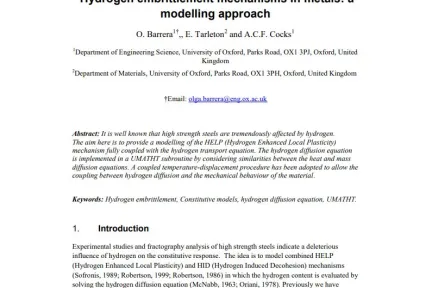
Hydrogen embrittlement mechanisms in metals: a modelling approach

It is well known that high strength steels are tremendously affected by hydrogen. The aim here is to provide a modelling of the HELP (Hydrogen Enhanced Local Plasticity) mechanism fully coupled with the hydrogen transport equation. The hydrogen diffusion equation is implemented in a UMATHT subroutine by considering similarities between the heat and mass diffusion equations. A coupled temperature-displacement procedure has been adopted to allow the coupling between hydrogen diffusion and the mechanical behaviour of the material.

Customer Papers

Hydrogen embrittlement mechanisms in metals: a modelling approach
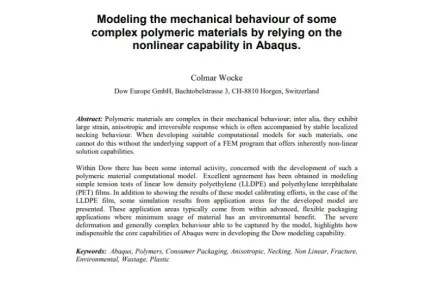
Modeling the mechanical behaviour of some complex polymeric materials by relying on the nonlinear capability in Abaqus.

Polymeric materials are complex in their mechanical behaviour; inter alia, they exhibit large strain, anisotropic and irreversible response which is often accompanied by stable localized necking behaviour. When developing suitable computational models for such materials, one cannot do this without the underlying support of a FEM program that offers inherently non-linear solution capabilities.

Customer Papers

Modeling the mechanical behaviour of some complex polymeric materials by relying on the nonlinear capability in Abaqus.
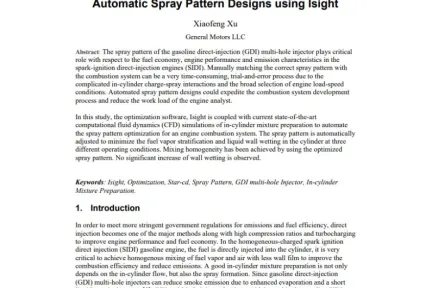
Automatic Spray Pattern Designs using Isight

In this study, the optimization software, Isight is coupled with current state-of-the-art computational fluid dynamics (CFD) simulations of in-cylinder mixture preparation to automate the spray pattern optimization for an engine combustion system. The spray pattern is automatically adjusted to minimize the fuel vapor stratification and liquid wall wetting in the cylinder at three different operating conditions. Mixing homogeneity has been achieved by using the optimized spray pattern. No significant increase of wall wetting is observed.

Customer Papers

Automatic Spray Pattern Designs using Isight
Application of CAE to Optimize the Durability of Suspension Air Spring

Application of the CAE is needed to obtain optimized performance of the air spring under the consideration of many design factors. This Paper presents a method for estimating the durability of the air spring by applying it to the suspensions of a vehicle. We developed FE analysis techniques based on Abaqus, which enables us to evaluate and enhance the durability of the air spring at the initial design stage. Also, we validated the results by applying it to a mass production vehicle.

Customer Papers

Application of CAE to Optimize the Durability of Suspension Air Spring
Application of Impact Analysis for Aluminum Wheel with Inflated Tire

In this paper, we discussed the application of impact analysis of aluminum wheel. The analysis model consisted of aluminum wheel and tire structure. The tire structure model was naturally inflated with pressure by Abaqus/Standard, and the results of implicit analysis were imported to Abaqus/Explicit for the dynamical impact analysis afterward. Both results of 13 and 90 degree impact analyses were compared with the experimental data; the performance and accuracy were examined.

Customer Papers

Application of Impact Analysis for Aluminum Wheel with Inflated Tire
Stability of Automatic Storage and Retrieval Rack Systems at Elevated Temperatures

Automatic Storage and Retrieval Systems (ASRS) are computer-controlled systems for handling products in storage facilities with minimal manual labor. The combination of densely stored goods, height of structures, large number of interconnected racks, and tight geometrical tolerances raises concerns of structural damage to the system when exposed to elevated temperatures. Structural damage of this type could potentially lead to long down-times while the affected unit is being repaired or loss of building integrity when the rack is part of a building’s structural support. The behavior of typical single- and multiple-row ASRS racks was investigated.

Customer Papers

Stability of Automatic Storage and Retrieval Rack Systems at Elevated Temperatures
Coupled Euler-Lagrange Simulation of the JOLT HE Event

We simulated the Defense Threat Reduction Agency (DTRA)-sponsored Jointed Limestone Test (JOLT) using the Abaqus fully coupled Euler-Lagrange computation scheme. JOLT was a small-scale experiment consisting of over 37,000 individual cubes of limestone surrounding simulated tunnels. This test bed was loaded with ground shock generated by a spherical Comp B charge, thereby providing data for the study of computer codes used to compute the response of buried tunnels to explosive loading. We modeled the cubes as continuum blocks with contact, making for a dis-continuum simulation using a hybrid continuum code including Eulerian modeling of the explosive region and Lagrangian modeling of the remainder of the test bed. This paper has been approved for unlimited release under LA-UR-14-20056.

Customer Papers

Coupled Euler-Lagrange Simulation of the JOLT HE Event
How to Select and Calibrate an Accurate Material Model for Polymers

The non-linear mechanical response of thermoplastics, rubbers, foams, and biomaterials can be challenging to accurately represent in a FE simulation. Recent versions of Abaqus/Standard and Abaqus/Explicit support a number of different viscoelastic and viscoplastic material models, including the new Parallel Rheological Framework model. These material models can provide accurate predictions of the response of different material classes, but in many applications it can still be challenging to select an appropriate material model and to calibrate it to experimental data. This paper discusses what experimental data is necessary to use these models, illustrates the importance of model validation, and demonstrates how the material models can quickly be calibrated using the MCalibration software.

Customer Papers

How to Select and Calibrate an Accurate Material Model for Polymers
Combining the eXtended Finite Element Method with Virtual Crack Closure Technique and Cohesive Surface Modeling to simulate delamination migration in cross-ply laminates

Using recently developed benchmarks, the performance of the eXtended Finite Element Method (XFEM), as implemented in Abaqus/Standard, is assessed and its main features highlighted. Subsequently, a strategy is proposed to model delamination migration using Abaqus/Standard that combines: the Cohesive Surface (CS) formulation and/or the Virtual Crack Closure Technique (VCCT) to model delamination with XFEM to capture migration. Finally, the proposed strategy is applied to model the Delamination Migration (DM) test and the results obtained are compared to experiments.

Customer Papers

Combining the eXtended Finite Element Method with Virtual Crack Closure Technique and Cohesive Surface Modeling to simulate delamination migration in cross-ply laminates
Static and Dynamic Simulation of Rubber Tracks using Multi-Body Dynamics to Study Pressure Contact on Treads

The study of large and complex structures that involve multiple bodies functioning kinematically together have been rather challenging until recent technological advancements were found. When one was faced with such a task, the most viable way to proceed was to make use of simplicity and assumptions to conduct analysis at the component of interest. In what is called “system-level” simulation, all components of a given structure or system are taken into consideration in the analysis, thus reducing the yield of error in the theorization of your model. Such analysis method must be used when studying the phenomena of tread wear in a rubber track as it rolls over an undercarriage type-motion system.

Customer Papers

Static and Dynamic Simulation of Rubber Tracks using Multi-Body Dynamics to Study Pressure Contact on Treads
There are 245 results

Customer stories

There are 129 results

From the communities

There are 6 results

SIMULIA Self Learning

We provide hundreds of self-learning modules so you can continue to learn at your convenience

Blogs

Read the SIMULIA blog on the latest news and innovations from our experts.

There are 694 results

Learn What SIMULIA Can Do for You

Speak with a SIMULIA expert to learn how our solutions enable seamless collaboration and sustainable innovation at organizations of every size.

Get Started

Courses and classes are available for students, academia, professionals and companies. Find the right SIMULIA training for you. 

Get Help

Find information on software & hardware certification, software downloads, user documentation, support contact and services offering