There are 1483 results
Fatigue Analysis of a Piston with ABAQUS and a Thermo Mechanical Method According Sehitoglu

The fatigue life of power train components can be improved dramatically by finding crack initiation points with suitable software tools and optimization of the critical areas. With increasing capacities of computers the prediction of the fatigue life for components by numerical methods gets more and more important. The modern virtual development process is able to include many physical effects to enable realistic analyses. The presentation deals with an application on a piston of the software ABAQUS and the Sehitoglu’s TMF method to access the thermo mechanical fatigue life due to transient temperature distributions.

Customer Papers
Fatigue Analysis of a Piston with ABAQUS and a Thermo Mechanical Method According Sehitoglu
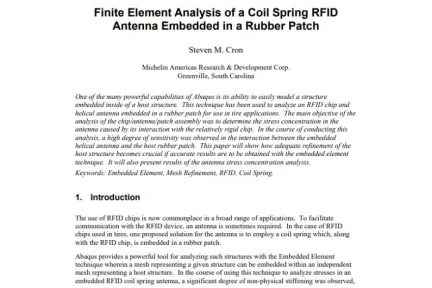
Finite Element Analysis of a Coil Spring RFID Antenna Embedded in a Rubber Patch

One of the many powerful capabilities of Abaqus is its ability to easily model a structure embedded inside of a host structure. This technique has been used to analyze an RFID chip and helical antenna embedded in a rubber patch for use in tire applications. The main objective of the analysis of the chip/antenna/patch assembly was to determine the stress concentration in the antenna caused by its interaction with the relatively rigid chip. In the course of conducting this analysis, a high degree of sensitivity was observed in the interaction between the embedded helical antenna and the host rubber patch. This paper will show how adequate refinement of the host structure becomes crucial if accurate results are to be obtained with the embedded element technique.

Customer Papers

Finite Element Analysis of a Coil Spring RFID Antenna Embedded in a Rubber Patch
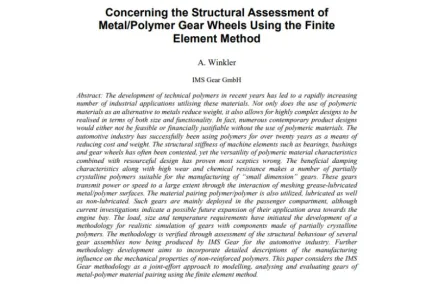
Concerning the Structural Assessment of MetalPolymer Gear Wheels Using the Finite Element Method

The development of technical polymers in recent years has led to a rapidly increasing number of industrial applications utilising these materials. Not only does the use of polymeric materials as an alternative to metals reduce weight, it also allows for highly complex designs to be realised in terms of both size and functionality. In fact, numerous contemporary product designs would either not be feasible or financially justifiable without the use of polymeric materials. The automotive industry has successfully been using polymers for over twenty years as a means of reducing cost and weight.

Customer Papers

Concerning the Structural Assessment of MetalPolymer Gear Wheels Using the Finite Element Method
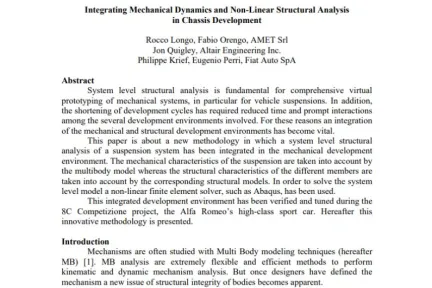
Integrating Mechanical Dynamics and Non-Linear Structural Analysis in Chassis Development

This paper is about a new methodology in which a system level structural analysis of a suspension system has been integrated in the mechanical development environment. The mechanical characteristics of the suspension are taken into account by the multibody model whereas the structural characteristics of the different members are taken into account by the corresponding structural models. In order to solve the system level model a non-linear finite element solver, such as Abaqus, has been used. This integrated development environment has been verified and tuned during the 8C Competizione project, the Alfa Romeo’s high-class sport car. Hereafter this innovative methodology is presented.

Customer Papers

Integrating Mechanical Dynamics and Non-Linear Structural Analysis in Chassis Development
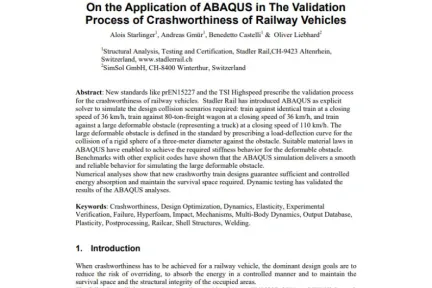
On the Application of ABAQUS in The Validation Process of Crashworthiness of Railway Vehicles

New standards like prEN15227 and the TSI Highspeed prescribe the validation process for the crashworthiness of railway vehicles. Stadler Rail has introduced ABAQUS as explicit solver to simulate the design collision scenarios required: train against identical train at a closing speed of 36 km/h, train against 80-ton-freight wagon at a closing speed of 36 km/h, and train against a large deformable obstacle (representing a truck) at a closing speed of 110 km/h. The large deformable obstacle is defined in the standard by prescribing a load-deflection curve for the collision of a rigid sphere of a three-meter diameter against the obstacle. Suitable material laws in ABAQUS have enabled to achieve the required stiffness behavior for the deformable obstacle.

Customer Papers

On the Application of ABAQUS in The Validation Process of Crashworthiness of Railway Vehicles
Optimization Module for Abaqus/CAE based on Genetic Algorithm

Genetic algorithms have become one of successful tools in design and topology optimization. The optimization module based on genetic algorithms was developed and employed in Abaqus/CAE by GUI and kernel scripting. The new module extends advanced functionality of Abaqus/CAE allowing to perform optimization directly in Abaqus Unified FEA product suite from SIMULIA. Significant improvement in evolving into optimal solution can be achieved when genetic algorithms are combined with neural networks which one can train by running Abaqus jobs, and substantially improve the efficiency of computations. In the paper the shape optimization problem of a tooth implant will be presented and discussed in detail.

Customer Papers

Optimization Module for Abaqus/CAE based on Genetic Algorithm
Elastic-Plastic-Failure Finite Element Analyses of Railroad Tank Car Heads in Impact

This paper presents a computational framework that employs elastic-plastic-failure finite element analysis (FEA) tools to predict dynamic forces, deformations and puncture resistance of railroad tank car heads in impact events. First, computational sensitivity to analysis code, analysis type, element type, element size, through-the-thickness characteristics and element integration scheme is studied for elastic-plastic analyses. Second, the progressive damage and failure modeling for ductile metals is employed to estimate the puncture resistance of a tank car head.

Customer Papers

Elastic-Plastic-Failure Finite Element Analyses of Railroad Tank Car Heads in Impact
Nonlinear Dynamic Earthquake Analysis of Skyscrapers by ABAQUS

Due to the limitation of computer capacity and the soften of the material constitution, the nonlinear dynamic earthquake analyses of skyscrapers are not practical in engineer’s desktop, and even in the research area they are still open problems. Utilizing ABAQUS’s unique combination of implicit and explicit technologies and capable of solving large problem efficiently, the author solves the problem elegantly and practically. In the analysis model, all members and shear-walls are modeled by plastic zone model, and large deflection effects are taking into account.

Customer Papers

Nonlinear Dynamic Earthquake Analysis of Skyscrapers by ABAQUS
Creep modelling of Polyolefins using artificial neural networks

Notwithstanding the increasing demand for polymeric materials in an extraordinary variety of applications, the engineers have often only limited tools suitable for the design of parts made of polymers, both in terms of mathematical models and reliable material data, which together constitute the basis for a finite-elements based design. In order to predict the polymer creep behaviour, this paper proposes a solution based on artificial neural networks, where the experimental creep curves are used to determine the parameters of a neural network which is then simply implemented in an Abaqus user subroutine.

Customer Papers

Creep modelling of Polyolefins using artificial neural networks
Boundary Condition Influences on Shank Stress in 3D Solid Bolt Simulation

When simulating bolts, the amount of detail to include is often raised. The analyst is left with using judgment in deciding to include or not include details, such as threads. For system models, where the primary bolt function is to transfer load from the cover to the base, thread details are sometimes perceived as not needed. It is believed that a reasonable result can be achieved without this detail. This paper evaluates boundary conditions and software settings used in simulating bolts. A simulated threaded bolt with full contact is the baseline model. A model with interaction, smear, at the threaded region and one with tied contact at the threaded region is compared against the baseline model.

Customer Papers

Boundary Condition Influences on Shank Stress in 3D Solid Bolt Simulation
Application of Abaqus for Advanced Inelastic Analysis

In the past several years, Abaqus, the leading edge of the implicit method, has added the explicit method to its line-up. Consequently, the ability to solve highly nonlinear problems, especially for two of them, i.e., geometric nonlinearity and boundary condition nonlinearity, has been extensively improved. However, as for material nonlinearity, the issue of defining the constitutive law unresolved. This is due to the fact that this issue may not be resolved solely by using FEM capabilities, but rather may be deeply involved with the management of FEM.

Customer Papers

Application of Abaqus for Advanced Inelastic Analysis
Fatigue Life Estimation of Nitinol Medical Devices

Stents have been used in the treatment of coronary artery disease for decades, and their use in the peripheral arterial vasculature is growing rapidly. Mechanical loads imposed on peripheral stents may include loads due to arterial pulsation, axial compression, bending and torsion. These stents are most often manufactured using nitinol, a nickel-titanium alloy that exhibits unique shape memory and superelastic characteristics. Finite element analysis can be a powerful tool in designing medical devices to withstand such a rigorous loading environment. This paper will focus on the use of Abaqus/Standard for fatigue life characterization of nitinol stents and comparison of performance predicted by FEA to experimental data.

Customer Papers

Fatigue Life Estimation of Nitinol Medical Devices
There are 245 results

Customer stories

There are 130 results

From the communities

There are 6 results

SIMULIA Self Learning

We provide hundreds of self-learning modules so you can continue to learn at your convenience

Blogs

Read the SIMULIA blog on the latest news and innovations from our experts.

There are 694 results

Learn What SIMULIA Can Do for You

Speak with a SIMULIA expert to learn how our solutions enable seamless collaboration and sustainable innovation at organizations of every size.

Get Started

Courses and classes are available for students, academia, professionals and companies. Find the right SIMULIA training for you. 

Get Help

Find information on software & hardware certification, software downloads, user documentation, support contact and services offering