1506 Ergebnisse
Pirelli Formula 1 tyre modeling application with Abaqus

As the sole tyre supplier for Formula1 Championship, Pirelli Tyre provides the teams with a virtual tyre model to help simulate racing conditions. The highly sophisticated body shape of a F1 car is driven by aerodynamic efficiency and tyre deformation plays an important role in this context. Tyre shape prediction at speeds up 300kph has been achieved by using a combination of Abaqus/Standard and Abaqus/Explicit. The numerical results have been verified using indoor test bench results. Tyre shape is also the key factor for wind tunnel analysis. The same modeling technique has been applied to wind tunnel FE tyre model.

Customer Papers

Pirelli Formula 1 tyre modeling application with Abaqus
Integrated Tool for Strain Extraction in Virtual Testing

This paper presents an automated approach to extract strains of aircraft structural models from widely used CAD and FE environments. The developed approach has been implemented as an integrated tool in widely used CATIA V5 and Abaqus environments. The integrated tool eliminates tedious procedures involved in manual extraction of strains using FEA models at appropriate strain gage locations. This integrated tool is a quick, inexpensive and effective technique for predicting structural strains. This work uses Abaqus-Python, CATIA-VB and Visual Basic environment to develop integrated tool for identifying location, direction and strains in the strain gages present in an aircraft structure.

Customer Papers

Integrated Tool for Strain Extraction in Virtual Testing
Validation of VUEOS in Abaqus/Explicit and Application to Noble-Abel and Mie-Grüneisen Equations of State

In the release of Abaqus 6.13-1, SIMULIA is adding a new user subroutine capability in Explicit termed VUEOS. This capability allows the user to define a hydrodynamic material model in which the material's volumetric response is determined by a user-defined equation of state (EOS). The introduction of this capability gives the user the ability define an EOS based on a constitutive relationship involving pressure, energy, and density, where the pressure may have parameter fits or empirical data. In order to validate this new user subroutine framework, the U.S. Army – ARDEC developed three user EOS’s for comparison with analytical and published data.

Customer Papers

Validation of VUEOS in Abaqus/Explicit and Application to Noble-Abel and Mie-Grüneisen Equations of State
Development of analytical prediction method for pulley bolt-loosening

Many auxiliary parts (e.g. the water pump, the oil pump, the alternator, and etc) in an engine are driven by the crankshaft. For this, a pulley is assembled to the crankshaft by a bolt. A bolt-loosening of the pulley can cause noise and vibration and bring engine breakdown in severe case. A finite element analysis procedure and a rig test were developed to predict a bolt-loosening of the pulley. The FE analysis results agree with the rig test results and verified with the real engine test. The parameters making worse the bolt-loosening are investigated. They are the torsional and lateral vibration of the crankshaft, the belt tension, the belt torque variation and the pulley inertia. Authors thought this procedure developed here can be applied to solve a boltloosening in other system.

Customer Papers

Development of analytical prediction method for pulley bolt-loosening
Correlation of the Vibroacoustic Response of Structural Panels with Isight for Use in Statistical Energy Analysis in Aerospace Applications

With the increasingly common use of advanced composite materials in the design of aerospace structures, vibroacoustic loads have become an important factor for structural design and integrity. Vibroacoustic analysis at high frequency is often performed by statistical energy analysis (SEA) using software products such as ESI’s VA One. A difficulty in performing SEA on complex aerospace structures is ensuring that the SEA subsystem (e.g., a structural panel) properly represents the actual structure. The model is often checked by comparing the response of a subsystem to that of a refined finite element (FE) mesh of the subsystem.

Customer Papers

Correlation of the Vibroacoustic Response of Structural Panels with Isight for Use in Statistical Energy Analysis in Aerospace Applications
Mechanical Behavior of a Pipe-in-Pipe in a Span

In a free span, the inner pipe of a pipe-in-pipe system (PiP) bends substantially due to internal pressure and temperature and possibly contacts the outer pipe. The study is motivated by the need to understand how the interaction between the two pipes affects the PiP behavior at a free span during thermal expansion and how a PiP can be modeled adequately. The pipes were simulated with thick wall pipe, elbow, and shell elements. The interaction between the inner and outer pipes was simulated with multi-point constraints (MPC), tube-to-tube contact elements (ITT), and contact surfaces. Finite element (FE) model accuracy and cost effectiveness were compared in a case study.

Customer Papers

Mechanical Behavior of a Pipe-in-Pipe in a Span
A Methodology for Sensor Positioning Based on Eigenmode data

The importance of sensor location is crucial for a correct assessment of the dynamic response of structures and, if early structural damage detection is a concern, for increasing the POD-Probability of Detection of Structural Health Monitoring (SHM) vibration-based methods. Also, the high cost of sensoring equipment (accelerometers, strain-gauges, fibre-optic sensors, etc...) implies the use of a minimum number of sensors that must be judiciously positioned in order to extract adequate and relevant information from the monitored structure. Critical Materials S.A. is developing algorithms for sensor positioning procedures, as an auxiliary tool for the deployment of vibration-based SHM techniques, based on Eigenmode and Eigenfrequency data retrieved from natural frequency extraction analysis procedures.

Customer Papers

A Methodology for Sensor Positioning Based on Eigenmode data
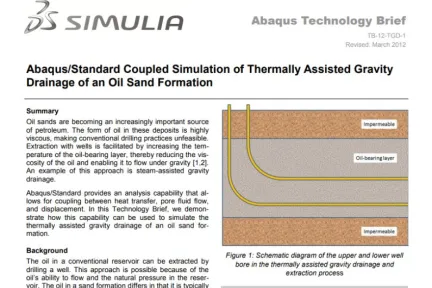
Abaqus/Standard Coupled Simulation of Thermally Assisted Gravity Drainage of an Oil Sand Formation

Oil sands are becoming an increasingly important source of petroleum. The form of oil in these deposits is highly viscous, making conventional drilling practices unfeasible. Extraction with wells is facilitated by increasing the temperature of the oil-bearing layer, thereby reducing the viscosity of the oil and enabling it to flow under gravity [1,2]. An example of this approach is steam-assisted gravity drainage. Abaqus/Standard provides an analysis capability that allows for coupling between heat transfer, pore fluid flow, and displacement. In this Technology Brief, we demonstrate how this capability can be used to simulate the thermally assisted gravity drainage of an oil sand formation.

Tech Notes

Abaqus/Standard Coupled Simulation of Thermally Assisted Gravity Drainage of an Oil Sand Formation
Combining Detailed Experiments, PolyUMod, Kornucopia, and Abaqus to Create Accurate FE Scratch Simulations

Creating a viable simulation approach capable of representing key fundamental aspects of scratch of polymers is an extremely challenging task. The simulation must include complicated material response, such as nonlinear viscoelastic/viscoplastic behavior of the polymeric material at large strains. In addition, the model must include a sufficiently detailed representation of the scratching event using frictional contact between the indenter and the sample, and the model must take into account the indenter loading history. This paper discusses how Abaqus/Explicit models using the PolyUMod advanced Parallel Network Material models were used in conjunction with detail experiments processed by Kornucopia to create scratch simulations that correlated well to several physical scratch tests.

Customer Papers

Combining Detailed Experiments, PolyUMod, Kornucopia, and Abaqus to Create Accurate FE Scratch Simulations
Numerical simulations of quasi-static and rockfall impact tests of ultra-high strength steel wire-ring nets using Abaqus/Explicit

Flexible, light-weight wire ring-net barriers are used to stop falling rocks serving as protection for villages and roadways in mountainous regions. The steel wire-ring nets are difficult to model because of their complex geometry. The rings consist of a single steel wire strand wrapped together multiple times, and are connected to one another in a chainmail fashion to form the net. Their geometry and behavior represent a challenge to finite element modeling. This paper presents quasi-static and impact explicit FE simulation results of wire-ring net tests using an approach which relies on the general contact algorithm available in the FE code Abaqus. This approach allows a better description of the physics involved in impact problems related to rock falls.

Customer Papers

Numerical simulations of quasi-static and rockfall impact tests of ultra-high strength steel wire-ring nets using Abaqus/Explicit
Design and Finite Element evaluation using Abaqus of a tri-axle suspension frame for a passenger bus.

The usage of modern suspension systems in passenger buses increases the performance of the vehicle, to include a new kind of suspension in a passenger bus requires a careful examination of the packaging needs, load transfer and structure characteristics which leads to a safe design to be manufactured. The main objective of this paper is to provide a design proposal for a passenger bus frame to incorporate a commercial tri-axle pneumatic suspension, a system level CAE evaluation is presented to validate and optimize the proposed design.

Customer Papers

Design and Finite Element evaluation using Abaqus of a tri-axle suspension frame for a passenger bus.
260 Ergebnisse

Kundengeschichten

145 Ergebnisse
2 Ergebnisse

SIMULIA Selbstlernprogramm

Wir bieten Hunderte von Selbstlernmodulen an, damit jeder nach seinen eigenen Vorstellungen lernen kann

Blogs

Lesen Sie die neuesten Nachrichten und Innovationen unserer Experten auf dem SIMULIA Blog.

696 Ergebnisse

Vernetzen Sie sich mit SIMULIA

Erfahren Sie, was SIMULIA für Sie tun kann

Lassen Sie sich von unseren SIMULIA Experten zeigen, wie unsere Lösungen eine nahtlose Zusammenarbeit und nachhaltige Innovation in Unternehmen jeder Größe ermöglichen.

Erste Schritte

Wir bieten Kurse und Schulungen für Studierende, Hochschulen, Fachleute und Unternehmen an. Finden Sie die passende SIMULIA Schulung. 

Hilfe anfordern

Hier finden Sie Informationen zu Software- und Hardware-Zertifizierungen, Software-Downloads, Anwenderdokumentation, Support-Kontakten und Serviceangeboten