1506 Ergebnisse
Simulating Underbelly Blast Events using AbaqusExplicit - CEL

Accurate modeling and simulation of the effects of near-field blast events on vehicles and personnel is of interest to the Department of Defense. Applications include minimizing casualties and improving vehicle survivability from attacks using improvised explosive devices. The coupled Eulerian-Lagrangian (CEL) capability in Abaqus/Explicit was used to replicate experimental tests in which the structural response of varying metal panels subjected to the detonation of a buried charge was characterized. A Lagrangian representation was used for the test structure and panel and an Eulerian representation was used for the soil, explosive, and ambient air.

Customer Papers
Simulating Underbelly Blast Events using AbaqusExplicit - CEL
Cyclic martensitic phase transformation in multivariant mono-crystals at finite strains using UMAT

Numerical validation of a mico-macro material model for solid-solid martensitic phase transformation (PT) of multi-variant mono-crystals at finite strains with comparisons to linearized strains is presented, using reliable experimental data. The material and numerical models are based on work by Govindjee and Miehe (2001) and by Stein and Zwickert (2006) at linearized strains and extended to finite strains by Stein and Sagar (submitted 2006). In the above mentioned works, C1 -continuous thermo-mechanical micro-macro PT-theory using Bain’s principle is presented by a unified Lagrangian functional including phase evolution equations with mass conservation and quasi-convexification of energy wells.

Customer Papers

Cyclic martensitic phase transformation in multivariant mono-crystals at finite strains using UMAT
Study of the Rayleigh-Taylor and RichtmyerMeshkov instabilities in elastoplastic solids by means of the ABAQUS code

The classical Rayleigh-Taylor (RT) instability appears in the interface between two fluids of different densities in a gravitatory field while the Richtmyer-Meshkov (RM) instability develops when a shock passes through such an interface. In both cases, the inevitable imperfections of the interface grow without bound. Conditions for the development of the RT and RM instabilities arise in the Laboratory of Planetary Sciences (LAPLAS) experiment that will be performed at Gesellschaft für Schwerionenforschung (GSI), Darmstadt, Germany, in the frame of the Facility for Antiproton and Ion Research (FAIR) facility. In this experiment, a multilayered cylindrical target is irradiated by means of an annular heavy ion beam in order to compress the inner sample without heating it.

Customer Papers

Study of the Rayleigh-Taylor and RichtmyerMeshkov instabilities in elastoplastic solids by means of the ABAQUS code
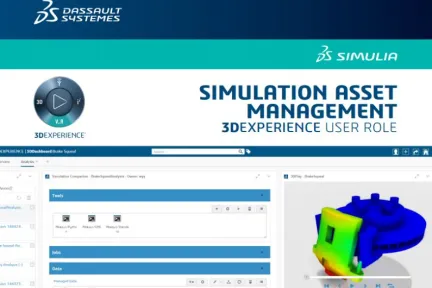
SIMULATION ASSET MANAGEMENT 3DEXPERIENCE USER ROLE

Simulation Asset Management provides a non-intrusive platform to capture workflows as designers and engineers interact with their respective tools. Key decisions such as the tools required, the versions to use, the necessary inputs and run options are automatically captured. As such Simulation Asset Management allows users to interact with all of the tools required to complete their work whilst providing critical traceability and repeatability.

Brochures

SIMULATION ASSET MANAGEMENT 3DEXPERIENCE USER ROLE
Analysis of Oil Well Casing Connections Subjected to Non-axisymmetric Loads

Oilfield casings employ threaded connections which are designed to provide both structural and sealing integrity under installation and service loads. This paper presents a finite element methodology for analyzing casing connections subjected to non-axisymmetric loads. The analysis approach can be used for assessing connection structural integrity, sealability and fatigue life.

Customer Papers

Analysis of Oil Well Casing Connections Subjected to Non-axisymmetric Loads
CONSIDERATIONS ABOUT NON-LINEARITIES ON ENGINEERING PLASTICS

This work makes a revision of the main relative aspects of the nonlinear structural analysis in engineering plastic structures using the software ABAQUS Standard V6.5. Effects of temperature, mechanical effort, fluency and relaxation are considered. Mechanical properties of plastics were shown to be highly sensitivity with temperature. Then it ́s important that these kind of effects will be considered for most plastics structural analysis. Another important aspect is relative to time effects due to viscoelastic nature of polymers. The work validates experimental results relative to creep and relaxation through a numerical study coupling thermo-mechanical and viscous material effects.

Customer Papers

CONSIDERATIONS ABOUT NON-LINEARITIES ON ENGINEERING PLASTICS
STRESS ENGINEER 3DEXPERIENCE USER ROLE

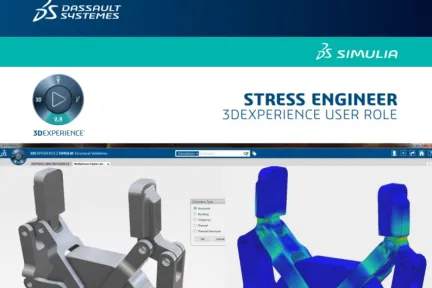
Stress Engineer delivers static, thermal, bucking and durability simulation capabilities for product behavior assessment on the 3DEXPERIENCE platform . It provides simulation-based design guidance during product development to improve product performance and quality while reducing the time requirement and cost of physical prototyping. To accelerate adoption of design simulation in the product development process, Stress Engineer is intuitive for design engineers, while still including the functionality required to simulate the complexities of real-world behavior accurately. Models built using Stress Engineer can be shared for collaboration with SIMULIA analyst tools, providing a unique and smooth workflow between product engineers and analysts.

Brochures

STRESS ENGINEER 3DEXPERIENCE USER ROLE
MECHANICAL ANALYST 3DEXPERIENCE USER ROLE

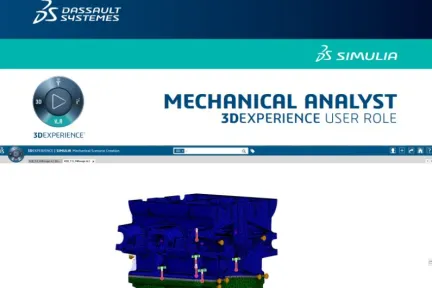
The Mechanical Analyst uses advanced finite element simulation techniques to understand and validate complex engineering problems. With an extensive toolset to enhance productivity and efficiency, the Mechanical Analyst is equipped to conduct structural static, dynamic, and thermal simulation of product designs and assemblies within the 3DEXPERIENCE platform. Fully integrated with both the environment and with the geometry, Mechanical Analyst provides a unique platform to collaborate, simulate, and impact design processes throughout the extended enterprise using state-of-the-art Abaqus simulation technology.

Brochures

MECHANICAL ANALYST 3DEXPERIENCE USER ROLE
A Study on Predicting the Long-term Creep Behavior of Plastics using the Short-term Creep Test

The creep performance of plastics is one of the main criteria for a variety of applications with strict dimensional stability needs, including electrical/electronic parts and various automotive applications. However obtaining or generating accurate creep data is very difficult for both resin suppliers and product designers because the creep property is time dependent, which means it takes over several weeks or even a year time span. Hence a faster and more reliable method of predicting creep behavior of plastics is required when designing plastic products that will encounter long-term loading. This work presents an easy method for predicting the long-term creep behavior of plastics using the short-term creep experimental data.

Customer Papers

A Study on Predicting the Long-term Creep Behavior of Plastics using the Short-term Creep Test
Simulation of powder compaction using to optimize the compaction and ejection process.

Compaction of powder is is used in p/m (powder metal) components, hard metals, ceramics and pharmaceutical industries. Optimisation of the punch / die / kinematics is of importance to the designer to obtain uniform density distribution. An understanding of the compaction behavior is essential to design the process and the tooling for a given component production by p/m route. FEM analysis of p/m compaction is an useful tool to minimize the tool and die development design cycle. The designer can explore various possibilities of tool and die as well as process design using FEM simulation. A robust yield function that describes the yielding and densification of the powder, availability of a valid constitutive behavior of the powder material, incorporation of the process model in FEM simulation are critical issues.

Customer Papers

Simulation of powder compaction using to optimize the compaction and ejection process.
The Use of Computer Modelling Techniques for the Analysis of Solid and Melt Phase Polymer Processing

Application of computer modelling techniques to the melt and solid phase processing of polymeric materials is a challenging area of research for both academics and industrialist. In the Computer Modelling Research Centre at the IRC in Polymer Engineering, University of Bradford, we are actively researching all areas of processing from melt extrusion and injection moulding through to biaxial orientation of nanocomposite materials. The challenges such analyses pose have led to the construction of novel constitutive theories, employment of adaptive meshing for large strain applications, contact analysis with velocity dependent friction and the application of RVEs in the multiscale modelling of polymer nanocomposites. In this paper we describe some typical analyses from the Centre and an overview of the direction in which this demanding area of research is moving.

Customer Papers

The Use of Computer Modelling Techniques for the Analysis of Solid and Melt Phase Polymer Processing
260 Ergebnisse

Kundengeschichten

145 Ergebnisse
2 Ergebnisse

SIMULIA Selbstlernprogramm

Wir bieten Hunderte von Selbstlernmodulen an, damit jeder nach seinen eigenen Vorstellungen lernen kann

Blogs

Lesen Sie die neuesten Nachrichten und Innovationen unserer Experten auf dem SIMULIA Blog.

696 Ergebnisse

Vernetzen Sie sich mit SIMULIA

Erfahren Sie, was SIMULIA für Sie tun kann

Lassen Sie sich von unseren SIMULIA Experten zeigen, wie unsere Lösungen eine nahtlose Zusammenarbeit und nachhaltige Innovation in Unternehmen jeder Größe ermöglichen.

Erste Schritte

Wir bieten Kurse und Schulungen für Studierende, Hochschulen, Fachleute und Unternehmen an. Finden Sie die passende SIMULIA Schulung. 

Hilfe anfordern

Hier finden Sie Informationen zu Software- und Hardware-Zertifizierungen, Software-Downloads, Anwenderdokumentation, Support-Kontakten und Serviceangeboten