1506 Ergebnisse
Consideration of manufacturing pre-history influence of fatigue life of sheet metal formed automotive parts

This contribution considers the effects of sheet metal forming processes on the fatigue performance of LCV wheel discs, manufactured from microalloyed steel. Traditionally, such parts had to pass standard cyclic load test in the process of experimental validation, but road tests in real life conditions sometimes show fatigue cracks in highly stressed areas, predominantly in bending loading mode. To estimate fatigue life and safety margins standard fatigue tests should be accompanied by numerical simulations based on FEA results. Unfortunately, in spite of the long history of fatigue analysis codes, based on FEA results, the industry still relies heavily on tests because of frequent disagreements between simulation and test results.

Customer Papers
Consideration of manufacturing pre-history influence of fatigue life of sheet metal formed automotive parts
Impact simulation of a hearing aid

In the development of hearing aids, many factors are important to make a good hearing aid. It can be the sound quality, design and easiness of use. However, it is also important that the device can withstand the environment that it is used in, both regarding moisture, sweat and to be dropped on a hard surface. One of the most sensitive parts in the hearing aid regarding dropping the device on a hard surface is the receiver (name for the loudspeaker in the hearing aid). The development of hearing aids demands shorter time to market and higher rate of success in achieving all the development requirements for the device. Therefore, it is important to be able to predict and improve designs in development projects.

Customer Papers

Impact simulation of a hearing aid
Thermal Management of Electronic Devices used in Automotive Safety – A DoE approach

Electronic devices used in automotive safety has a trend to reduce size in packaging and increase performance of the product, both of which contribute to exponential increase in power consumption of the system consequently increasing the heat generation. Designers have very less choice on PCB board components but have flexibility in designing the enclosures over the PCBs. This calls the need for an optimal enclosure design to maximize the heat dissipation and to reduce the temperature well below the allowable operational limit. Majority of heat generated by these devices get dissipated by conduction and natural convection modes. Heat generated by the chip on PCB due to power consumption is transferred to the cover and housing via heat sink and thermal pads respectively by conduction.

Customer Papers

Thermal Management of Electronic Devices used in Automotive Safety – A DoE approach
Development of a Separator Plate for Valve Bodies in a Vehicle Automatic Transmission

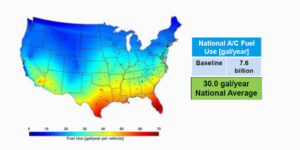
Nowadays the automatic transmissions need to be an economically optimized system. To meet CO2 goals, the transmission has to be more efficient. One possibility is to raise the operating pressure in the hydraulic fluid. But this leads to a higher leakage rate and thus larger pressure pumps are required. To overcome this dilemma several innovative solutions were needed to develop a new generation of separator plates. These replace the conventional separator plates in new high efficient automatic transmissions. Lower leakage rates at higher pressure demand a more effective sealing solution. If this solution works particularly efficient it could provide an opportunity to reduce the amount of bolts required for the joint. This opens the possibility of more flexible design of the hydraulic channels.

Customer Papers
Development of a Separator Plate for Valve Bodies in a Vehicle Automatic Transmission
Developing a Finite Element Head Model for Impact Simulation in Abaqus

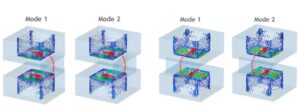
A computational model of the human head has been developed by Simpleware and the U.S. Naval Research Laboratory (NRL) to simulate head impact. The head model was generated using high-resolution scan data, segmentation and image-based meshing techniques, and has been used in Abaqus for a range of simulations. The NRL/Simpleware head model addresses several key limitations of existing techniques for head impact modelling, most notably mesh adaptability for different applications. This paper will focus on the development of the modeling techniques used to create the NRL/Simpleware head model, and its use in Abaqus/Explicit to demonstrate accuracy and feasibility against a widely used experimental benchmark in impact loading and through investigation of potential brain injury under blast overpressure loading.

Customer Papers
Developing a Finite Element Head Model for Impact Simulation in Abaqus
Automated Weight Optimization Process for Automotive Wheel Hub Bearing

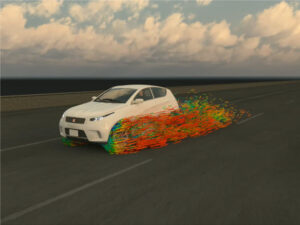
Automotive wheel bearing is an essential component of the vehicle. It transmits engine power into wheels and supports vehicle weight. In recent years, the demand worldwide for weight reduction in automotive part in order to improve fuel efficiency has increased. Despite of it, automakers are requiring that wheel bearing performance in the areas of stiffness, strength, and life be maintained or improved. In this study, weight optimization for automotive wheel bearing was performed. Design variables were the bearing geometry and bearing internal specification. Cost function was bearing weight and constraint conditions were bearing life and stiffness. CATIA was used to model the geometry and Abaqus was used to carry out the stiffness analysis. To construct the optimization formulation, the commercial optimization software, Isight was used.

Customer Papers
Automated Weight Optimization Process for Automotive Wheel Hub Bearing
Automated Analysis in CATIA V5

The traditional process for assessing the strength, stiffness and modal performance of a chassis component such as a suspension link, and iterating the design to meet targets in the optimum way, is time consuming. Some design engineers experimented with using integrated analysis in CATIA V5 to assess and iterate the design more efficiently. Success was limited due to the complexity of setup and poor correlation with the results obtained by CAE specialists using the standardised process. This paper outlines how a combination of CATIA V5 analysis and scripting was used to solve these problems for a number of component types. The success of the tools released to date and the advantages of using them will be discussed. Guidelines for identifying processes which are suitable for automation will be presented.

Customer Papers

Automated Analysis in CATIA V5
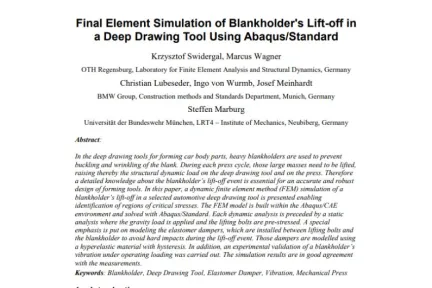
Final Element Simulation of Blankholder's Lift-off in a Deep Drawing Tool Using Abaqus/Standard

In the deep drawing tools for forming car body parts, heavy blankholders are used to prevent buckling and wrinkling of the blank. During each press cycle, those large masses need to be lifted, raising thereby the structural dynamic load on the deep drawing tool and on the press. Therefore a detailed knowledge about the blankholder’s lift-off event is essential for an accurate and robust design of forming tools. In this paper, a dynamic finite element method (FEM) simulation of a blankholder’s lift-off in a selected automotive deep drawing tool is presented enabling identification of regions of critical stresses. The FEM model is built within the Abaqus/CAE environment and solved with Abaqus/Standard.

Customer Papers

Final Element Simulation of Blankholder's Lift-off in a Deep Drawing Tool Using Abaqus/Standard
260 Ergebnisse

Kundengeschichten

145 Ergebnisse
2 Ergebnisse

SIMULIA Selbstlernprogramm

Wir bieten Hunderte von Selbstlernmodulen an, damit jeder nach seinen eigenen Vorstellungen lernen kann

Blogs

Lesen Sie die neuesten Nachrichten und Innovationen unserer Experten auf dem SIMULIA Blog.

696 Ergebnisse
Have a Heart!

In a new series, we are featuring our partners and the work...

Article

Have a Heart!

Vernetzen Sie sich mit SIMULIA

Erfahren Sie, was SIMULIA für Sie tun kann

Lassen Sie sich von unseren SIMULIA Experten zeigen, wie unsere Lösungen eine nahtlose Zusammenarbeit und nachhaltige Innovation in Unternehmen jeder Größe ermöglichen.

Erste Schritte

Wir bieten Kurse und Schulungen für Studierende, Hochschulen, Fachleute und Unternehmen an. Finden Sie die passende SIMULIA Schulung. 

Hilfe anfordern

Hier finden Sie Informationen zu Software- und Hardware-Zertifizierungen, Software-Downloads, Anwenderdokumentation, Support-Kontakten und Serviceangeboten