1506 Ergebnisse
IDIADA’s Virtual Proving Ground for durability analysis

It is usual that the loads applied on structural elements are in fluctuating situations. Sometimes the component can break under its ultimate or its yield strength. This breakage situation is due to the fluctuating loads that have been applied over long periods. For this purpose this breakage type is called “fatigue breaking”. Fatigue breaking is a consequence of crack growth. When no prototypes are available, it is necessary to calculate the life prediction as soon as possible. Simulation through the VPG is increasingly being used for life prediction. The present work shows a methodology that uses a finite element model (FEM) that runs on a proving ground. In this case, no MBS (multibody software) model is used to obtain the loads on the structure.

Customer Papers
IDIADA’s Virtual Proving Ground for durability analysis
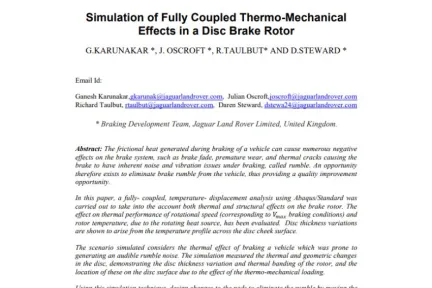
Simulation of Fully Coupled Thermo-Mechanical Effects in a Disc Brake Rotor

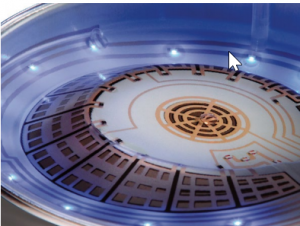
In this paper, a fully- coupled, temperature- displacement analysis using Abaqus/Standard was carried out to take into the account both thermal and structural effects on the brake rotor. The effect on thermal performance of rotational speed (corresponding to braking conditions) and rotor temperature, due to the rotating heat source, has been evaluated. Disc thickness variations are shown to arise from the temperature profile across the disc cheek surface. The scenario simulated considers the thermal effect of braking a vehicle which was prone to generating an audible rumble noise. The simulation measured the thermal and geometric changes in the disc, demonstrating the disc thickness variation and thermal banding of the rotor, and the location of these on the disc surface due to the effect of the thermo-mechanical loading.

Customer Papers

Simulation of Fully Coupled Thermo-Mechanical Effects in a Disc Brake Rotor
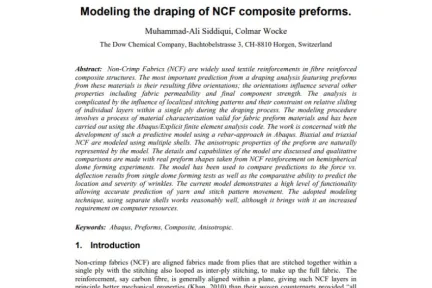
Modeling the draping of NCF composite preforms.

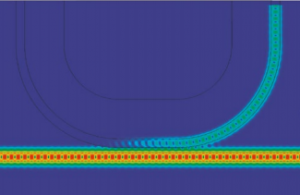
Non-Crimp Fabrics (NCF) are widely used textile reinforcements in fibre reinforced composite structures. The most important prediction from a draping analysis featuring preforms from these materials is their resulting fibre orientations; the orientations influence several other properties including fabric permeability and final component strength. The analysis is complicated by the influence of localized stitching patterns and their constraint on relative sliding of individual layers within a single ply during the draping process. The modeling procedure involves a process of material characterization valid for fabric preform materials and has been carried out using the Abaqus/Explicit finite element analysis code.

Customer Papers
Modeling the draping of NCF composite preforms.
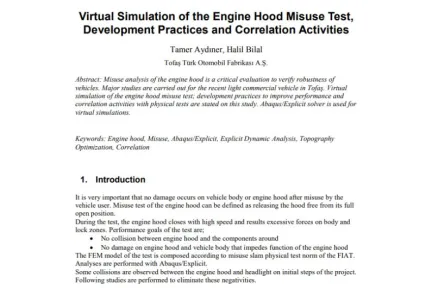
Virtual Simulation of the Engine Hood Misuse Test, Development Practices and Correlation Activities

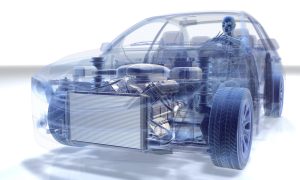
Misuse analysis of the engine hood is a critical evaluation to verify robustness of vehicles. Major studies are carried out for the recent light commercial vehicle in Tofaş. Virtual simulation of the engine hood misuse test; development practices to improve performance and correlation activities with physical tests are stated on this study. Abaqus/Explicit solver is used for virtual simulations.

Customer Papers
Virtual Simulation of the Engine Hood Misuse Test, Development Practices and Correlation Activities
Brake system model reduction for squeal noise study

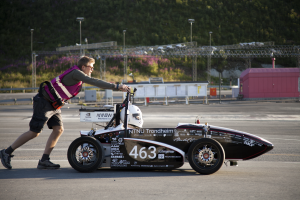
Although the problem of friction-induced vibration has been the subject of many investigations over recent decades, it is still responsible for a large number of nuisances in the field of automotive. Using Abaqus For CATIA V5 (AFC) and Abaqus, this study presents a numerical process based on modal reduction to generate a Super-Element for the whole brake system. The size of the model is minimized using a specific non-linear modeling at the frictional interface. Then, the Super-Element is used in Matlab to check is ability to predict the stability analysis of large Finite Element Models that correspond to real automotive braking systems subjected to friction-induced vibrations.

Customer Papers
Brake system model reduction for squeal noise study
System Modeling and Simulation at Dana Holding

In this paper we explain what SMS means to Dana, how we approach this topic, and what technologies we are investigating in order to achieve this new level of engineering. Since the process is very complex, we decided to start with a business value assessment (BVA). This engineering assessment was undertaken to understand the current status of our engineering organizations and existing technology, and then identify the gaps to where we want to be with our business. This helped to formulate a foundational strategy and long-term roadmap. With an existing strong focus on the CAE environment this also meant we needed, as previously mentioned, enhance the mindset and our global culture to make the next step in our systems evolution.

Customer Papers

System Modeling and Simulation at Dana Holding
Developing a Constitutive Model for a Highly Deformable Latex Rubber with Implementations in Lagrangian Frameworks > Dassault Systèmes

To improve product design and enhance the realism of BD’s advanced finite element models, the development of a constitutive model capable of predicting mechanical behavior at high deformations was initiated for a commercially available latex rubber. A set of baseline experiments was conducted to determine the isothermal mechanical response(s) of the latex rubber. The experiments were designed to provide fundamental insight into any viscoelastic, hyperelastic, and Mullins effects exhibited by the material. A constitutive model was constructed for specific load cases from the aforementioned experimental data. Attention was given to the model’s primary use case, numerical stability, and its ability to perform at high deformation ranges..

Customer Papers

Developing a Constitutive Model for a Highly Deformable Latex Rubber with Implementations in Lagrangian Frameworks > Dassault Systèmes
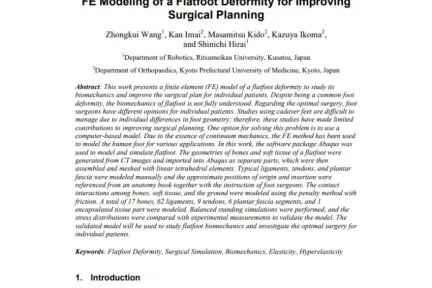
FE Modeling of a Flatfoot Deformity for Improving Surgical Planning

This work presents a finite element (FE) model of a flatfoot deformity to study its biomechanics and improve the surgical plan for individual patients. Despite being a common foot deformity, the biomechanics of flatfoot is not fully understood. Regarding the optimal surgery, foot surgeons have different opinions for individual patients. Studies using cadaver feet are difficult to manage due to individual differences in foot geometry; therefore, these studies have made limited contributions to improving surgical planning. One option for solving this problem is to use a computer-based model. Due to the essence of continuum mechanics, the FE method has been used to model the human foot for various applications. In this work, the software package Abaqus was used to model and simulate flatfoot.

Customer Papers

FE Modeling of a Flatfoot Deformity for Improving Surgical Planning
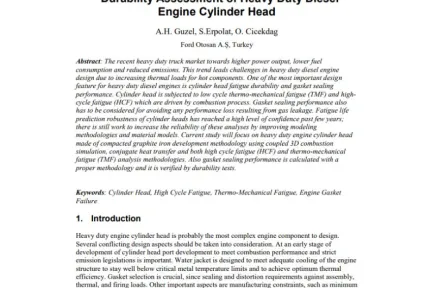
Durability Assessment of Heavy Duty Diesel Engine Cylinder Head

The recent heavy duty truck market towards higher power output, lower fuel consumption and reduced emissions. This trend leads challenges in heavy duty diesel engine design due to increasing thermal loads for hot components. One of the most important design feature for heavy duty diesel engines is cylinder head fatigue durability and gasket sealing performance. Cylinder head is subjected to low cycle thermo-mechanical fatigue (TMF) and highcycle fatigue (HCF) which are driven by combustion process. Gasket sealing performance also has to be considered for avoiding any performance loss resulting from gas leakage.

Customer Papers

Durability Assessment of Heavy Duty Diesel Engine Cylinder Head
260 Ergebnisse

Kundengeschichten

145 Ergebnisse
2 Ergebnisse

SIMULIA Selbstlernprogramm

Wir bieten Hunderte von Selbstlernmodulen an, damit jeder nach seinen eigenen Vorstellungen lernen kann

Blogs

Lesen Sie die neuesten Nachrichten und Innovationen unserer Experten auf dem SIMULIA Blog.

696 Ergebnisse

Vernetzen Sie sich mit SIMULIA

Erfahren Sie, was SIMULIA für Sie tun kann

Lassen Sie sich von unseren SIMULIA Experten zeigen, wie unsere Lösungen eine nahtlose Zusammenarbeit und nachhaltige Innovation in Unternehmen jeder Größe ermöglichen.

Erste Schritte

Wir bieten Kurse und Schulungen für Studierende, Hochschulen, Fachleute und Unternehmen an. Finden Sie die passende SIMULIA Schulung. 

Hilfe anfordern

Hier finden Sie Informationen zu Software- und Hardware-Zertifizierungen, Software-Downloads, Anwenderdokumentation, Support-Kontakten und Serviceangeboten