1506 Ergebnisse
Advanced finite element analysis of deep excavations using Abaqus

Deep excavation, widely used for underground constructions, is a very complex soil-structure interaction problem in geotechnical engineering. Its performance is influenced by the sophisticated soil behavior, complex retaining structures, and variable construction sequences. As the excavation goes deeper and larger in scale, challenges arise for both practical applications and research. Finite element analysis is an effective tool to study its mechanism, which can consider both geotechnical and structural aspects. It provides necessary information on the performance of deep excavations for design purpose, and can also be used to predict the behavior of deep excavation and provide guidance for the construction. The main issues involved with the finite element analysis of deep excavations include selecting appropriate constitutive models for soils and structures, the simulation of the construction procedure, and the modelling of the soil/structure interface. These issues are addressed in detail based on the use of Abaqus. The application of this procedure is demonstrated through a detailed analysis of a deep excavation case history. Results showed that the finite element analysis can capture the performance of the deep excavation satisfactorily.

Customer Papers
Advanced finite element analysis of deep excavations using Abaqus
Evaluation of the Fatigue Strength of a SteelAluminum Tapped Thread Joint with Local Concepts

This paper deals with the design of a steel/aluminum tapped thread joint. The concept developed by Schneider (Schneider,2011) is used as the basis for assessment up to the occurrence of technical cracks. Crack propagation, up to component failure, is described with linear elastic fracture mechanics and using the finite element method (FEM). For the purpose of validating the concept, the calculated lives are compared with experimental tests.

Customer Papers

Evaluation of the Fatigue Strength of a SteelAluminum Tapped Thread Joint with Local Concepts
On the numerical implementation of a 3D fractional viscoelastic constitutive model

The aim of this paper is the implementation of a 3D fraction al viscoelastic constitutive law in a user material subroutine (UMAT) in the finite element software Abaqus. Essential to the implementation of the model is access to the strain history at each Gauss point of each element in a constructive manner. Details of the UMAT and comparison with some analytical results are presented in order to show that the fractional viscoelastic constitutive law has been successfully implemented.

Customer Papers

On the numerical implementation of a 3D fractional viscoelastic constitutive model
Experimental Validation of Simulation Capabilities for Hydraulic Fractures Propagating in a Porous Medium

The problem of a fluid-driven (hydraulic) fracture propagating in a porous medium is studied using recently co-developed capabilities in SIMULIA Abaqus Standard (“Abaqus”) for fully-coupled simulation of hydraulic fracturing. The hydraulic fracturing simulation capabilities are validated against lab-scale experimental results. A Polyaxial Test Cell (PTC) is set up for controlled hydraulic fracturing in fabricated rock samples allowing different testing conditions of confining stress, injection rate, and rock and fluid properties. Two representative regimes of fracture propagation (toughness/storage and viscosity/leak-off) are selected to compare against numerical simulations carried out in Abaqus.

Customer Papers

Experimental Validation of Simulation Capabilities for Hydraulic Fractures Propagating in a Porous Medium
A Numerical Investigation on the Bedding Resistance of Laterally Displaced Pipelines

The soil resistances in axial and lateral direction strongly affect the behavior of earthburied district heating pipes under variable operating temperatures. The state of knowledge regarding these resistance forces is summarized, and it is shown that almost no information exists regarding the cyclic effects on lateral soil resistances. However, for the safe design of a district heating network, the forces that soil can exert on the structure due to relative soil-pipe displacements are of particular interest. So, a numerical model has been developed, using the concept of hypoplasticity as an advanced constitutive model for noncohesive, granular materials.

Customer Papers

A Numerical Investigation on the Bedding Resistance of Laterally Displaced Pipelines
Use of FEA and Radial Basis Functions for Reliability-based Design and Assessment of Tubular Connection Sealability

One of the significant challenges in oil wells is to maintain adequate structural and sealing capacities of casing and tubing connections. In particular, unconventional wells, such as thermal and HPHT wells, require elevated standards to evaluate structural integrity and sealability of tubular connections. This paper presents a Reliability Based Design & Assessment (RBDA) methodology that characterizes system safety using a quantitative estimate of reliability. This paper also presents an FEA example of a generic premium connections to demonstrate the use of the proposed methodology.

Customer Papers
Use of FEA and Radial Basis Functions for Reliability-based Design and Assessment of Tubular Connection Sealability
The Virtual Composites Factory

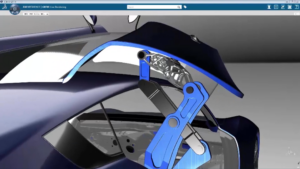
The Virtual Factory (VF) can put composites manufacturing simulations in the hands of those who need them to invent new and innovative ways to capture the extraordinary benefits of these high performance products at an acceptable manufactured cost. “Crowd-sourcing” is the new way to drive innovation where contributions from organizations, large and small, are joined in the development of new products. The VF provides the user with simple browser access to powerful tools that simulate the actual steps and outcome conditions of a complex manufacturing process without the need to download and maintain software in the conventional manner. Learning to use uncertainty quantification (UQ) with manufacturing simulation tools will also be accomplished on the VF in order to allow for continuous learning and growth of the human talent required in composites manufacturing.

Customer Papers
The Virtual Composites Factory
High Velocity Perforation as a Benchmark Problem for Material Model Validation

High velocity perforation problem is taken as a benchmark to validate material plasticity and fracture models. 2024-T3(51) aluminum alloy is chosen as a reference material. Numerical simulations of a plate perforation using Johnson-Cook plasticity model with two sets of parameters, Johnson-Cook fracture criterion with one set of fitting parameters and pressure and Lode dependent ductile fracture criterion with three sets of material constants are performed into Abaqus/Explicit. Calibration of all the material constants is accomplished using results of quasistatic and high strain rate experiments.

Customer Papers
High Velocity Perforation as a Benchmark Problem for Material Model Validation
Modeling of Hyperelastic Water-Skipping Spheres using Abaqus/Explicit

This research seeks to model and elucidate the physics of water impact of elastomeric spheres, including the mechanisms by which severe deformations enable spheres to skip off the free water surface. The interplay between solid mechanics and fluid mechanics, or fluid-structure interaction, is extremely rich and complicated for this physical phenomenon. This research and knowledge could lead to exciting applications such as the novelty products from Waboba Inc. Numerical simulations are performed in Abaqus/Explicit of a highly-compliant elastomeric sphere impacting a free surface of water using a Coupled Euler-Lagrangian (CEL) approach.

Customer Papers

Modeling of Hyperelastic Water-Skipping Spheres using Abaqus/Explicit
Simulating Damage due to a Lightning Strike Event: Effects of Temperature Dependent Properties on Interlaminar Damage

A multidirectional, carbon fiber/epoxy, composite panel is subjected to a simulated lightning strike, within a finite element method framework, and the effect of material properties on the failure (delamination) response is investigated through a detailed numerical study. The numerical model of the composite panel consists of individual homogenized plies with userdefined, cohesive interface elements between them. Lightning strikes are simulated as an assumed combination of excessive heat and high pressure loadings. It is observed that the initiation and propagation of lightning-induced delamination is a significant function of the temperature dependency of interfacial fracture toughness.

Customer Papers

Simulating Damage due to a Lightning Strike Event: Effects of Temperature Dependent Properties on Interlaminar Damage
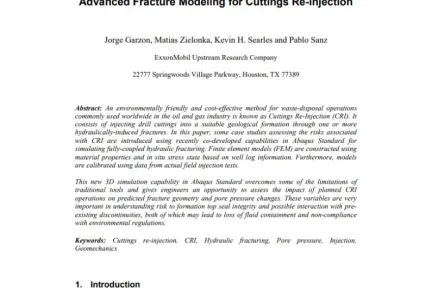
Advanced Fracture Modeling for Cuttings Re-injection

An environmentally friendly and cost-effective method for waste-disposal operations commonly used worldwide in the oil and gas industry is known as Cuttings Re-Injection (CRI). It consists of injecting drill cuttings into a suitable geological formation through one or more hydraulically-induced fractures. In this paper, some case studies assessing the risks associated with CRI are introduced using recently co-developed capabilities in Abaqus Standard for simulating fully-coupled hydraulic fracturing. Finite element models (FEM) are constructed using material properties and in situ stress state based on well log information. Furthermore, models are calibrated using data from actual field injection tests.

Customer Papers

Advanced Fracture Modeling for Cuttings Re-injection
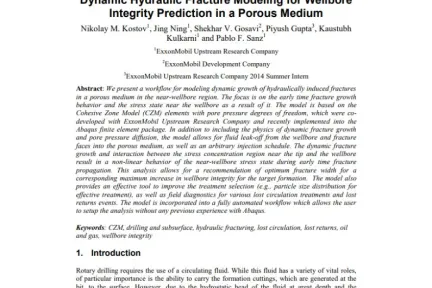
Dynamic Hydraulic Fracture Modeling for Wellbore Integrity Prediction in a Porous Medium

We present a workflow for modeling dynamic growth of hydraulically induced fractures in a porous medium in the near-wellbore region. The focus is on the early time fracture growth behavior and the stress state near the wellbore as a result of it. The model is based on the Cohesive Zone Model (CZM) elements with pore pressure degrees of freedom, which were codeveloped with ExxonMobil Upstream Research Company and recently implemented into the Abaqus finite element package. In addition to including the physics of dynamic fracture growth and pore pressure diffusion, the model allows for fluid leak-off from the wellbore and fracture faces into the porous medium, as well as an arbitrary injection schedule.

Customer Papers

Dynamic Hydraulic Fracture Modeling for Wellbore Integrity Prediction in a Porous Medium
260 Ergebnisse

Kundengeschichten

145 Ergebnisse
2 Ergebnisse

SIMULIA Selbstlernprogramm

Wir bieten Hunderte von Selbstlernmodulen an, damit jeder nach seinen eigenen Vorstellungen lernen kann

Blogs

Lesen Sie die neuesten Nachrichten und Innovationen unserer Experten auf dem SIMULIA Blog.

696 Ergebnisse
Blinded by Science!

Dassault Systèmes SIMULIA is excited to announce that it’s partnering with sister...

Article

Blinded by Science!

Vernetzen Sie sich mit SIMULIA

Erfahren Sie, was SIMULIA für Sie tun kann

Lassen Sie sich von unseren SIMULIA Experten zeigen, wie unsere Lösungen eine nahtlose Zusammenarbeit und nachhaltige Innovation in Unternehmen jeder Größe ermöglichen.

Erste Schritte

Wir bieten Kurse und Schulungen für Studierende, Hochschulen, Fachleute und Unternehmen an. Finden Sie die passende SIMULIA Schulung. 

Hilfe anfordern

Hier finden Sie Informationen zu Software- und Hardware-Zertifizierungen, Software-Downloads, Anwenderdokumentation, Support-Kontakten und Serviceangeboten