1506 Ergebnisse
Modeling and Analysis of Salt Creep Deformations in Drilling Applications

Drilling through salt has created increasing challenges for the oil and gas industry. In many cases, deepwater exploration around the world requires drilling through salt layers above oil and/or gas reservoirs. Borehole closure and instability due to salt creep are two major concerns in designing completions for production wells drilled through salt layers. Similar issues also occur where gas storage caverns are built in salt formations. Pressure changes that occur in the salt cavern during operation can cause cavern closure and instability.

Customer Papers
Modeling and Analysis of Salt Creep Deformations in Drilling Applications
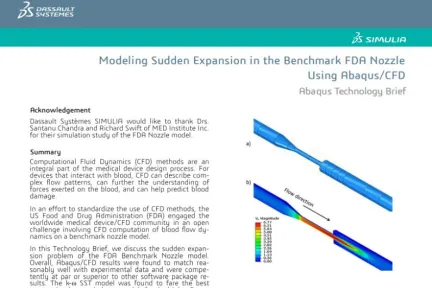
Modeling Sudden Expansion in the Benchmark FDA Nozzle Using Abaqus/CFD

In this Technology Brief, we discuss the sudden expansion problem f the FDA Benchmark Noozle model. Overall, Abaqus/CFD results were found to match reasonably well with experimental data and were competently at par or superior to other package software results. The k-ω SST model was found to fare the best among the three turbulence models for the higher Reynolds number cases.

Solution Briefs

Modeling Sudden Expansion in the Benchmark FDA Nozzle Using Abaqus/CFD
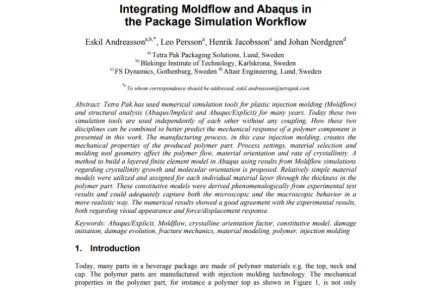
Integrating Moldflow and Abaqus in the Package Simulation Workflow

Tetra Pak has used numerical simulation tools for plastic injection molding (Moldflow) and structural analysis (Abaqus/Implicit and Abaqus/Explicit) for many years. Today these two simulation tools are used independently of each other without any coupling. How these two disciplines can be combined to better predict the mechanical response of a polymer component is presented in this work. The manufacturing process, in this case injection molding, creates the mechanical properties of the produced polymer part. Process settings, material selection and molding tool geometry affect the polymer flow, material orientation and rate of crystallinity.

Contact

Integrating Moldflow and Abaqus in the Package Simulation Workflow
Parameter Survey for Implicit Dynamic Time Integration under Contact Condition

Dynamic problems involving contact are of great importance in industry related to mechanical and civil engineering, but also in environmental and medical applications. Regarding the implicit dynamic structural analysis, Abaqus/Standard has the HHT (Hilber-Hughes-Taylor) method which is a family of unconditionally stable one step methods for the direct time integration. This method is extended from well known Newmark beta method.

Customer Papers

Parameter Survey for Implicit Dynamic Time Integration under Contact Condition
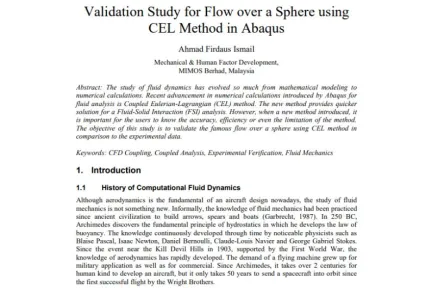
Validation Study for Flow over a Sphere using CEL Method in Abaqus

The study of fluid dynamics has evolved so much from mathematical modeling to numerical calculations. Recent advancement in numerical calculations introduced by Abaqus for fluid analysis is Coupled Eulerian-Lagrangian (CEL) method. The new method provides quicker solution for a Fluid-Solid Interaction (FSI) analysis. However, when a new method introduced, it is important for the users to know the accuracy, efficiency or even the limitation of the method. The objective of this study is to validate the famous flow over a sphere using CEL method in comparison to the experimental data.

Customer Papers

Validation Study for Flow over a Sphere using CEL Method in Abaqus
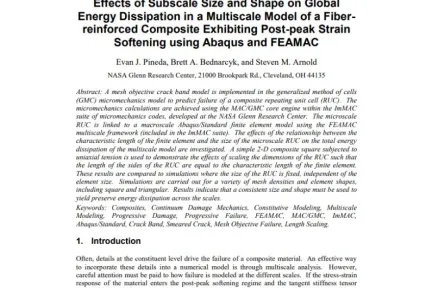
Effects of Subscale Size and Shape on Global Energy Dissipation in a Multiscale Model of a Fiberreinforced Composite Exhibiting Post-peak Strain Softening using Abaqus and FEAMAC

A mesh objective crack band model is implemented in the generalized method of cells (GMC) micromechanics model to predict failure of a composite repeating unit cell (RUC). The micromechanics calculations are achieved using the MAC/GMC core engine within the ImMAC suite of micromechanics codes, developed at the NASA Glenn Research Center. The microscale RUC is linked to a macroscale Abaqus/Standard finite element model using the FEAMAC multiscale framework (included in the ImMAC suite). The effects of the relationship between the characteristic length of the finite element and the size of the microscale RUC on the total energy dissipation of the multiscale model are investigated.

Customer Papers

Effects of Subscale Size and Shape on Global Energy Dissipation in a Multiscale Model of a Fiberreinforced Composite Exhibiting Post-peak Strain Softening using Abaqus and FEAMAC
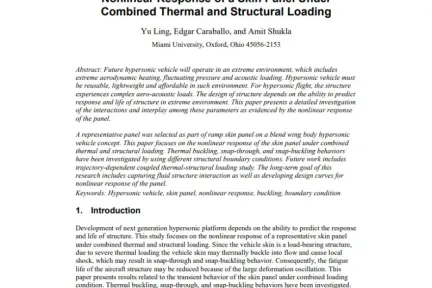
Nonlinear Response of a Skin Panel Under Combined Thermal and Structural Loading

Future hypersonic vehicle will operate in an extreme environment, which includes extreme aerodynamic heating, fluctuating pressure and acoustic loading. Hypersonic vehicle must be reusable, lightweight and affordable in such environment. For hypersonic flight, the structure experiences complex aero-acoustic loads. The design of structure depends on the ability to predict response and life of structure in extreme environment. This paper presents a detailed investigation of the interactions and interplay among these parameters as evidenced by the nonlinear response of the panel.

Customer Papers

Nonlinear Response of a Skin Panel Under Combined Thermal and Structural Loading
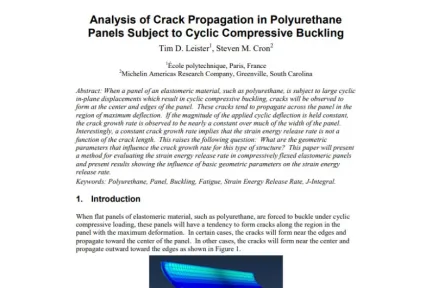
Analysis of Crack Propagation in Polyurethane Panels Subject to Cyclic Compressive Buckling

When a panel of an elastomeric material, such as polyurethane, is subject to large cyclic in-plane displacements which result in cyclic compressive buckling, cracks will be observed to form at the center and edges of the panel. These cracks tend to propagate across the panel in the region of maximum deflection. If the magnitude of the applied cyclic deflection is held constant, the crack growth rate is observed to be nearly a constant over much of the width of the panel. This paper will present a method for evaluating the strain energy release rate in compressively flexed elastomeric panels and present results showing the influence of basic geometric parameters on the strain energy release rate.

Customer Papers

Analysis of Crack Propagation in Polyurethane Panels Subject to Cyclic Compressive Buckling
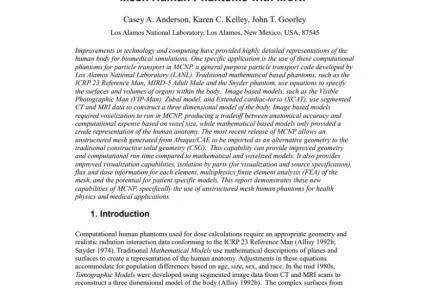
Mesh Human Phantoms with MCNP

Improvements in technology and computing have provided highly detailed representations of the human body for biomedical simulations. One specific application is the use of these computational phantoms for particle transport in MCNP, a general purpose particle transport code developed by Los Alamos National Laboratory (LANL). Traditional mathematical based phantoms, such as the ICRP 23 Reference Man, MIRD-5 Adult Male and the Snyder phantom, use equations to specify the surfaces and volumes of organs within the body. Image based models, such as the Visible Photographic Man (VIP-Man), Zubal model, and Extended cardiac-torso (XCAT), use segmented CT and MRI data to construct a three dimensional model of the body.

Customer Papers

Mesh Human Phantoms with MCNP
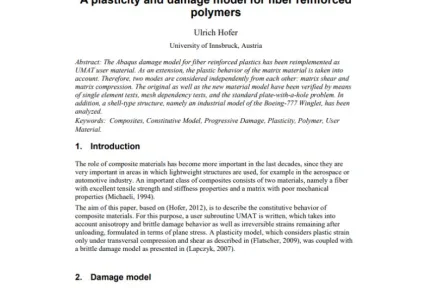
A plasticity and damage model for fiber reinforced polymers

The Abaqus damage model for fiber reinforced plastics has been reimplemented as UMAT user material. As an extension, the plastic behavior of the matrix material is taken into account. Therefore, two modes are considered independently from each other: matrix shear and matrix compression. The original as well as the new material model have been verified by means of single element tests, mesh dependency tests, and the standard plate-with-a-hole problem. In addition, a shell-type structure, namely an industrial model of the Boeing-777 Winglet, has been analyzed.

Customer Papers

A plasticity and damage model for fiber reinforced polymers
Fully Coupled Fluid-Structure Interaction Analysis of Wind Turbine Rotor Blades

In this Technology Brief, a fully coupled fluid-structure interaction analysis of a wind turbine rotor is presented. Abaqus/Standard and STAR-CCM+ are directly coupled through the SIMULIA co-simulation engine. With this approach, a high fidelity modeling strategy can be used to develop an accurate understanding of the blade dynamics.

Solution Briefs

Fully Coupled Fluid-Structure Interaction Analysis of Wind Turbine Rotor Blades
Simulation of Beneficial Compressive Residual Stress Fields as Design Tool in Manufacturing Internally Pressurized Parts

: Internally pressurized steel parts, such as components of fuel injection systems, are often treated with manufacturing processes which selectively induce beneficial compressive residual stresses. An available manufacturing technology to do so is hydraulic Autofrettage (AF). With the help of a single over-pressurization, the compressive residual stress field is established right at the most failure critical area of the components, e.g. around the bore in a thick-walled cylinder or at the bore intersection in a pressure distributor block. This allows for the full exploitation of the material potential and the successful implementation of lightweight design concepts. This paper presents several approaches to model the material behavior and the corresponding residual stress generation during AF for two representative geometries.

Customer Papers

Simulation of Beneficial Compressive Residual Stress Fields as Design Tool in Manufacturing Internally Pressurized Parts
260 Ergebnisse

Kundengeschichten

145 Ergebnisse
2 Ergebnisse

SIMULIA Selbstlernprogramm

Wir bieten Hunderte von Selbstlernmodulen an, damit jeder nach seinen eigenen Vorstellungen lernen kann

Blogs

Lesen Sie die neuesten Nachrichten und Innovationen unserer Experten auf dem SIMULIA Blog.

696 Ergebnisse

Vernetzen Sie sich mit SIMULIA

Erfahren Sie, was SIMULIA für Sie tun kann

Lassen Sie sich von unseren SIMULIA Experten zeigen, wie unsere Lösungen eine nahtlose Zusammenarbeit und nachhaltige Innovation in Unternehmen jeder Größe ermöglichen.

Erste Schritte

Wir bieten Kurse und Schulungen für Studierende, Hochschulen, Fachleute und Unternehmen an. Finden Sie die passende SIMULIA Schulung. 

Hilfe anfordern

Hier finden Sie Informationen zu Software- und Hardware-Zertifizierungen, Software-Downloads, Anwenderdokumentation, Support-Kontakten und Serviceangeboten