1506 Ergebnisse
Structural Topology Optimization of Car Body Using ATOM

The weight reduction of components and systems is of utmost importance in the automotive industry. Reducing weight translates into higher performance and lower fuel consumption. In this paper, we suggest an optimization process for linear and nonlinear load cases of car body. In order to achieve this goal without sacrificing the current performance of selected model, we use Abaqus Topology Optimization Module (ATOM).

Customer Papers
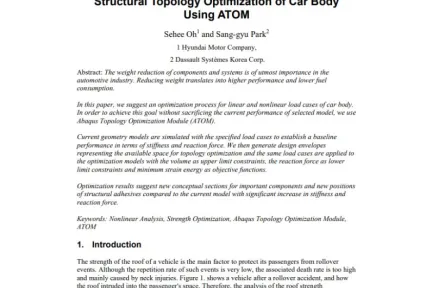
Structural Topology Optimization of Car Body Using ATOM
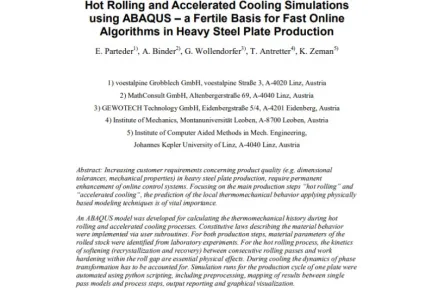
Hot Rolling and Accelerated Cooling Simulations using ABAQUS – a Fertile Basis for Fast Online Algorithms in Heavy Steel Plate Production

Increasing customer requirements concerning product quality (e.g. dimensional tolerances, mechanical properties) in heavy steel plate production, require permanent enhancement of online control systems. Focusing on the main production steps “hot rolling” and “accelerated cooling“, the prediction of the local thermomechanical behavior applying physically based modeling techniques is of vital importance.

Customer Papers

Hot Rolling and Accelerated Cooling Simulations using ABAQUS – a Fertile Basis for Fast Online Algorithms in Heavy Steel Plate Production
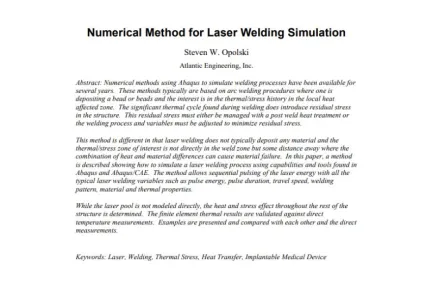
Numerical Method for Laser Welding Simulation

Numerical methods using Abaqus to simulate welding processes have been available for several years. These methods typically are based on arc welding procedures where one is depositing a bead or beads and the interest is in the thermal/stress history in the local heat affected zone. The significant thermal cycle found during welding does introduce residual stress in the structure. This residual stress must either be managed with a post weld heat treatment or the welding process and variables must be adjusted to minimize residual stress.

Customer Papers

Numerical Method for Laser Welding Simulation
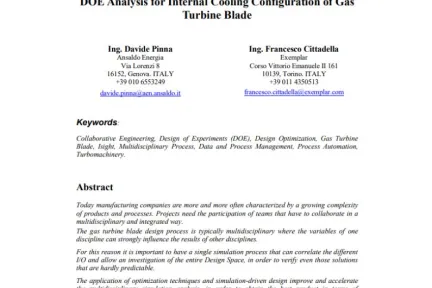
DOE Analysis for Internal Cooling Configuration of Gas Turbine Blade

Today manufacturing companies are more and more often characterized by a growing complexity of products and processes. Projects need the participation of teams that have to collaborate in a multidisciplinary and integrated way. The gas turbine blade design process is typically multidisciplinary where the variables of one discipline can strongly influence the results of other disciplines. For this reason it is important to have a single simulation process that can correlate the different I/O and allow an investigation of the entire Design Space, in order to verify even those solutions that are hardly predictable.

Customer Papers

DOE Analysis for Internal Cooling Configuration of Gas Turbine Blade
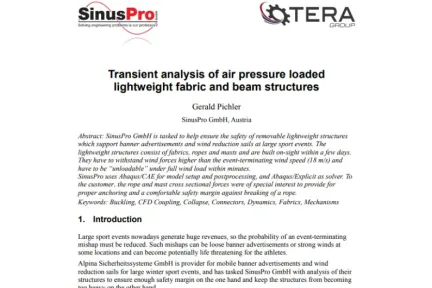
Transient analysis of air pressure loaded lightweight fabric and beam structures

SinusPro GmbH is tasked to help ensure the safety of removable lightweight structures which support banner advertisements and wind reduction sails at large sport events. The lightweight structures consist of fabrics, ropes and masts and are built on-sight within a few days. They have to withstand wind forces higher than the event-terminating wind speed (18 m/s) and have to be “unloadable” under full wind load within minutes. SinusPro uses Abaqus/CAE for model setup and postprocessing, and Abaqus/Explicit as solver. To the customer, the rope and mast cross sectional forces were of special interest to provide for proper anchoring and a comfortable safety margin against breaking of a rope.

Customer Papers

Transient analysis of air pressure loaded lightweight fabric and beam structures
Importance of Capturing Non-linear Viscoelastic Material Behavior in Tire Rolling Simulations

Tire engineers are always interested in predicting rolling resistance using a finite element analysis tool. Rolling resistance mainly depends on the viscoelastic energy dissipation of the rubber material used in the tires. Computation of viscoelastic energy dissipation with linear viscoelasticity approach for finite strains is inaccurate and remains a technical challenge so far. With the recent implementation of the Parallel Rheological Framework model (PRF) in Abaqus1,2 , a non-linear viscoelastic approach, the viscoelastic energy dissipation is computed more accurately than it was possible before. This paper provides a theoretical background of the linear and non-linear viscoelastic models available in Abaqus.

White Papers

Importance of Capturing Non-linear Viscoelastic Material Behavior in Tire Rolling Simulations
Collaborative Robust Engine Design Optimization

This paper describes some of the major contents of the set up and technical coupled simulations within an extended enterprise as developed during the European FP7 research project CRESCENDO (2009-2012). Focus is given on the execution of simulation processes (workflows) for collaborative engineering design tasks in the aeronautical industry towards the ability to perform optimization and robust design studies. Different types of simulation workflows will be explained, such as event or process driven under the aspects of low, medium or high frequency access and execution. An industrial example of the implementation of a high frequency process driven workflow in the extended enterprise shall give an impression of the developed workflow execution capabilities in the case of an aero engine design application.

Customer Papers

Collaborative Robust Engine Design Optimization
Evaluate Medical Device Design Robustness by Combining Statistical and Probabilistic Tools with Finite Element Analysis

Finite Element Analysis (FEA) has been widely used to analyze the in vivo structural response of implantable medical devices and assess device performance, reliability and durability. Take stents for example. Several characteristics like radial force, peak stresses and strains and fatigue safety factors can be determined using these modeling techniques. As all physical phenomena are stochastic, all design parameters have built-in variability. On the other hand, stents are typically modeled with nominal dimensions and material properties. Minimum and maximum dimensions are used in certain instances, while other dimensional variances are often not considered. In addition, the in vivo boundary conditions also vary widely across patient population.

Customer Papers

Evaluate Medical Device Design Robustness by Combining Statistical and Probabilistic Tools with Finite Element Analysis
Damage Assessment of Casting Materials in High Temperature Applications Influenced by Varying Plasticity Models

The turbine housing of an exhaust turbocharger is exposed to extensive cyclic thermomechanical loading. Consequently, the design of the turbine housing becomes a major challenge in ensuring the guaranteed lifetime in relation to the high-temperature behavior of the materials. In a first step, a phenomenological lifetime approach together with a rate-independent constitutive plasticity model of Chaboche-type was developed and validated for application on casting materials. The present study deals with the more detailed analysis of rate-dependent plasticity applied in the finite-element analysis with respect to the subsequent creep-fatigue damage calculation procedure.

Customer Papers

Damage Assessment of Casting Materials in High Temperature Applications Influenced by Varying Plasticity Models
Thermomechanical Fatigue FE Analysis Applied to High Temperature Metal Forming Processes

In high temperature metal forming processes strong mechanical and thermal gradients in the formed material and in the tooling coexist. Such gradients have a negative influence in the tool life cycle. That influence occurs due to mechanical and thermal cyclic loads undergone during the production process. This factor leads to the appearance of cracks on the tool surface because of thermomechanical fatigue phenomenon. The presented work is focused on a specific manufacturing process of seamless steel tubes which includes three basic steps: backward extrusion, perforation and Pilger rolling mill. The objective of this paper is to present thermomechanical fatigue FE analysis.

Customer Papers

Thermomechanical Fatigue FE Analysis Applied to High Temperature Metal Forming Processes
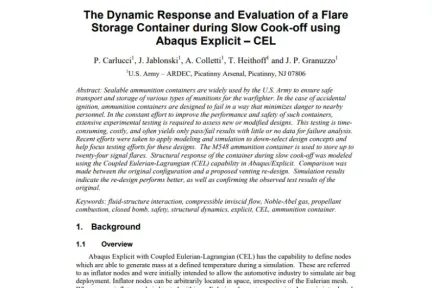
The Dynamic Response and Evaluation of a Flare Storage Container during Slow Cook-off using Abaqus Explicit – CEL

Sealable ammunition containers are widely used by the U.S. Army to ensure safe transport and storage of various types of munitions for the warfighter. In the case of accidental ignition, ammunition containers are designed to fail in a way that minimizes danger to nearby personnel. In the constant effort to improve the performance and safety of such containers, extensive experimental testing is required to assess new or modified designs. This testing is timeconsuming, costly, and often yields only pass/fail results with little or no data for failure analysis. Recent efforts were taken to apply modeling and simulation to down-select design concepts and help focus testing efforts for these designs.

Customer Papers

The Dynamic Response and Evaluation of a Flare Storage Container during Slow Cook-off using Abaqus Explicit – CEL
260 Ergebnisse

Kundengeschichten

145 Ergebnisse
2 Ergebnisse

SIMULIA Selbstlernprogramm

Wir bieten Hunderte von Selbstlernmodulen an, damit jeder nach seinen eigenen Vorstellungen lernen kann

Blogs

Lesen Sie die neuesten Nachrichten und Innovationen unserer Experten auf dem SIMULIA Blog.

696 Ergebnisse

Vernetzen Sie sich mit SIMULIA

Erfahren Sie, was SIMULIA für Sie tun kann

Lassen Sie sich von unseren SIMULIA Experten zeigen, wie unsere Lösungen eine nahtlose Zusammenarbeit und nachhaltige Innovation in Unternehmen jeder Größe ermöglichen.

Erste Schritte

Wir bieten Kurse und Schulungen für Studierende, Hochschulen, Fachleute und Unternehmen an. Finden Sie die passende SIMULIA Schulung. 

Hilfe anfordern

Hier finden Sie Informationen zu Software- und Hardware-Zertifizierungen, Software-Downloads, Anwenderdokumentation, Support-Kontakten und Serviceangeboten