1506 Ergebnisse
Realistic Simulation of NSM-CFRP Strengthened TBeam

This paper is a summary of finite element modeling approach used in the project for SC@UM Strengthening CFRP Challenge at FRPRCS-11. The modeling competition is to predict the behavior of a T-shaped reinforced concrete beam, shear and flexural strengthened with carbon reinforced polymer (CFRP) laminates according to the Near Surface Mounted (NSM) technique. A complete 3D Abaqus model was constructed to simulate the load displacement response of the CFRP laminates strengthened T-shaped reinforced concrete beam. Abaqus concrete damaged plasticity material model was employed to model concrete cracking/crushing failure. Embedded element was used to model concrete-rebar interaction.

Customer Papers
Realistic Simulation of NSM-CFRP Strengthened TBeam
Account of Modal Damping Instead Rayleigh One in Floor Response Spectra Analysis in Civil Structures of Nuclear Power Plants Under Aircraft Crash

Presently the problem of safety providing of NPP under aircraft crash (AC) has special importance, because rather often floor response spectra (FRS) obtained in the AC analysis are dominant with respect to spectra, obtained in other special dynamic loadings, such as seismic load and explosive wave. In this paper we suggest approach, which gives an opportunity to change global Rayleigh damping matrix on global modal damping matrix, that previously was determined by special way. Also in this paper we represent results of the analysis of test model and of the real example, where authors represent significant diminishing of spectral accelerations in case of changing Rayleigh global damping matrix on modal global damping matrix.

Customer Papers

Account of Modal Damping Instead Rayleigh One in Floor Response Spectra Analysis in Civil Structures of Nuclear Power Plants Under Aircraft Crash
Computational Study of Cortical Bone Screw Pullout using the Extended Finite Element Method

A study of screw pullout from cortical bone has been conducted using the UDMGINI subroutine with the extended finite element method (XFEM). XFEM alleviates mesh dependency when computationally modeling crack initiation and propagation. Cortical bone is a naturally occurring composite with a distinctive aligned microstructure that leads to anisotropic material behavior and damage. In this study, using a UDMGINI subroutine, stress components relative to a predefined osteon orientation were computed and an anisotropic damage criterion was used to determine damage initiation and to predict crack propagation. A 2D model of a single screw embedded in cortical bone was generated. A displacement boundary condition was applied to the top surface of the screw.

Customer Papers

Computational Study of Cortical Bone Screw Pullout using the Extended Finite Element Method
Enhancing operational flexibility of fossil power generating assets based on non-linear numerical thermo-mechanical damage and fracture analysis

A power generation toggle from the conventional sources to the becoming rapidly prioritisable renewable energy production poses a challenge for the fossil fired power plants. The strong dependency on the weather conditions makes such issues as e.g. non-predictable availability and variable loading to the ad hoc asset management tasks in terms of increasing operational flexibility. The paper focuses on the results of this tendency and their impact on the backbone of all power plants - power plant equipment –suffering from the accelerated accumulation of the combined creep-fatigue damage because of the more and more tightened transient start-up and shutdown conditions, increased heating rates and number of operational cycling.

Customer Papers

Enhancing operational flexibility of fossil power generating assets based on non-linear numerical thermo-mechanical damage and fracture analysis
Automated systematic strength calculation of high duty bolted joints

FE modeling of high duty bolted joints, such as those found in wind-turbines, is in many aspects a very complex task. On the one hand, the bolt analysis must comply with standardized guidelines, such as VDI 2230. On the other hand, FE models are usually highly detailed and contain a large number of bolt connections. This makes the whole design process error-prone and cumbersome for the FE engineer, since modeling all these connections by hand usually takes a large amount of time and diligence.

Customer Papers

Automated systematic strength calculation of high duty bolted joints
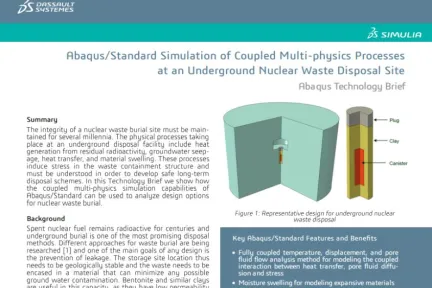
Abaqus/Standard Simulation of Coupled Multi-physics Processes at an Underground Nuclear Waste Disposal Site

The integrity of a nuclear waste burial site must be maintained for several millenia. The physical processes taking place at an underground disposal facility include seepage, heat transfer, and material swelling. These processes induce stress in the waste containment structure and must be understood in order to develop long-term disposal schemes. In this Technology Brief we show how the coupled multi-physics simulation capabilities of Abaqus/Standard can be used to analyze design options for nuclear waste burial.

Tech Notes

Abaqus/Standard Simulation of Coupled Multi-physics Processes at an Underground Nuclear Waste Disposal Site
Sequentially coupled thermal-stress analysis of a new steelconcrete composite slab under fire

The paper describes the numerical simulations required to estimate the performance of a composite slab using a re-entrant profiled steel sheet, prior to conducting a loaded fire test to verify the performance predicted by the simulations and obtain a fire rating according to accepted international standards. The purpose of the simulations was to optimize the design of the composite slab, by eliminating unnecessary reinforcement bars. Heat transfer analysis involving convection, conduction and boundary radiation was undertaken on a detailed solid modelled slab as part of a new steel-concrete slab product development. The simulation accounted for the thermal contact resistance at the cold-formed steel-concrete interface.

Customer Papers

Sequentially coupled thermal-stress analysis of a new steelconcrete composite slab under fire
Simulating the Pouch Forming Process Using a Detailed Fluid-Structure Interaction

A deeper understanding of the interaction between machine, packaging material and liquid product during the forming process of pouches is enabled by the use of numerical simulation. Tetra Pak pouch forming system forms the pouches in a continuous fashion starting from a tube of packaging material filled with the liquid to be packaged. Simulating the pouch forming, including a detailed fluid-structure interaction is the goal of this paper. The simulation is performed coupling Abaqus for the structural side and FlowVision for the fluid side through a Direct Coupling interface. The definition of the problem as well the results of the simulation are presented in the paper.

Customer Papers

Simulating the Pouch Forming Process Using a Detailed Fluid-Structure Interaction
Finite Element Analysis of Casing and Casing Connections for Shale Gas Wells

The application of horizontal drilling and hydraulic fracturing has enabled operators to rapidly develop shale gas procution from deep shale formations over the past decade. It has, however, presented significant challenges to casing and casing connection designs due to the complicated and extreme load conditions within these wells. Advanced Finite Element Analysis (FEA) is therefore required to understand casing deformation using Abaqus for analyzing casing and casing connections under shale gas well load scenarios, such as horizontal well installation, perforating and hydraulic fracturing pressures, and formation shear movement. Analysis examples are provided.

Customer Papers

Finite Element Analysis of Casing and Casing Connections for Shale Gas Wells
Air Blast Loaded Safety Devise Dynamical Response Analysis

Equipment of many oil and gas processing plants in Russian Federation is considerably worn-out. This cause the decrease of reliability and durability of equipment, and to rise of accident rate. An air explosion is the one of the most dangerous cases for plants in oil and gas industry, usually caused by uncontrolled emission and inflammation of oil products. Air explosion can lead to significant danger for life and health of plant staff, so it needs necessity of safety device usage. New type of safety device designed. Numerical simulation is necessary to analyze design parameters and performance of safety device, subjected to air blast loading. Coupled fluid-structure interaction analysis performed to determine strength of protective devise and its performance.

Customer Papers

Air Blast Loaded Safety Devise Dynamical Response Analysis
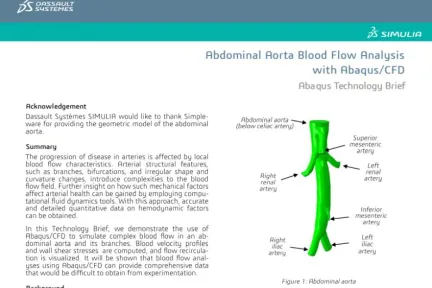
Abdominal Aorta Blood Flow Analysis with Abaqus/CFD

In this Technology Brief, we demonstrate the use of Abaqus/CFD to simulate complex blood flow in an abdominal aorta and its branches. Blood velocity profiles and wall shear stresses are computed, and flow recirculation is visualized. It will be shown that blood flow analyses using Abaqus/CFD can provide comprehensive data that would be difficult to obtain from experimentation.

Tech Notes

Abdominal Aorta Blood Flow Analysis with Abaqus/CFD
MAN Diesel & Turbo - Industrial Equipment Case Study

A century ago this year, the first ocean-going diesel ship in the world, the M/S Selandia, embarked on her maiden voyage. She was a technological wonder, and both her hull and engines were built by Burmeister & Wain (B&W) of Copenhagen, Denmark. B&W is now a part of MAN Diesel & Turbo—a company with 12,000 employees worldwide—and the marine low-speed business unit is located in Copenhagen. The unit has capitalized on B&W’s historic expertise to produce new engines that can weigh up to 2800 metric tons and tower 16 meters high. Once such behemoth engines are installed, they have to be serviced in place—and they must require servicing as infrequently as possible.

Tech Notes

MAN Diesel & Turbo - Industrial Equipment Case Study
260 Ergebnisse

Kundengeschichten

145 Ergebnisse
2 Ergebnisse

SIMULIA Selbstlernprogramm

Wir bieten Hunderte von Selbstlernmodulen an, damit jeder nach seinen eigenen Vorstellungen lernen kann

Blogs

Lesen Sie die neuesten Nachrichten und Innovationen unserer Experten auf dem SIMULIA Blog.

696 Ergebnisse

Vernetzen Sie sich mit SIMULIA

Erfahren Sie, was SIMULIA für Sie tun kann

Lassen Sie sich von unseren SIMULIA Experten zeigen, wie unsere Lösungen eine nahtlose Zusammenarbeit und nachhaltige Innovation in Unternehmen jeder Größe ermöglichen.

Erste Schritte

Wir bieten Kurse und Schulungen für Studierende, Hochschulen, Fachleute und Unternehmen an. Finden Sie die passende SIMULIA Schulung. 

Hilfe anfordern

Hier finden Sie Informationen zu Software- und Hardware-Zertifizierungen, Software-Downloads, Anwenderdokumentation, Support-Kontakten und Serviceangeboten