1506 Ergebnisse
Multi-disciplinary optimization of turbine components with the aid of surrogate modeling techniques

Turbomachinery components design and optimization process requires a multi disciplinary approach. These components are designed and optimized for aerodynamic efficiency with robust mechanical integrity requirements. Further analyses are also required for thermal stresses, rotor dynamics, acoustics and other design requirements. The analyses require different tools (in-house and commercial) which must be integrated within a fully automated process. The calculation time for these calculations, particularly for CFD, could be a limiting factor for the number of iterations used.

Customer Papers

Multi-disciplinary optimization of turbine components with the aid of surrogate modeling techniques
Application of Thermoplastic Polyester Elastomer for Honeycomb Shock Absorbing Components

Thermoplastic polyester elastomer (TPEE) possesses the properties of both rubber and engineering plastic. The most important feature of this material lies in its ability to combine the superior repulsion elasticity and flexibility of rubber with the rigidity of engineering plastic. This enables it to exhibit durability against fatigue, even when exposed repeatedly to large deformation. The most remarkable feature of TPEE is such that it can realize material properties with very small strain rate dependency. This paper attempts to develop shock absorbing components of small sizes with light weight for automobile applications.

Customer Papers

Application of Thermoplastic Polyester Elastomer for Honeycomb Shock Absorbing Components
Structural Mechanics of Steam Turbines: Facing challenges in FE-postprocessing with STARpost

This paper describes how Siemens Energy large scale steam turbines R&D has faced this challenge by developing ‘STARpost’ (i.e. Steam Turbine Analysis Routine – postprocessing), an efficient post-processing-plug-in for Abaqus/CAE: ‘STARpost’ automatically reads in the relevant temperature-dependent material data, assesses the existing stresses against the varying allowable stresses (for components with different materials and different calculation steps), provides many more field outputs beneficial for hot turbomachinery R&D and an environment for convenient visualization.

Customer Papers

Structural Mechanics of Steam Turbines: Facing challenges in FE-postprocessing with STARpost
Multiphysics Simulation of Metal Solidification Processes with Abaqus

A coupled thermo-mechanical model of solidifying shell (Koric, 2006, 2011), (Hibbeler, 2009) in Abaqus/Standard is combined with turbulent fluid flow in the liquid pool and thermal distortion of the mold to create an accurate multiphysics model of steel continuous casting. The new model is applied to calculate temperature stress and deformation in a commercial beam blank caster with complex geometry. Results from the complete system compare favorably with plant measurements of shell thickness.

Customer Papers

Multiphysics Simulation of Metal Solidification Processes with Abaqus
A New Understanding of the Application of Tissue Strain by Negative Pressure Wound Interfaces through 3-Dimensional Finite Element Analysis

Within the wound care arena, the understanding of the effects of Negative Pressure Wound Therapy (NPWT) upon tissue and the processes of healing are still being developed. Optimisation of the level of strain applied to the tissue to affect the healing process, without causing undue stress on the tissue and pain to the patient, remains a key clinical objective.

Customer Papers

A New Understanding of the Application of Tissue Strain by Negative Pressure Wound Interfaces through 3-Dimensional Finite Element Analysis
The Use of Optimization Software TOSCA in a Standard Flexplate Design Process

A drive train is only as strong as its weakest link. One of those links is the flexplate. It is used with automatic transmissions to connect the engine to the torque converter/transmission. A flexplate is a thin metal plate that operates at high RPM. Flexplates are optimized for stiffness, strength and mass. Stiffness controls the axial forces transmitted between the engine and transmission. The complexity of flexplate loading from the engine and transmission makes it an ideal candidate for applying optimization techniques for design of a robust plate.

Customer Papers

The Use of Optimization Software TOSCA in a Standard Flexplate Design Process
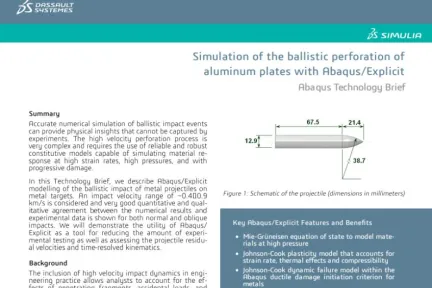
Simulation of the ballistic perforation of aluminum plates with Abaqus/Explicit

In this Technology Brief, we describe Abaqus/Explicit modelling of ballistic impact of metal projectiles on metal targets. An impact velocity range of ~0.4009 km/s is considered and very good quantitive and qualitative agreement between the numerical results and experimental data is shown for both normal and oblique impacts. We will demonstrate the utility of Abaqus/Explicit as a tool for reducing the amount of experimental testing as well as assessing the projectile residual velocities and time-resolved kinematics.

Tech Notes

Simulation of the ballistic perforation of aluminum plates with Abaqus/Explicit
Design Knowledge Exploration for the Conceptual Design of Tire Contours

The importance of the rule of simulation at a conceptual design stage is pointed out recently. The methodology using multi-objective design optimization and data mining, which is called MODE (Multi-Objective Design Exploration), is helpful to find out design knowledge. In this study, we show that the design knowledge found by MODE is fruitful for decision making at a conceptual design stage of real world example i.e. contour design of a fuel efficient tire. Our procedure of MODE consists of nonlinear FEA to predict tire performance, evolutional computation to get desirable solutions including Pareto solution, and data mining to find out design knowledge.

Customer Papers

Design Knowledge Exploration for the Conceptual Design of Tire Contours
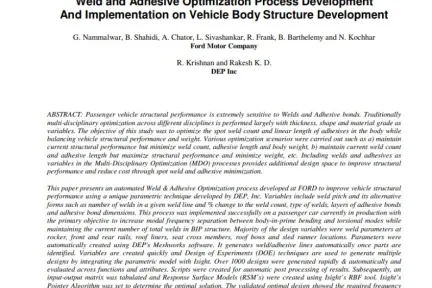
Weld and Adhesive Optimization Process Development And Implementation on Vehicle Body Structure Development

This paper presents an automated Weld & Adhesive Optimization process developed at FORD to improve vehicle structural performance using a unique parametric technique developed by DEP, Inc. Variables include weld pitch and its alternative forms such as number of welds in a given weld line and % change to the weld count, type of welds, layers of adhesive bonds and adhesive bond dimensions. This process was implemented successfully on a passenger car currently in production with the primary objective to increase modal frequency separation between body-in-prime bending and torsional modes while maintaining the current number of total welds in BIP structure.

Customer Papers

Weld and Adhesive Optimization Process Development And Implementation on Vehicle Body Structure Development
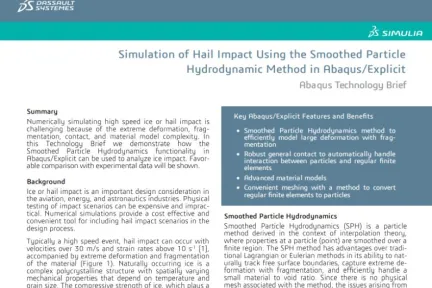
Simulation of Hail Impact Using the Smoothed Particle Hydrodynamic Method in Abaqus/Explicit

Numerically simulating high speed ice or hail impact is challenging because of the extreme deformation, fragmentation, contact, and material model complexity. In this Technology Brief we demonstrate how the Smoothed Particle Hydrodynamics functionality in Abaqus/Explicit can be used to analyze impact. Favorable comparison with experimental data will be shown.

Tech Notes

Simulation of Hail Impact Using the Smoothed Particle Hydrodynamic Method in Abaqus/Explicit
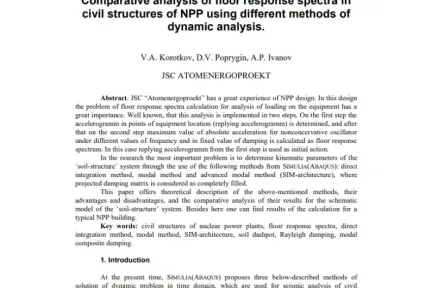
Comparative analysis of floor response spectra in civil structures of NPP using different methods of dynamic analysis

In the research the most important problem is to determine kinematic parameters of the ‘soil-structure’ system through the use of the following methods from SIMULIA(ABAQUS): direct integration method, modal method and advanced modal method (SIM-architecture), where projected damping matrix is considered as completely filled. This paper offers theoretical description of the above-mentioned methods, their advantages and disadvantages, and the comparative analysis of their results for the schematic model of the ‘soil-structure’ system. Besides here one can find results of the calculation for a typical NPP building.

Customer Papers

Comparative analysis of floor response spectra in civil structures of NPP using different methods of dynamic analysis
260 Ergebnisse

Kundengeschichten

145 Ergebnisse
2 Ergebnisse

SIMULIA Selbstlernprogramm

Wir bieten Hunderte von Selbstlernmodulen an, damit jeder nach seinen eigenen Vorstellungen lernen kann

Blogs

Lesen Sie die neuesten Nachrichten und Innovationen unserer Experten auf dem SIMULIA Blog.

696 Ergebnisse

Vernetzen Sie sich mit SIMULIA

Erfahren Sie, was SIMULIA für Sie tun kann

Lassen Sie sich von unseren SIMULIA Experten zeigen, wie unsere Lösungen eine nahtlose Zusammenarbeit und nachhaltige Innovation in Unternehmen jeder Größe ermöglichen.

Erste Schritte

Wir bieten Kurse und Schulungen für Studierende, Hochschulen, Fachleute und Unternehmen an. Finden Sie die passende SIMULIA Schulung. 

Hilfe anfordern

Hier finden Sie Informationen zu Software- und Hardware-Zertifizierungen, Software-Downloads, Anwenderdokumentation, Support-Kontakten und Serviceangeboten