1506 Ergebnisse
Development and Validation of Fully-Coupled Hydraulic Fracturing Simulation Capabilities

The problem of the propagation of a hydraulically driven fracture in a fully saturated, permeable, and porous medium is investigated. Fluid driven fracture propagation in porous media is a coupled problem with four unknown fields: the flow of the fracturing fluid within the fracture, the flow of the pore fluid within the pores, the porous medium deformation, and the fracture configuration. The corresponding governing equations are the mass balance of the fracturing fluid, mass balance of the pore fluid, equilibrium of the porous medium, and fracture initiation and propagation criteria. In this work, the recently co-developed Abaqus fully-coupled hydraulic fracturing modeling capabilities are evaluated by assessing their consistency, convergence, and accuracy qualities.

Customer Papers
Development and Validation of Fully-Coupled Hydraulic Fracturing Simulation Capabilities
Numerical Modeling of Spudcan Footing Penetration in Sand

Spudcans are a type of footing foundation to provide a secure operation of mobile jackup rigs. They are connected to each of the independent legs of a jack-up rig. The current practice to assess the penetration depths of spudcans and the risk of geotechnical failure (punch-through) involves calculating the bearing capacity of the footing at discrete depths. The finite element method offers the possibility to model the complex spudcan penetration process while involving detailed soil parameters and spudcan geometry. In this paper, the use of Coupled EulerianLagrangian (CEL) model elements, available in ABAQUS, to simulate large soil deformations during the spudcan penetration process is described.

Customer Papers

Numerical Modeling of Spudcan Footing Penetration in Sand
Co-Simulation for Wind Turbines: Using the SIMULIA Co-Simulation Engine for Aiming Towards Fluid-Structure Interaction with Control

Within this paper we show a challenging simulation representing problems within the renewable energy sector. The simulation of a wind turbine involving the interaction of the generator/gearbox with the wind is presented (signal field co-simulation). The simulation results are validated against measurement data from the National Renewable Energy Laboratory (NREL) Unsteady Aerodynamic Experiment Phase VI performed in the NASA AMES wind tunnel (Hand, 2001). In the outlook we present the methodology to extend the co-simulation to a fluid-structure-signal interaction by using the SIMULIA Co-Simulation Engine coupling Abaqus/Standard, OpenFOAM and MATLAB to capture the realist behavior by appropriately modeling the interaction of various components.

Customer Papers

Co-Simulation for Wind Turbines: Using the SIMULIA Co-Simulation Engine for Aiming Towards Fluid-Structure Interaction with Control
Analysis of Fatigue Life Estimate for the M119 Cradle Assembly with a Gouge Cut Defect

The M119 howitzer is a lightweight towed 105mm field artillery weapon system. It is an indirect-fire (gunfire delivered to a target that is not in a direct line of sight) weapon that primarily fires projectiles along a curved trajectory. This paper will discuss the impact of a manufactured tooling groove defect in the firing plate on the life cycle of the cradle. Results predicted that the cradle with the gouge cut in the firing plate would have a design life greater than 1000 cycles. Results are consistent with the 200+ successful shots that have been completed on fielded M119 howitzers with this gouge.

Customer Papers

Analysis of Fatigue Life Estimate for the M119 Cradle Assembly with a Gouge Cut Defect
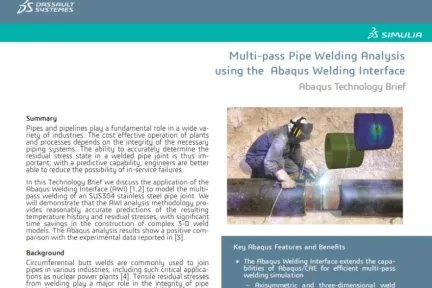
Multi-pass Pipe Welding Analysis using the Abaqus Welding Interface

In this Technology Brief we discuss the application of the Abaqus Welding Interface (AWI) to model the multipass welding of an SUS304 stainless steel pipe joint. We will demonstrate that the AWI analysis methodology provides reasonably accurate predictions of the resulting temperature history and residual stresses, with significant time stresses savings in the construction of complex 3-D weld models. The Abaqus analysis results show a positive comparison with the experimental data reported.

Tech Notes

Multi-pass Pipe Welding Analysis using the Abaqus Welding Interface
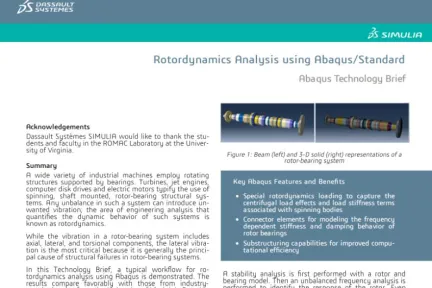
Rotordynamics Analysis using Abaqus/Standard

In this Technology Brief, a typical workflow for rotordynamics analysis using Abaqus is demonstrated. The results compare favorably witht those from industry-standard codes from the University of Virginia's Rotating Machinery and Controls Laboratory (commonly known as ROMAC). A substructuring application is also discussed

Tech Notes

Rotordynamics Analysis using Abaqus/Standard
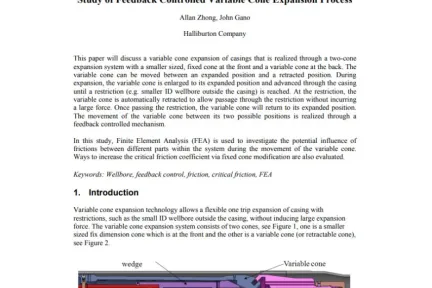
Study of Feedback Controlled Variable Cone Expansion Process

This paper will discuss a variable cone expansion of casings that is realized through a two-cone expansion system with a smaller sized, fixed cone at the front and a variable cone at the back. The variable cone can be moved between an expanded position and a retracted position. During expansion, the variable cone is enlarged to its expanded position and advanced through the casing until a restriction (e.g. smaller ID wellbore outside the casing) is reached. At the restriction, the variable cone is automatically retracted to allow passage through the restriction without incurring a large force. Once passing the restriction, the variable cone will return to its expanded position. The movement of the variable cone between its two possible positions is realized through a feedback controlled mechanism.

Customer Papers

Study of Feedback Controlled Variable Cone Expansion Process
Intermediate Crack Debonding Model of FRPStrengthened Concrete Beams Using XFEM

The use of fiber reinforced polymer (FRP) systems as externally bonded reinforcement has become very popular for the repair and strengthening of reinforced concrete (RC) structures as an alternative to the traditional techniques. One of the common failure modes of FRPstrengthened concrete beams is intermediate crack (IC) debonding of the FRP initiated at the tip of flexural or flexural/shear cracks in the substrate concrete; locations at which the interface is subjected to mixed-mode loading. This study presents a numerical analysis method using the extended finite element method (XFEM) implemented in Abaqus to model FRP intermediate crack debonding failure started at the tip of a flexural crack in a plain concrete beam specimen.

Customer Papers

Intermediate Crack Debonding Model of FRPStrengthened Concrete Beams Using XFEM
A Numerical Prediction of Particle Contaminations in the Seal Design for a Bearing by One Way Coupling

In recent years the tightening of fuel economy regulations and the trend towards environmentally friendly products increase demand for compact, lightweight and more efficient automotive transmissions. At the same time, the bearings in the transmission are always more often subject to harsh lubrication conditions. Contaminants in the lubricant have a strong lifereducing effect on rolling bearings. Past practices for protecting bearings from contamination include the use of lip seals make direct contact with raceway, but this solution lead to high frictional torque in the bearing system. Another practice includes the use of labyrinth isolators, but this solution also is not sufficient to prevent premature bearing failures due to contaminants.

Customer Papers

A Numerical Prediction of Particle Contaminations in the Seal Design for a Bearing by One Way Coupling
The Use of Abaqus in an Engine Bearing Design Environment

Abaqus is an integral part of the analysis process, proving data related to the structural stiffness of the housing, assembly deformations, inertia effects and journal/crankpin misalignment. This paper provides an overview of the different types of Abaqus analysis which have been developed and deployed in order to extract the required input data for SABRE-EHL. In addition to providing input data to SABRE-EHL, Abaqus can also be used to apply bearing pressures back onto the structural model. SABRE-EHL oil film pressures are mapped onto the Abaqus bearing mesh and used to perform a non-linear engine cycle analysis where housing stresses and detailed housing-bearing contact interactions can be investigated.

Customer Papers

The Use of Abaqus in an Engine Bearing Design Environment
260 Ergebnisse

Kundengeschichten

145 Ergebnisse
2 Ergebnisse

SIMULIA Selbstlernprogramm

Wir bieten Hunderte von Selbstlernmodulen an, damit jeder nach seinen eigenen Vorstellungen lernen kann

Blogs

Lesen Sie die neuesten Nachrichten und Innovationen unserer Experten auf dem SIMULIA Blog.

696 Ergebnisse

Vernetzen Sie sich mit SIMULIA

Erfahren Sie, was SIMULIA für Sie tun kann

Lassen Sie sich von unseren SIMULIA Experten zeigen, wie unsere Lösungen eine nahtlose Zusammenarbeit und nachhaltige Innovation in Unternehmen jeder Größe ermöglichen.

Erste Schritte

Wir bieten Kurse und Schulungen für Studierende, Hochschulen, Fachleute und Unternehmen an. Finden Sie die passende SIMULIA Schulung. 

Hilfe anfordern

Hier finden Sie Informationen zu Software- und Hardware-Zertifizierungen, Software-Downloads, Anwenderdokumentation, Support-Kontakten und Serviceangeboten