1506 Ergebnisse
ADVANS - A Strategic Collaboration for Airbus to Develop Advanced Numerical Simulation Capabilities

Advanced non-linear and vulnerability analyses are used today to support all phases of Airbus aircraft structures, especially the design and certification phases, by providing an understanding and an ever better prediction level of structural behavior. On the A350XWB program, numerical predictions have become key to ensuring a risk free major static test campaign. In the coming years, with the increased number of flying aircraft, the use of numerical capabilities will also grow to help resolve or prevent potential in-service issues. This paper presents an overview of selected ADVANS achievements reached so far and perspectives of the future.

Customer Papers
ADVANS - A Strategic Collaboration for Airbus to Develop Advanced Numerical Simulation Capabilities
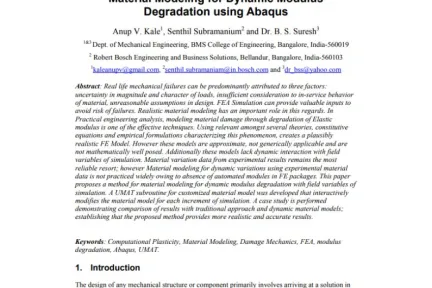
Material Modeling for Dynamic Modulus Degradation using Abaqus

Real life mechanical failures can be predominantly attributed to three factors: uncertainty in magnitude and character of loads, insufficient consideration to in-service behavior of material, unreasonable assumptions in design. FEA Simulation can provide valuable inputs to avoid risk of failures. Realistic material modeling has an important role in this regards. In Practical engineering analysis, modeling material damage through degradation of Elastic modulus is one of the effective techniques. Using relevant amongst several theories, constitutive equations and empirical formulations characterizing this phenomenon, creates a plausibly realistic FE Model. However these models are approximate, not generically applicable and are not mathematically well posed.

Customer Papers

Material Modeling for Dynamic Modulus Degradation using Abaqus
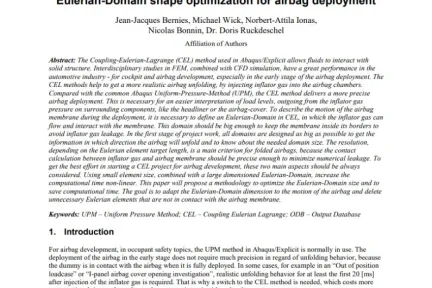
Eulerian-Domain shape optimization for airbag deployment

The Coupling-Eulerian-Lagrange (CEL) method used in Abaqus/Explicit allows fluids to interact with solid structure. Interdisciplinary studies in FEM, combined with CFD simulation, have a great performance in the automotive industry - for cockpit and airbag development, especially in the early stage of the airbag deployment. The CEL methods help to get a more realistic airbag unfolding, by injecting inflator gas into the airbag chambers. Compared with the common Abaqus Uniform-Pressure-Method (UPM), the CEL method delivers a more precise airbag deployment. This is necessary for an easier interpretation of load levels, outgoing from the inflator gas pressure on surrounding components, like the headliner or the airbag-cover.

Customer Papers

Eulerian-Domain shape optimization for airbag deployment
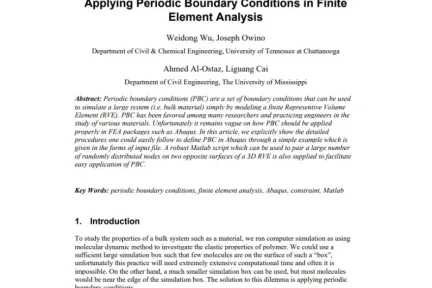
Applying Periodic Boundary Conditions in Finite Element Analysis

Periodic boundary conditions (PBC) are a set of boundary conditions that can be used to simulate a large system (i.e. bulk material) simply by modeling a finite Representive Volume Element (RVE). PBC has been favored among many researchers and practicing engineers in the study of various materials. Unfortunately it remains vague on how PBC should be applied properly in FEA packages such as Abaqus. In this article, we explicitly show the detailed procedures one could easily follow to define PBC in Abaqus through a simple example which is given in the forms of input file. A robust Matlab script which can be used to pair a large number of randomly distributed nodes on two opposite surfaces of a 3D RVE is also supplied to facilitate easy application of PBC.

Customer Papers

Applying Periodic Boundary Conditions in Finite Element Analysis
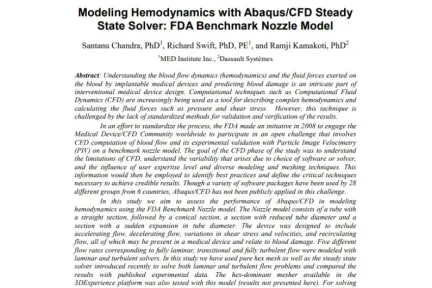
Modeling Hemodynamics with Abaqus/CFD Steady State Solver: FDA Benchmark Nozzle Model

In this study we aim to assess the performance of Abaqus/CFD in modeling hemodynamics using the FDA Benchmark Nozzle model. The Nozzle model consists of a tube with a straight section, followed by a conical section, a section with reduced tube diameter and a section with a sudden expansion in tube diameter. The device was designed to include accelerating flow, decelerating flow, variations in shear stress and velocities, and recirculating flow, all of which may be present in a medical device and relate to blood damage. In this study we have used pure hex mesh as well as the steady state solver introduced recently to solve both laminar and turbulent flow problems and compared the results with published experimental data.

Customer Papers

Modeling Hemodynamics with Abaqus/CFD Steady State Solver: FDA Benchmark Nozzle Model
Plastic Flow Modelling of a Hot-Rolling Manufacturing Procedure

During the qualification of a manufacturing technique, radiographic inspection revealed porosity in and around a weld. It was hypothesised that the cause of this porosity was associated with a previous manufacturing hot rolling procedure rather than an issue associated with the welding technique itself. The analysis demonstrated a mechanistic root cause of the initial porosity found during the radiography and this was substantiated by good correlation with a number of controlled manufacturing experiments. The sensitivity analysis helped to identify the key parameters to control during the hot rolling procedure. Further to this, the assessment improved the understanding of the procedure and helped to identify improvements for Non-Destructive Examination (NDE) by bounding the potential extent of the concern

Customer Papers

Plastic Flow Modelling of a Hot-Rolling Manufacturing Procedure
Modeling Approach Provides Optimal Retrieval Time to Minimize Core Decompression Damage

This paper presents a resolution to the challenge of finding the best core retrieval time by using Abaqus and Isight. A core retrieval effort is described by modeling an axisymmetric, finite-element representation of a core with pore fluid that is subjected to successively decreasing external porepressure boundary conditions and pressure loads. The modeling results are analyzed for the maximum pore-pressure difference and compared with rock strength criteria to predict potential core damage. The technique uses Isight to obtain the optimal retrieval time for given geometric and material parameters.

Customer Papers

Modeling Approach Provides Optimal Retrieval Time to Minimize Core Decompression Damage
Numerical Simulation of Nugget Formation in Spot Welding

This paper provides a finite element model to predict the nugget development during resistance spot welding of steel sheets. The model employs the coupled thermal-electricalmechanical analysis capability of Abaqus. The contact area and the interface pressure distribution are determined from a thermal-mechanical coupling in the analysis. The knowledge of interface pressure allows for accurate prediction of interfacial heat and electrical resistance, which have a dominant role in Joule heat generation. Temperature-dependent material properties for the coupled analysis are used. The significant parameters in the spot-welding process are current magnitude and frequency, welding time, sheet material and thickness, geometry of electrodes, and electrode force.

Customer Papers

Numerical Simulation of Nugget Formation in Spot Welding
Abaqus/Standard-based quantification of human cardiac mechanical properties

Computational modeling can provide critical insight into existing and potential new surgical procedures, medical or minimally-invasive treatments for heart failure, one of the leading causes of deaths in the world that has reached epidemic proportions. In this paper, we present our Abaqus/Standard-based pipeline to create subject-specific left ventricular models. We first review our generic left ventricular model, and then the personalization process based on magnetic resonance images. Identification of subject-specific cardiac material properties is done by coupling Abaqus/Standard to the python optimization library NL-Opt. Compared to previous studies from our group, the emphasis is here on the fully implicit solving of the model, and the two-parameter optimization of the passive cardiac material properties.

Customer Papers

Abaqus/Standard-based quantification of human cardiac mechanical properties
Geomechanical Optimization of Underground Gas Storage Operation

The paper presents the workflow used to assess fault slip risk during the UGS operation. The workflow starts with the construction of a 3D finite element model of the complex geology using Abaqus and is followed by coupling it to a reservoir flow model of the field. The results show that a strong pressure gradient in the field is one of the factors which impact the fault stability. Therefore, a balanced reservoir model is developed to control pressure on both sides of the fault. This model minimizes the risk of fault re-activation. A Monte Carlo simulation on the fault slip stability is performed to quantify the reliability of the prediction.

Customer Papers

Geomechanical Optimization of Underground Gas Storage Operation
Subsea Flowline-PLET-Jumper Integrated Abaqus Model

Oil and gas field development is moving into ever deeper waters to meet the world’s growing demand for energy. Subsea flowlines, jumpers and pipeline end terminals (PLETs) are the key components for a reliable and cost-effective subsea field development. Usually, the subsea flowline, jumper and PLET are designed and analyzed separately by different engineering groups using simplified end boundary conditions, and the interface loads from the flowline / jumper to PLET are obtained from de-coupled finite element (FE) models.This paper presents a comprehensive Abaqus model to more accurately analyze the subsea system collectively.

Customer Papers

Subsea Flowline-PLET-Jumper Integrated Abaqus Model
Abaqus Welding Interface - Isight integration for optimum weld-sequencing

Pipe joining by welding is a widely used process across many industries, including nuclear, pressure vessels, piping and oil & gas. The ability to accurately determine the residual stresses in a pipe joint is important for cost effective operation of plants. Weld sequence and direction plays important role in pipe welding process which has direct impact on residual stresses along with geometry of structure, weld material, type of weld joint, torch speed etc. The objective of this work is to identify the optimum weld sequence that results in minimum residual stresses. The application of Abaqus Welding Interface (AWI) to model multi pass welding of a stainless steel pipe joint is presented, demonstrating the integration of Isight and AWI to obtain optimum weld-sequencing for minimum residual stress distribution.

Customer Papers

Abaqus Welding Interface - Isight integration for optimum weld-sequencing
260 Ergebnisse

Kundengeschichten

145 Ergebnisse
2 Ergebnisse

SIMULIA Selbstlernprogramm

Wir bieten Hunderte von Selbstlernmodulen an, damit jeder nach seinen eigenen Vorstellungen lernen kann

Blogs

Lesen Sie die neuesten Nachrichten und Innovationen unserer Experten auf dem SIMULIA Blog.

696 Ergebnisse

Vernetzen Sie sich mit SIMULIA

Erfahren Sie, was SIMULIA für Sie tun kann

Lassen Sie sich von unseren SIMULIA Experten zeigen, wie unsere Lösungen eine nahtlose Zusammenarbeit und nachhaltige Innovation in Unternehmen jeder Größe ermöglichen.

Erste Schritte

Wir bieten Kurse und Schulungen für Studierende, Hochschulen, Fachleute und Unternehmen an. Finden Sie die passende SIMULIA Schulung. 

Hilfe anfordern

Hier finden Sie Informationen zu Software- und Hardware-Zertifizierungen, Software-Downloads, Anwenderdokumentation, Support-Kontakten und Serviceangeboten