1506 Ergebnisse
Material Modeling of Polylactide

Computational modeling of stents can provide insight into critical locations (high stress/strain regions), help with design iterations/optimization, and reduce the need for bench-top testing. This study focuses on the developmental efforts to create a material model that can capture the mechanical response of poly-L-lactide, the backbone of Abbott Vascular’s ABSORB Bioresorbable Vascular Scaffold.

Customer Papers
Material Modeling of Polylactide
High Performance Computing and CAE within a modern Engineering Environment

The state of the current automotive or heavy duty industries is changing rapidly, especially with the recent recession still in mind or to some extend still looming. In such an environment the competitiveness of a company is tested on every step. Engineering-based companies have to re-define their strategies, what means engineering to them.

Customer Papers

High Performance Computing and CAE within a modern Engineering Environment
Modelling an Advanced Gas-Cooled Reactor Core using ABAQUS

An irradiated graphite material UMAT subroutine models the through life behaviour of the core components, but the whole core structure is so large with many interactions that an ABAQUS model would normally put excessive demands on computational resources. However this difficulty has been overcome by making use of superelements and parallel programming.

Customer Papers

Modelling an Advanced Gas-Cooled Reactor Core using ABAQUS
Biomechanical study of a drop foot brace

A person specific drop foot brace was simulated in the commercial finite element code Abaqus.The geometry was imported from a 3D optical scan of the actual surface and modeled as a composite material layup defined in a local discrete material coordinate system. The finite element model was used in order to model the stance phase in a normal walking. The material choice is a challenging task giving flexibility to the brace together with sufficiently stiffness and fatigue strength. The simulation has been compared with measurements from a strain gauge mounted foot brace tested in use. Based on simulations, a large number of expensive trial and error iterations can be avoided. Simulations show a strong geometry interaction with the loading of the material.

Customer Papers

Biomechanical study of a drop foot brace
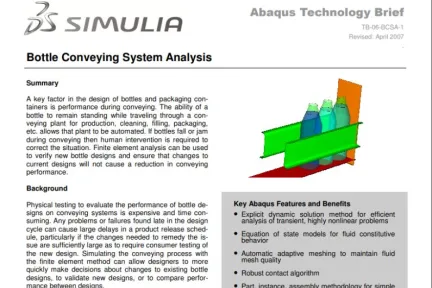
Bottle Conveying System Analysis

A key factor in the design of bottles and packaging containers is performance during conveying. The ability of a bottle to remain standing while traveling through a conveying plant for production, cleaning, filling, packaging, etc. allows that plant to be automated. If bottles fall or jam during conveying then human intervention is required to correct the situation. Finite element analysis can be used to verify new bottle designs and ensure that changes to current designs will not cause a reduction in conveying performance.

Solution Briefs

Bottle Conveying System Analysis
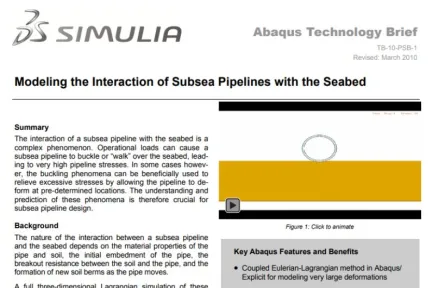
Modeling the Interaction of Subsea Pipelines with the Seabed

The interaction of a subsea pipeline with the seabed is a complex phenomenon. Operational loads can cause a subsea pipeline to buckle or “walk” over the seabed, leading to very high pipeline stresses. In some cases however, the buckling phenomena can be beneficially used to relieve excessive stresses by allowing the pipeline to deform at pre-determined locations. The understanding and prediction of these phenomena is therefore crucial for subsea pipeline design.

Solution Briefs

Modeling the Interaction of Subsea Pipelines with the Seabed
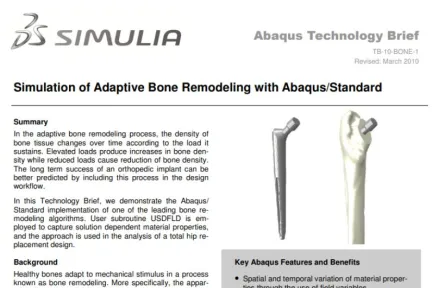
Simulation of Adaptive Bone Remodeling with Abaqus/Standard

In this Technology Brief, we demonstrate the Abaqus/ Standard implementation of one of the leading bone remodeling algorithms. User subroutine USDFLD is employed to capture solution dependent material properties, and the approach is used in the analysis of a total hip replacement design.

Solution Briefs

Simulation of Adaptive Bone Remodeling with Abaqus/Standard
Creep Analysis of Lead-Free Solders Undergoing Thermal Loading

Lead and its compounds have been widely used for many years in the electronics industry. However, the global demand to reduce the use of hazardous materials has compelled electronics manufacturers to consider lead-free materials in future products. This transition has heightened the necessity for new finite element material models that can be used to evaluate the reliability of lead-free solders. Along with extensive nonlinear analysis capabilities, Abaqus/Standard includes a variety of creep models, including those applicable to lead-free solders. It is thus an ideal design tool for the electronics industry.

Solution Briefs

Creep Analysis of Lead-Free Solders Undergoing Thermal Loading
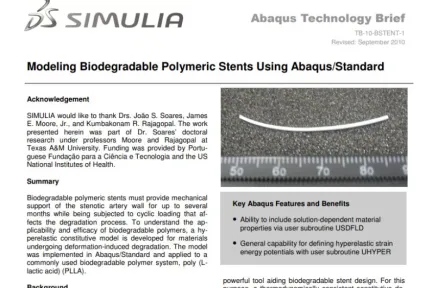
Modeling Biodegradable Polymeric Stents Using Abaqus/Standard

Biodegradable polymeric stents must provide mechanical support of the stenotic artery wall for up to several months while being subjected to cyclic loading that affects the degradation process. To understand the applicability and efficacy of biodegradable polymers, a hyperelastic constitutive model is developed for materials undergoing deformation-induced degradation. The model was implemented in Abaqus/Standard and applied to a commonly used biodegradable polymer system, poly (Llactic acid) (PLLA).

Solution Briefs

Modeling Biodegradable Polymeric Stents Using Abaqus/Standard
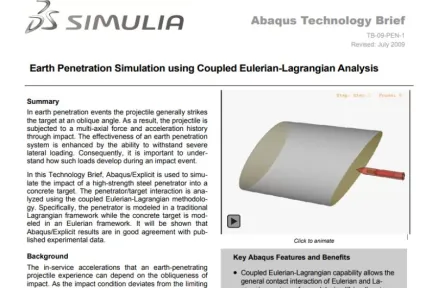
Earth Penetration Simulation using Coupled Eulerian-Lagrangian Analysis

In this Technology Brief, Abaqus/Explicit is used to simulate the impact of a high-strength steel penetrator into a concrete target. The penetrator/target interaction is analyzed using the coupled Eulerian-Lagrangian methodology. Specifically, the penetrator is modeled in a traditional Lagrangian framework while the concrete target is modeled in an Eulerian framework. It will be shown that Abaqus/Explicit results are in good agreement with published experimental data.

Solution Briefs

Earth Penetration Simulation using Coupled Eulerian-Lagrangian Analysis
Simulation of Composite Fatigue Delamination in a Mixed-Mode Setting

For many important applications, the principal failure mode in structures built with layered composite members develops from repeated cyclic loading. Fatigue simulation adds yet another layer complexity to composite delamination response, something that has been proven very difficult to simulate with any kind of accuracy and reliability. This work introduces an approach to fatigue simulation that promises to yield results compatible with the energetics of the problem, and hence throws light onto the processes that initiate and propagate composite fatigue damage and failure.

Customer Papers

Simulation of Composite Fatigue Delamination in a Mixed-Mode Setting
Buckling analysis for the long-term integrity evaluation of a hydrocarbon well

During the exploitation of a reservoir the displacements occurring in the near wellbore areas may induce mechanical actions on the well completions, including the steel casing and the cemented annulus, bringing to instability and failure of the well structure, with strong impacts on the economics of the field. The evaluation of the well completion integrity in the long-term is therefore a critical issue in the design phase.

Customer Papers

Buckling analysis for the long-term integrity evaluation of a hydrocarbon well
260 Ergebnisse

Kundengeschichten

145 Ergebnisse
2 Ergebnisse

SIMULIA Selbstlernprogramm

Wir bieten Hunderte von Selbstlernmodulen an, damit jeder nach seinen eigenen Vorstellungen lernen kann

Blogs

Lesen Sie die neuesten Nachrichten und Innovationen unserer Experten auf dem SIMULIA Blog.

696 Ergebnisse

Vernetzen Sie sich mit SIMULIA

Erfahren Sie, was SIMULIA für Sie tun kann

Lassen Sie sich von unseren SIMULIA Experten zeigen, wie unsere Lösungen eine nahtlose Zusammenarbeit und nachhaltige Innovation in Unternehmen jeder Größe ermöglichen.

Erste Schritte

Wir bieten Kurse und Schulungen für Studierende, Hochschulen, Fachleute und Unternehmen an. Finden Sie die passende SIMULIA Schulung. 

Hilfe anfordern

Hier finden Sie Informationen zu Software- und Hardware-Zertifizierungen, Software-Downloads, Anwenderdokumentation, Support-Kontakten und Serviceangeboten