1506 Ergebnisse
Achieving a more Accurate Prediction of a Polymer Snap Deformation Pattern

From simple geometry loading to virtual prototyping, this paper exemplifies the stepwise progress towards a successful match between load case, measurement setup and numerical model validation. It also deals with the gaps at the current numerical model availability and proposes optional enhancements.

Customer Papers
Achieving a more Accurate Prediction of a Polymer Snap Deformation Pattern
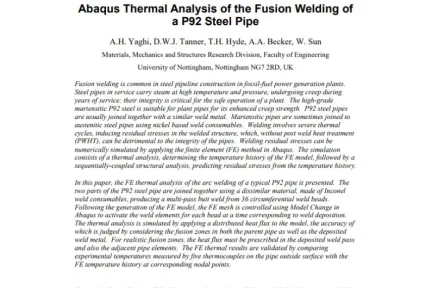
Abaqus Thermal Analysis of the Fusion Welding of a P92 Steel Pipe

In this paper, the FE thermal analysis of the arc welding of a typical P92 pipe is presented. The two parts of the P92 steel pipe are joined together using a dissimilar material, made of Inconel weld consumables, producing a multi-pass butt weld from 36 circumferential weld beads. Following the generation of the FE model, the FE mesh is controlled using Model Change in Abaqus to activate the weld elements for each bead at a time corresponding to weld deposition. The thermal analysis is simulated by applying a distributed heat flux to the model, the accuracy of which is judged by considering the fusion zones in both the parent pipe as well as the deposited weld metal. For realistic fusion zones, the heat flux must be prescribed in the deposited weld pass and also the adjacent pipe elements. The FE thermal results are validated by comparing experimental temperatures measured by five thermocouples on the pipe outside surface with the FE temperature history at corresponding nodal points.

Customer Papers

Abaqus Thermal Analysis of the Fusion Welding of a P92 Steel Pipe
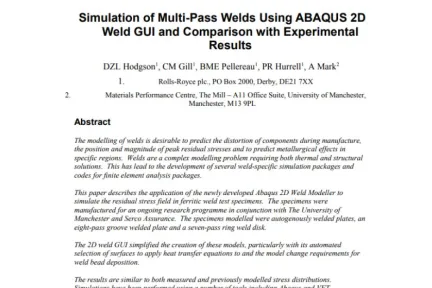
Simulation of Multi-Pass Welds Using ABAQUS 2D Weld GUI and Comparison with Experimental Results

This paper describes the application of the newly developed Abaqus 2D Weld Modeller to simulate the residual stress field in ferritic weld test specimens. The specimens were manufactured for an ongoing research programme in conjunction with The University of Manchester and Serco Assurance. The specimens modelled were autogenously welded plates, an eight-pass groove welded plate and a seven-pass ring weld disk.

Customer Papers

Simulation of Multi-Pass Welds Using ABAQUS 2D Weld GUI and Comparison with Experimental Results
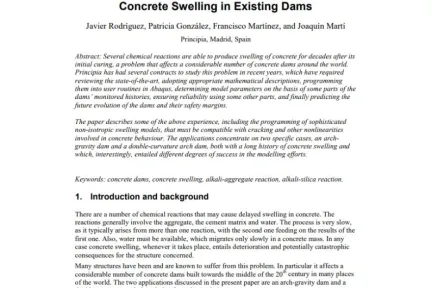
Concrete Swelling in Existing Dams

Several chemical reactions are able to produce swelling of concrete for decades after its initial curing, a problem that affects a considerable number of concrete dams around the world. Principia has had several contracts to study this problem in recent years, which have required reviewing the state-of-the-art, adopting appropriate mathematical descriptions, programming them into user routines in Abaqus, determining model parameters on the basis of some parts of the dams’ monitored histories, ensuring reliability using some other parts, and finally predicting the future evolution of the dams and their safety margins.

Customer Papers

Concrete Swelling in Existing Dams
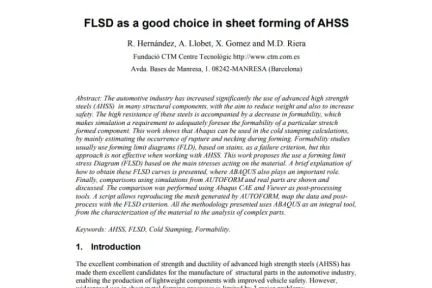
FLSD as a good choice in sheet forming of AHSS

The automotive industry has increased significantly the use of advanced high strength steels (AHSS) in many structural components, with the aim to reduce weight and also to increase safety. The high resistance of these steels is accompanied by a decrease in formability, which makes simulation a requirement to adequately foresee the formability of a particular stretch formed component. This work shows that Abaqus can be used in the cold stamping calculations, by mainly estimating the occurrence of rupture and necking during forming.

Customer Papers

FLSD as a good choice in sheet forming of AHSS
Marine Hose Non Linear Analysis Development

Some cases of loading were studied through Abaqus/Standard Analysis in order to validate the finite elements model according to the physical tests results made in marine hoses to transport oil considering several situations, such as reeling of the marine hose line in reel during the period of disuse and under hydrostatic pressure conditions. After validating the models, automated process of analysis were developed through the creation of plug-in in the interface Abaqus/CAE and the integration of Abaqus/CAE, Abaqus/Standard and Excel in the software Insight. These automated processes of analysis allow Abaqus to become an important tool in the marine hoses development, and also allow the Development and Research Engineering to analyze virtually several configurations before producing the prototype, reducing the costs of about millions of dollars.

Customer Papers

Marine Hose Non Linear Analysis Development
TEST AND NUMERICAL SIMULATION OF BIRD SYNTHETIC MODEL

Bird strike events are a potential dangerous problem faced by flight safety nowadays. These events are usually simulated through numerical approaches due mainly to the technical difficulties and high costs associated with experimental tests. Definition of structures within appropriate non-linear finite element codes is now well known and developed, however, bird models vary considerably between workers. Differences in density, shape and aspect ratio are easy to see. Differences in mechanical properties are not as transparent. Unless data to define analytical birds can be justified against viable sources, it is unlikely that certification of structures by analysis alone will be successful. Similar thoughts apply when considering substituting real birds for synthetic birds in testing.

Customer Papers

TEST AND NUMERICAL SIMULATION OF BIRD SYNTHETIC MODEL
Modeling of a Tactical Spike Strip for use at Checkpoints

It is sometimes necessary to strategically place temporary checkpoints in theatre. One such tool for creating an effective checkpoint is a deployable spike strip. One fault of the current system is that puncturing and deflating the tires may not be sufficient to bring the car to a halt. The U.S. Army proposed a request for improvement to design a new spike strip that actually causes the vehicle to come to a stop once the deployed system is rolled over. Tests of this new system are both costly to run and time consuming. A finite element simulation of the proposed system was created in Abaqus/Explicit to provide insight into how the system operated. Once set up, the model could then be used to down-select between subsequent iterations.

Customer Papers

Modeling of a Tactical Spike Strip for use at Checkpoints
3D Geomechanical Modeling of Complex Salt Structures

In this paper, we present the workflow starting from the structural information through the FE mesh creation and population of its properties to the final 3D finite element based geomechanical modeling. The resulting 3D stress field around salt structures helps to significantly improve the wellbore stability predictions. The workflow described provides an efficient way to create realistic 3D finite-element simulations from complicated structural data. It is optimized for the best resolution around the area of interest (well trajectory) while limiting the size of the numerical problem to an order that can be handled in reasonable times.

Customer Papers

3D Geomechanical Modeling of Complex Salt Structures
Numerical application of three-dimensional failure criteria for laminated composite materials

During the last twenty years, composite materials have gained great popularity in many applications such as aerospace, naval and wind turbines. Despite their wide use, the behaviour of composite materials still needs to be thoroughly investigated, especially during and after failure. Only a deep knowledge of these phenomena could maximize the benefit achieved by their use. Many failure criteria have been published in the last thirty years. Among them, the three-dimensional criteria (considering also the out of plane stress) have received particular attention. The present work has focused on the implementation of threedimensional failure criteria (Puck and Hashin 3D) in the commercial Finite Element program ABAQUS, using a USDFLD subroutine.

Customer Papers

Numerical application of three-dimensional failure criteria for laminated composite materials
Virtual Testing of Composites Using Abaqus

In this study Virtual testing was performed using both Abaqus/Standard and Abaqus/Explicit, using a dedicated user-defined material model developed at Fokker Landing Gear. In this material model the composite constituents (fibers and resin) are modelled as separate materials with their own specific material and failure behavior. The crucial interaction between the fibers and resin is accounted for using a new analytical approach. Damage between plies is accounted for using cohesive surfaces.

Customer Papers

Virtual Testing of Composites Using Abaqus
Spring Orthosis Analysis – Finite element modeling and optimization of a composite material

This paper covers finite element (FE) analysis and optimization of a spring orthosis, constructed from a pre-impregnated carbon-fibre epoxy composite material. The spring orthosis is one of the most advanced aids that are used in the orthopedist industry. The work has been performed in collaboration with Ortopedteknik, Borås Hospital, at FS Dynamics in Gothenburg.

Customer Papers

Spring Orthosis Analysis – Finite element modeling and optimization of a composite material
260 Ergebnisse

Kundengeschichten

145 Ergebnisse
2 Ergebnisse

SIMULIA Selbstlernprogramm

Wir bieten Hunderte von Selbstlernmodulen an, damit jeder nach seinen eigenen Vorstellungen lernen kann

Blogs

Lesen Sie die neuesten Nachrichten und Innovationen unserer Experten auf dem SIMULIA Blog.

696 Ergebnisse

Vernetzen Sie sich mit SIMULIA

Erfahren Sie, was SIMULIA für Sie tun kann

Lassen Sie sich von unseren SIMULIA Experten zeigen, wie unsere Lösungen eine nahtlose Zusammenarbeit und nachhaltige Innovation in Unternehmen jeder Größe ermöglichen.

Erste Schritte

Wir bieten Kurse und Schulungen für Studierende, Hochschulen, Fachleute und Unternehmen an. Finden Sie die passende SIMULIA Schulung. 

Hilfe anfordern

Hier finden Sie Informationen zu Software- und Hardware-Zertifizierungen, Software-Downloads, Anwenderdokumentation, Support-Kontakten und Serviceangeboten