There are 1489 results
Multi-Stage, Multi-Wellbore Hydraulic Fracturing Simulation in Naturally Fractured Reservoirs Using Cohesive Zone Model

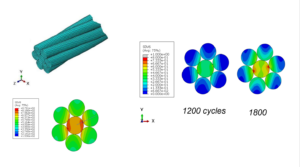
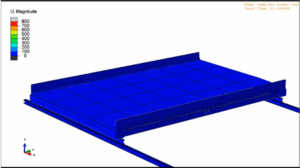
Microseismic surveys have demonstrated the abundance of natural fractures where shear slippage occurs due to hydraulic fracturing. These natural fractures and their intersection with hydraulic fractures significantly complicate the optimization of hydraulic fracturing strategies especially in shale resources with multiple simultaneous or sequential stimulation stages. The clusters’ hydraulic connection within a stage may substantially influence the hydraulic fracture propagation pattern considering the highly variable perforation efficiencies of clusters. These complexities promote the proposed developments in our poro-elastic cohesive zone models for hydraulic fracturing in Abaqus.

Tech Notes
Multi-Stage, Multi-Wellbore Hydraulic Fracturing Simulation in Naturally Fractured Reservoirs Using Cohesive Zone Model
SECURE, WEB-BASED ACCESS TO SIMULATION

As the world’s top OEMs can attest, simulation products are not created equal. Accurate, reliable, real-world results require a validated, proven simulation software package with years of research and development invested. These premier simulations demand significant computational hardware resources that are difficult and expensive to maintain. Simulation has become an absolute necessity to remain competitive in product design and engineering. To best optimize designs and contain development costs, engineers worldwide seek access to premium simulation software which, until now, may have been too costly to deploy internally.

Tech Notes

SECURE, WEB-BASED ACCESS TO SIMULATION
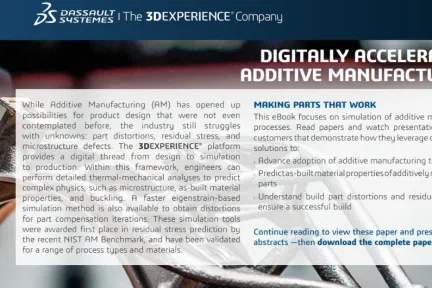
DIGITALLY ACCELERATING ADDITIVE MANUFACTURING

While Additive Manufacturing (AM) has opened up possibilities for product design that were not even contemplated before, the industry still struggles with unknowns: part distortions, residual stress, and microstructure defects. The 3DEXPERIENCE platform provides a digital thread from design to simulation to production. Within this framework, engineers can perform detailed thermal-mechanical analyses to predict complex physics, such as microstructure, as-built material properties, and buckling. A faster eigenstrain-based simulation method is also available to obtain distortions for part compensation iterations. These simulation tools were awarded first place in residual stress prediction by the recent NIST AM Benchmark, and have been validated for a range of process types and materials.

E-seminars

DIGITALLY ACCELERATING ADDITIVE MANUFACTURING
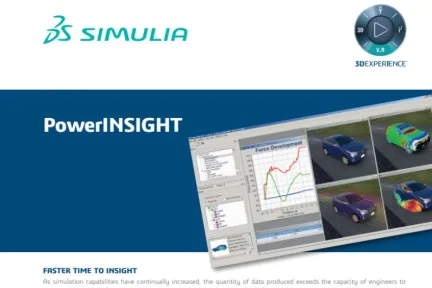
PowerINSIGHT

As simulation capabilities have continually increased, the quantity of data produced exceeds the capacity of engineers to extract meaningful information in a timely manner. Little time is available for thorough analysis in increasingly tight design schedules. A wealth of information is barely examined by engineers leaving tremendous value on the table. Even if precious time is taken to extract meaningful results, sharing this information across and between organizations takes significant additional time and effort. This can often cause either product development delays or suboptimal product quality.

Tech Notes

PowerINSIGHT
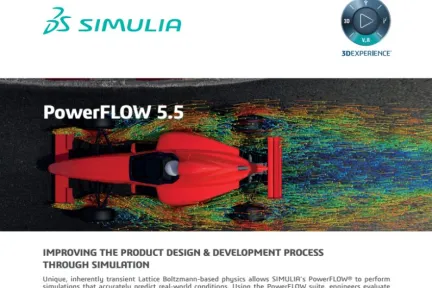
IMPROVING THE PRODUCT DESIGN & DEVELOPMENT PROCESS THROUGH SIMULATION

Unique, inherently transient Lattice Boltzmann-based physics allows SIMULIA’s PowerFLOW to perform simulations that accurately predict real-world conditions. Using the PowerFLOW suite, engineers evaluate product performance early in the design process prior to any prototype being built—when the impact of change is most significant for design and budgets.

Tech Notes

IMPROVING THE PRODUCT DESIGN & DEVELOPMENT PROCESS THROUGH SIMULATION
PowerTHERM

Thermal management is a critical aspect of vehicle design. When designing with ever-tight packaging and thermally sensitive electronics and plastics for weight reduction, components can exceed safe operating temperature limits and there is potential for systems to fail. Additionally, conditions can degrade nearby components leading to catastrophic durability, safety and warranty issues. Vehicle systems (such as the engine, transmission, HVAC, or power steering) have significant energy requirements and the related thermal efficiency has a direct impact on fuel economy, performance and passenger comfort. Careful analysis of cooling airflow, component placement and thermal shielding is required to avoid costly late-stage design fixes - or worse, failures in operation.

Tech Notes

PowerTHERM
THE DIGITAL CORE ANALYSIS LAB

DigitalROCK uses digital imaging and simulation to measure important rock properties accurately and efficiently. Multi-phase relative permeability and capillary pressure results are available in days instead of waiting months for physical lab testing. Faster access to more data reduces uncertainties, improves reservoir modeling, and informs key field planning and engineering decisions.

Tech Notes

THE DIGITAL CORE ANALYSIS LAB
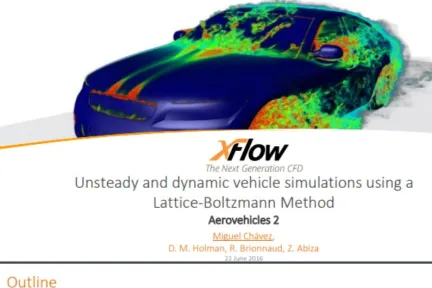
Direct Noise Computation with a Lattice-Boltzmann Method and Application to Industrial Test Cases

The Direct Noise Computation (DNC) approach is challenging in Computational Aero-Acoustics (CAA) since the computation of the pressure fluctuations requires the resolution of unsteady and compressible flows. Indeed, most numerical methods such as the finite volume and element methods face limitations to efficiently resolve the unsteady compressible Navier-Stokes equations for turbulent flows and the computational costs is extremely high. Instead, steady-state analysis with Reynolds-Averaged Navier-Stokes (RANS) turbulence modeling is generally preferred, however this prevents from a direct computation of the noise as only the mean pressure field is obtained. The use of artificial viscosity is also required to achieve numerical stability, which dampens the high frequency physics.

Tech Notes

Direct Noise Computation with a Lattice-Boltzmann Method and Application to Industrial Test Cases
There are 245 results

Customer stories

There are 129 results

From the communities

There are 6 results

SIMULIA Self Learning

We provide hundreds of self-learning modules so you can continue to learn at your convenience

Blogs

Read the SIMULIA blog on the latest news and innovations from our experts.

There are 694 results

Learn What SIMULIA Can Do for You

Speak with a SIMULIA expert to learn how our solutions enable seamless collaboration and sustainable innovation at organizations of every size.

Get Started

Courses and classes are available for students, academia, professionals and companies. Find the right SIMULIA training for you. 

Get Help

Find information on software & hardware certification, software downloads, user documentation, support contact and services offering