1506 Ergebnisse
Application of FMI in Metal Casting press-Forming Process

Accurate simulation of metal casting press-forming process needs to consider mutual coupling effects in a number of different fields of physics subsystem. Hydraulic systems, control systems and mechanical systems are the most important subsystems among them. It is difficult to create various subsystems in detail in a single modeling tools, so co-simulation technology is used to take advantage of different tools to achieve the entire physical process of system-level simulation. The paper researched the co-simulation in the Abaqus software and the Matlab software based on FMI standard, considered fully the coupling effect between different system, simulated the metal casting press-forming process. The simulation results showed that co-simulation based on FMI standard can be well suited for multi-disciplinary co-simulation in complex mechanical model, and played a well-guiding role in the engineering design. The co-simulation would take more computation time than traditional simulation, but it can be achieved to research the integrated features of system and to reduce greatly experiments costs and prototype trial risks by using this technology.

Customer Papers
Application of FMI in Metal Casting press-Forming Process
Quasi-static & Dynamic Spotweld Characterization for Automotive Crashworthiness Conditions

This paper presents an in-depth spotweld study that involves three different spotweld specimens: KSII; lap shear and peeling, for automotive steel grades and usual part thicknesses for each steel grade. The specimens are welded using automotive welding guns to ensure the representativeness of the samples following automotive standards during the manufacturing process. KSII specimen provides accurate information regarding the local spotweld properties. KSII specimen is tested considering three loading conditions: pure shear, pure tension, and 45 degree mixed-mode. Lap shear and peeling specimens represent the typical joining geometry for spotwelded steel parts (e.g. flange welding).

Customer Papers
Quasi-static & Dynamic Spotweld Characterization for Automotive Crashworthiness Conditions
Analysis of 3D Steel-Concrete Composite Buildings using Abaqus

Research on robustness analyses of steel-concrete composite building structures has been performed over the last two decades with few simplifications in composite building frame components. This is because the detailed modelling of the nonlinear behaviour of steelconcrete composite slabs and joints is rather tedious and involves interaction between floor beams, slab and beam-to-column joint behaviour. Past research on progressive collapse analysis of building frames has reported that full three-dimensional (3D) building frame analysis is computationally expensive and consumes substantial computational resources in order to predict the non-linear dynamic response of buildings.

Customer Papers

Analysis of 3D Steel-Concrete Composite Buildings using Abaqus
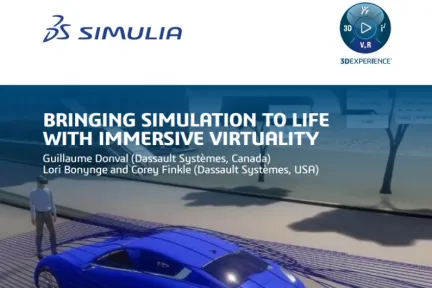
BRINGING SIMULATION TO LIFE WITH IMMERSIVE VIRTUALITY

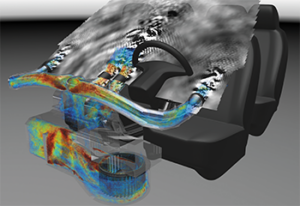
Immersive Virtuality allows us to observe things that simply cannot be seen in the real world, such as the cooling patterns of an additive manufacturing process, the under-the-hood deformation that occurs during a vehicle crash test, air flow around a jet engine, or even the blood flow through a beating human heart. By facsimileing these processes in an observable and measurable way, we can gain valuable insights for improvement, and share these findings in engaging and memorable ways. As a result, innovators can expect improved decision making, and findings, at each stage of the development process.

White Papers

BRINGING SIMULATION TO LIFE WITH IMMERSIVE VIRTUALITY
Modeling of Wave Propagation through Soft Electrically Tunable Metamaterials

In this paper, we present our numerical simulation capability, developed within the Abaqus/Standard environment, for modeling steady-state wave propagation through soft dielectric elastomer composites. Specifically, we will discuss (a) a nonlinear user-element subroutine (UEL) to simulate the coupled electric-displacement response of these soft materials, (b) a user MPC subroutine to enforce complex-valued Bloch-Floquet constraints, as well as to impose appropriate updated Lagrangian boundary conditions on the representative volume element (RVE), and (c) a method within the UEL to lower the dispersion error in the solution by modifying the mass matrix.

Customer Papers

Modeling of Wave Propagation through Soft Electrically Tunable Metamaterials
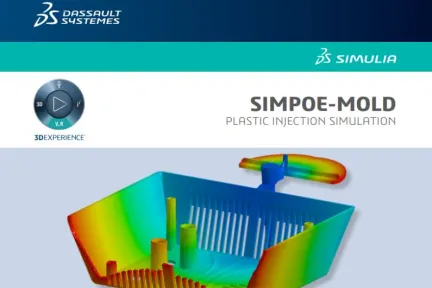
SIMPOE-MOLD PLASTIC INJECTION SIMULATION

For companies that design plastic parts or injection molds or manufacture plastic parts, SimpoeMold helps users predict and avoid manufacturing defects during the earliest stages of part and mold design, eliminating costly mold rework, improving part quality, decreasing time to market and optimizing production cycle times. The Simpoe-Mold plastic injection simulation solution is targeted towards all players involved in the plastic industry, whether they are product designers, mold designers, mold makers or plastic part manufacturers. Simpoe-Mold allows simulation with shell and solid mesh, with or without inserts, and it can handle complex shapes. Simpoe-Mold also allows simulation of more advanced processes, such as gas-assisted injection, co-injection molding, bi-refringance, overmolding, multishot or multi-domain injection.

Customer Papers

SIMPOE-MOLD PLASTIC INJECTION SIMULATION
Simulation of a Multi-pass Groove Weld and Clad Plate Using Abaqus 2D Weld GUI and Comparison with Measurements

The computer simulation of multiple layering of welds is necessary to determine the distortion and residual stresses from the welding process. The welding simulation requires thermal and structural solutions, which are usually carried out in two simulations. Once solved, the thermal transient model temperature results are read into the structural model to solve for component stresses.

Customer Papers

Simulation of a Multi-pass Groove Weld and Clad Plate Using Abaqus 2D Weld GUI and Comparison with Measurements
Automated framework to estimate probability of mechanical failure in handheld electronic devices

An automated framework for numerical simulation is developed to estimate the probability of brittle failure for a cell-phone display subjected to accelerated life cycle testing (ALT). SIMULIA Isight and the Abaqus-Python interface are used to predict the field-failure rate (FFR). The framework’s adaptable definition of inputs and output parameters can be extended to other common failures in handheld devices such as the denting and cracking of the housing walls, the cracking and delamination of the solder-joints in surface mounted devices, and the shock based criteria for packaged components.

Customer Papers

Automated framework to estimate probability of mechanical failure in handheld electronic devices
Analysis Tools for Accelerated Development of Composite Materials

Composite materials continue to rapidly improve in terms of structural performance. These materials offer the promise of significant weight reduction in many products—particularly aerospace structures, where weight minimization is critical to both cost and overall performance. Despite this potential, however, several challenges prevent composite materials from being used as widely and pervasively as traditional materials. Preliminary design concept evaluation of a structure with a novel material is difficult without a lengthy, expensive test program to provide the requisite material properties, but manufacturers are justifiably reluctant to invest this time and money without confidence that the material under consideration merits such expense.

Customer Papers

Analysis Tools for Accelerated Development of Composite Materials
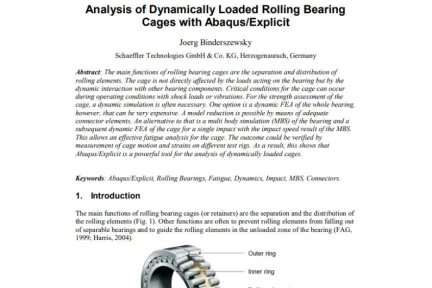
Analysis of Dynamically Loaded Rolling Bearing Cages with Abaqus/Explicit

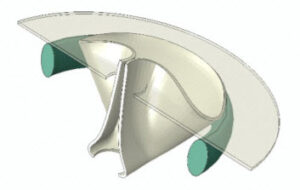
The main functions of rolling bearing cages are the separation and distribution of rolling elements. The cage is not directly affected by the loads acting on the bearing but by the dynamic interaction with other bearing components. Critical conditions for the cage can occur during operating conditions with shock loads or vibrations. For the strength assessment of the cage, a dynamic simulation is often necessary. One option is a dynamic FEA of the whole bearing, however, that can be very expensive. A model reduction is possible by means of adequate connector elements. An alternative to that is a multi body simulation (MBS) of the bearing and a subsequent dynamic FEA of the cage for a single impact with the impact speed result of the MBS. This allows an effective fatigue analysis for the cage. The outcome could be verified by measurement of cage motion and strains on different test rigs. As a result, this shows that Abaqus/Explicit is a powerful tool for the analysis of dynamically loaded cages.

Customer Papers

Analysis of Dynamically Loaded Rolling Bearing Cages with Abaqus/Explicit
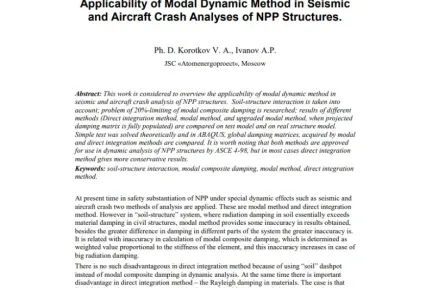
Applicability of Modal Dynamic Method in Seismic and Aircraft Crash Analyses of NPP Structures.

This work is considered to overview the applicability of modal dynamic method in seismic and aircraft crash analysis of NPP structures. Soil-structure interaction is taken into account; problem of 20%-limiting of modal composite damping is researched; results of different methods (Direct integration method, modal method, and upgraded modal method, when projected damping matrix is fully populated) are compared on test model and on real structure model. Simple test was solved theoretically and in ABAQUS, global damping matrices, acquired by modal and direct integration methods are compared. It is worth noting that both methods are approved for use in dynamic analysis of NPP structures by ASCE 4-98, but in most cases direct integration method gives more conservative results.

Customer Papers

Applicability of Modal Dynamic Method in Seismic and Aircraft Crash Analyses of NPP Structures.
260 Ergebnisse

Kundengeschichten

145 Ergebnisse
2 Ergebnisse

SIMULIA Selbstlernprogramm

Wir bieten Hunderte von Selbstlernmodulen an, damit jeder nach seinen eigenen Vorstellungen lernen kann

Blogs

Lesen Sie die neuesten Nachrichten und Innovationen unserer Experten auf dem SIMULIA Blog.

696 Ergebnisse

Vernetzen Sie sich mit SIMULIA

Erfahren Sie, was SIMULIA für Sie tun kann

Lassen Sie sich von unseren SIMULIA Experten zeigen, wie unsere Lösungen eine nahtlose Zusammenarbeit und nachhaltige Innovation in Unternehmen jeder Größe ermöglichen.

Erste Schritte

Wir bieten Kurse und Schulungen für Studierende, Hochschulen, Fachleute und Unternehmen an. Finden Sie die passende SIMULIA Schulung. 

Hilfe anfordern

Hier finden Sie Informationen zu Software- und Hardware-Zertifizierungen, Software-Downloads, Anwenderdokumentation, Support-Kontakten und Serviceangeboten