1506 Ergebnisse
Recent Applications of AbaqusExplicit in GM Chassis CAE

GM Chassis CAE has used ABAQUS successfully for many years. In the past most problems examined were more traditional durability and strength analyses of metallic structural components. Recently we have used ABAQUS/Explicit to great advantage to assess and solve for a wider range of component materials and loadings such as elastomers, sealing and impact. This presentation highlights some recent examples of these types of analyses, as well as sharing some general conclusions and lessons learned from these studies.

Customer Papers
Recent Applications of AbaqusExplicit in GM Chassis CAE
Arbitrary Normal and Tangential Loading Sequences for Circular Hertzian Contact

In this paper, analytical surface shear stress distributions for elastically similar spheres under quasi-statically applied normal and tangential loads are compared to those obtained using Abaqus/Standard 6.9. The agreement is quite good, with both methods predicting seemingly paradoxical features such as shear stress free portions of the contact zone, as well as non-zero shear stress distributions that result in zero net tangential force. The finite element results for elastically dissimilar spheres, for which no analytically-based solution exists, show significant differences in the shear stress distributions from those seen for elastically similar materials, due to the additional radially symmetric shear stress caused by the elastic dissimilarity.

Customer Papers

Arbitrary Normal and Tangential Loading Sequences for Circular Hertzian Contact
Linear Elastic Fracture Mechanics Analysis of Flaws within Residual Stress Fields

A procedure for calculating Linear Elastic Fracture Mechanics (LEFM) Stress Intensity Factors associated with postulated flaws located within regions of residual stress that result from large strain forming processes is presented. The procedure is validated by analyzing a structural system with residual stresses representative of a plane strain 3-point bending configuration, for which a known solution exists. The procedure is also applicable to the analysis of flaws in residual stress fields that result from in-service loads leading to large plastic strains, as illustrated by the determination of stress intensity factors associated with a postulated flaw in a deployed coronary stent.

Customer Papers

Linear Elastic Fracture Mechanics Analysis of Flaws within Residual Stress Fields
Adaptive 3D Remeshing for Metal Forming Simulation

An alternative remeshing methodology for 3D Abaqus explicit analyses which utilizes mesh mapping is presented. Excessive element distortion in 3D large deformation analyses necessitates remeshing, however in Abaqus explicit, the standard 3D remeshing techniques limits the analyst’s choice of element type. The presented technique allows remeshing of 3D perfectly plastic fully integrated higher order elements. The remeshing occurs in regions of high equivalent plastic strain or high equivalent plastic strain rate. The remeshing procedure maps the old boundary conditions, stress, and inelastic strain from the old distorted mesh.

Customer Papers

Adaptive 3D Remeshing for Metal Forming Simulation
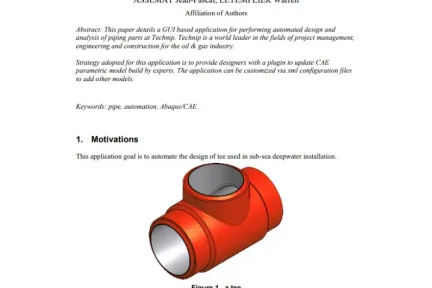
Tee Design Application

This paper details a GUI based application for performing automated design and analysis of piping parts at Technip. Technip is a world leader in the fields of project management, engineering and construction for the oil & gas industry. Strategy adopted for this application is to provide designers with a plugin to update CAE parametric model build by experts. The application can be customized via xml configuration files to add other models.

Customer Papers

Tee Design Application
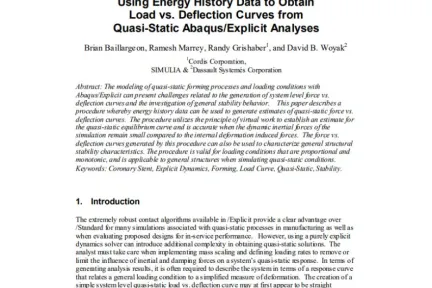
Using Energy History Data to Obtain Load vs. Deflection Curves from Quasi-Static AbaqusExplicit Analyses

The modeling of quasi-static forming processes and loading conditions with Abaqus/Explicit can present challenges related to the generation of system level force vs. deflection curves and the investigation of general stability behavior. This paper describes a procedure whereby energy history data can be used to generate estimates of quasi-static force vs. deflection curves. The procedure utilizes the principle of virtual work to establish an estimate for the quasi-static equilibrium curve and is accurate when the dynamic inertial forces of the simulation remain small compared to the internal deformation induced forces. The force vs. deflection curves generated by this procedure can also be used to characterize general structural stability characteristics. The procedure is valid for loading conditions that are proportional and monotonic, and is applicable to general structures when simulating quasi-static conditions.

Customer Papers

Using Energy History Data to Obtain Load vs. Deflection Curves from Quasi-Static AbaqusExplicit Analyses
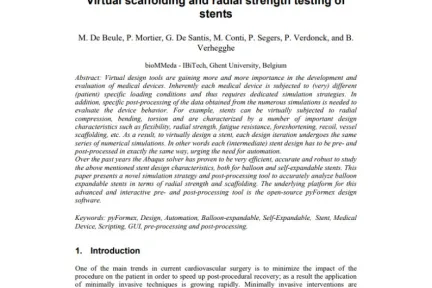
Virtual scaffolding and radial strength testing of stents

Over the past years the Abaqus solver has proven to be very efficient, accurate and robust to study the above mentioned stent design characteristics, both for balloon and self-expandable stents. This paper presents a novel simulation strategy and post-processing tool to accurately analyze balloon expandable stents in terms of radial strength and scaffolding. The underlying platform for this advanced and interactive pre- and post-processing tool is the open-source pyFormex design software.

Customer Papers

Virtual scaffolding and radial strength testing of stents
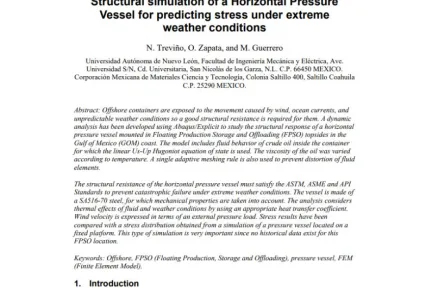
Structural simulation of a Horizontal Pressure Vessel for predicting stress under extreme weather conditions

Offshore containers are exposed to the movement caused by wind, ocean currents, and unpredictable weather conditions so a good structural resistance is required for them. A dynamic analysis has been developed using Abaqus/Explicit to study the structural response of a horizontal pressure vessel mounted in Floating Production Storage and Offloading (FPSO) topsides in the Gulf of Mexico (GOM) coast. The model includes fluid behavior of crude oil inside the container for which the linear Us-Up Hugoniot equation of state is used. The viscosity of the oil was varied according to temperature. A single adaptive meshing rule is also used to prevent distortion of fluid elements.

Customer Papers

Structural simulation of a Horizontal Pressure Vessel for predicting stress under extreme weather conditions
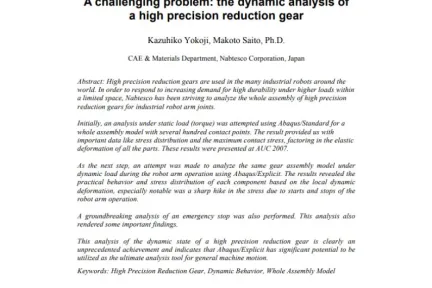
A challenging problem the dynamic analysis of a high precision reduction gear

High precision reduction gears are used in the many industrial robots around the world. In order to respond to increasing demand for high durability under higher loads within a limited space, Nabtesco has been striving to analyze the whole assembly of high precision reduction gears for industrial robot arm joints. Initially, an analysis under static load (torque) was attempted using Abaqus/Standard for a whole assembly model with several hundred contact points. The result provided us with important data like stress distribution and the maximum contact stress, factoring in the elastic deformation of all the parts.

Customer Papers

A challenging problem the dynamic analysis of a high precision reduction gear
Isight-Abaqus Optimization of a Ring-Stiffened Cylinder

Electric Boat’s design process involves evaluating the structural stability of ring-stiffened cylinder structures through finite element analyses to simulate a static pressure load. Each design revision of the cylinders must be evaluated to verify that the structure meets the required stress criteria for the static pressure load; any revision to geometry or material would require the design to be reevaluated. Additionally, it is critical that the weight of the structure is kept as light as possible while still satisfying all stress and deflection criteria. This presentation documents the use of Isight and Abaqus to perform a weight optimization for static pressure loading on a ring-stiffened cylinder, varying geometry and model thicknesses.

Customer Papers

Isight-Abaqus Optimization of a Ring-Stiffened Cylinder
Modeling of soils as multiphase-materials with Abaqus

Soils are mixtures of three phases, a porous soil skeleton of solid mineral particles and two fluids water and air filling the pores completely. The soil skeleton and the fluids can move depending on the constitutive behaviour of all constituents and interactions between them. In general a coupled deformation/seepage problem exists which can be uncoupled for certain circumstances. Mechanical models of soils are based on continuum mechanics or particle mechanics. The continuum approach requires a mixture theory, uncoupled problems require the classical continuum mechanics for single-phase materials only.

Customer Papers

Modeling of soils as multiphase-materials with Abaqus
Sensitivity Analyses of Structural Steel Connection Fire Performance

This paper presents results of finite element, thermal-stress analyses that investigate the effects of connection proximity with respect to adjacent columns and the extent of SFRM coverage. More specifically, the performance of a series of model configurations that vary in connection proximity and SFRM coverage were studied under exposure from a typical office fire. These parametric studies demonstrate that minor changes to a connection assembly may have a significant effect on its fire performance. In some cases, relatively simple connection detailing changes can enhance the overall structure’s fire resistance, even when SFRM coverage is not perfect.

Customer Papers

Sensitivity Analyses of Structural Steel Connection Fire Performance
260 Ergebnisse

Kundengeschichten

145 Ergebnisse
2 Ergebnisse

SIMULIA Selbstlernprogramm

Wir bieten Hunderte von Selbstlernmodulen an, damit jeder nach seinen eigenen Vorstellungen lernen kann

Blogs

Lesen Sie die neuesten Nachrichten und Innovationen unserer Experten auf dem SIMULIA Blog.

696 Ergebnisse

Vernetzen Sie sich mit SIMULIA

Erfahren Sie, was SIMULIA für Sie tun kann

Lassen Sie sich von unseren SIMULIA Experten zeigen, wie unsere Lösungen eine nahtlose Zusammenarbeit und nachhaltige Innovation in Unternehmen jeder Größe ermöglichen.

Erste Schritte

Wir bieten Kurse und Schulungen für Studierende, Hochschulen, Fachleute und Unternehmen an. Finden Sie die passende SIMULIA Schulung. 

Hilfe anfordern

Hier finden Sie Informationen zu Software- und Hardware-Zertifizierungen, Software-Downloads, Anwenderdokumentation, Support-Kontakten und Serviceangeboten